





Freckles
Freckles, medically called ephelides, are small, flat, light-brown to darker-brown spots that commonly appear on sun-exposed skin, especially the face, nose, cheeks, shoulders, arms, and upper chest.
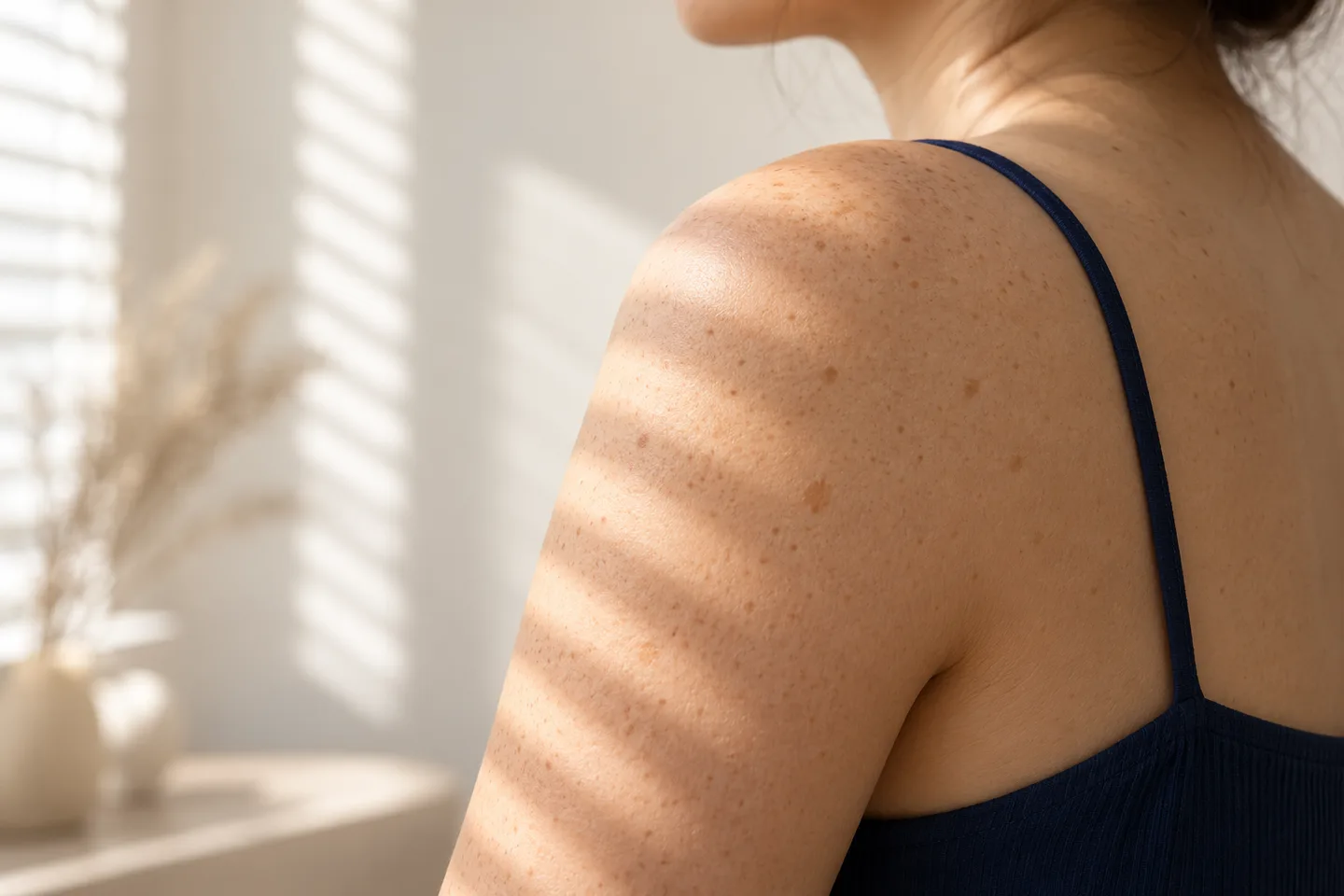
True freckles are benign and do not require medical treatment. They are strongly influenced by genetics and ultraviolet exposure, which is why they often become darker or more noticeable after sun exposure and may fade when sun exposure decreases.
For patients who want cosmetic improvement, treatment may include careful photoprotection and, in selected cases, pigment-targeting lasers or other procedures. However, not every small brown spot is a freckle. Solar lentigines, melasma, Post-Inflammatory Hyperpigmentation, moles, and occasionally suspicious pigmented lesions can look similar.
For this reason, accurate diagnosis is particularly important before treating an unusual, changing, or isolated pigmented spot with a laser.
What Are Freckles?
Freckles are small areas of increased pigmentation that usually develop on skin exposed to sunlight.
The medical term for a freckle is ephelis; multiple freckles are called ephelides.
They are usually:
- Flat
- Small
- Light brown to medium brown
- Relatively uniform in color
- More noticeable after sun exposure
- Located predominantly on sun-exposed skin
Common areas include:
- Nose
- Cheeks
- Forehead
- Shoulders
- Arms
- Upper chest
- Upper back
Freckles are caused by increased production of melanin, the pigment responsible for skin color.
Importantly, true freckles do not result from an increased number of melanocytes. Instead, the existing pigment-producing cells produce more pigment in affected areas.
Are Freckles Dangerous?
No. True freckles are benign.
They do not need to be removed for medical reasons and are commonly treated only when a patient wants cosmetic improvement.
However, there is an important distinction between saying that freckles are harmless and assuming that every brown spot is a freckle.
A melanoma, atypical mole, solar lentigo, pigmented actinic keratosis, or another pigmented lesion may occasionally be mistaken for a freckle.
The concern is therefore usually not that a true freckle will turn into cancer, but that an unusual pigmented lesion may be incorrectly assumed to be a freckle.
What Causes Freckles?
Freckles develop through an interaction between genetic susceptibility and ultraviolet radiation.
Some people have a strong inherited tendency to develop freckles. Sun exposure then stimulates melanocytes to produce additional melanin, making the spots more visible.
This explains why freckles may:
- Become darker during sunny periods
- Become more numerous or noticeable after sun exposure
- Fade during periods of reduced sun exposure
- Become less prominent with age in some people
Freckles cannot be completely prevented in someone who is genetically predisposed to them, but careful sun protection can reduce seasonal darkening.
Why Does Sunlight Make Freckles Darker?
Ultraviolet radiation stimulates melanin production.
When freckle-prone skin is exposed to sunlight, melanocytes increase pigment production, causing existing freckles to become darker and sometimes making previously subtle freckles more noticeable.
This is why sun protection is important even after successful cosmetic treatment.
Removing visible pigment does not remove the underlying genetic tendency to develop freckles.
In a sunny environment such as Bangkok and Thailand, ongoing photoprotection is particularly important for maintaining treatment results.
Who Is More Likely to Have Freckles?
Freckles can occur in different skin types and ethnic backgrounds, but genetic factors strongly influence their development.
They are particularly associated with:
- A family history of freckles
- Fairer skin phototypes
- Light hair or red hair
- Greater sensitivity to ultraviolet radiation
- Significant sun exposure
However, freckles also occur in Asian skin and should be distinguished from other common pigment disorders seen in Asian patients.
Freckles in Asian Skin
Pigmented lesions in Asian skin require thoughtful diagnosis because several conditions may look superficially similar.
Small brown spots on an Asian patient’s face may represent:
- Freckles
- Solar Lentigines
- Melasma
- Hori’s Nevus
- Post-Inflammatory Hyperpigmentation
- Seborrheic Keratosis
- Melanocytic Nevi
Asian skin may also be more prone to Post-Inflammatory Hyperpigmentation (PIH) following inflammation or certain cosmetic procedures.
This becomes particularly important when selecting laser settings or other pigment treatments. Reviews of laser treatment for pigmented lesions emphasize that treatment choice should account for the type and depth of pigmentation rather than treating all brown lesions identically.
What Do Freckles Look Like?
Typical freckles are:
- Flat
- Small
- Round or slightly irregular
- Light brown to brown
- Relatively uniform in color
- Multiple rather than solitary
- More prominent on sun-exposed areas
They usually do not:
- Bleed
- Ulcerate
- Become raised
- Cause persistent pain
- Develop multiple very different colors
- Change rapidly
A spot that behaves differently from surrounding freckles deserves further assessment.
Freckles vs Solar Lentigines: What Is the Difference?
Freckles and Solar Lentigines, commonly called sunspots or age spots, are not exactly the same condition.
Freckles
Freckles are strongly influenced by genetics and sunlight.
They often:
- Begin earlier in life
- Become darker after sun exposure
- Fade when sun exposure decreases
- Remain relatively small
Solar Lentigines
Solar Lentigines are associated more strongly with accumulated ultraviolet exposure over time.
They tend to:
- Become more common with age
- Occur on chronically sun-exposed areas
- Be larger and more sharply defined
- Persist rather than fading substantially during periods of reduced sunlight
The distinction matters because treatment response and recurrence patterns may differ.
Freckles vs Melasma
Freckles and melasma are different pigment disorders.
Freckles
Usually appear as multiple small individual brown spots.
Melasma
Usually appears as broader brown or gray-brown patches, commonly affecting:
- Cheeks
- Forehead
- Upper lip
- Nose
- Jawline
Melasma is influenced by sunlight, visible light, hormones, genetics, and changes within the skin.
Treating melasma as if it were a collection of freckles can lead to disappointing results or worsening pigmentation.
Freckles vs Post-Inflammatory Hyperpigmentation
Post-Inflammatory Hyperpigmentation (PIH) develops after inflammation or injury to the skin.
Examples include pigmentation following:
- Acne
- Eczema
- Insect bites
- Burns
- Scratching
- Cosmetic procedures
- Laser treatment
Freckles, in contrast, are not caused by previous inflammation.
Understanding the difference is important because PIH treatment focuses partly on controlling the underlying inflammatory trigger.
Freckles vs Moles
A typical freckle is a flat area of increased pigment.
A melanocytic nevus, or mole, represents a proliferation of melanocytes and has different biological characteristics.
Moles may be:
- Flat or raised
- Skin-colored, brown, black, or other colors
- Present from childhood or develop later
- Stable for many years
A lesion should not automatically be treated as a freckle simply because it is small and brown.
Can a Freckle Be Melanoma?
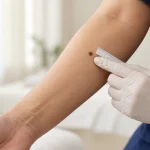
A true freckle is benign, but melanoma can sometimes resemble a new freckle, mole, or age spot.
This is one reason diagnosis should come before cosmetic destruction of an unusual pigmented lesion.
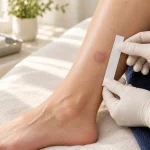
A useful warning system is the ABCDE rule:
A — Asymmetry
One half of the lesion looks different from the other.
B — Border
The border is irregular, poorly defined, or scalloped.
C — Color
There are multiple or uneven colors within the lesion.
D — Diameter
Melanoma is often larger than 6 mm when diagnosed, but importantly, it can also be smaller.
E — Evolving
The lesion changes in:
- Size
- Shape
- Color
- Surface
- Symptoms
A spot that looks distinctly different from a person’s other spots—the so-called “ugly duckling” concept—also deserves attention.
New or changing lesions, particularly those that itch, hurt, bleed, ulcerate, or repeatedly crust, should be evaluated rather than simply treated cosmetically.
How Does a Dermatologist Diagnose Freckles?
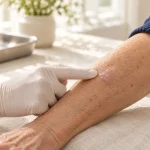
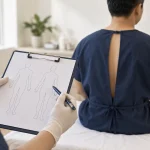
Typical freckles can usually be diagnosed clinically.
The dermatologist may assess:
- Size
- Shape
- Color
- Distribution
- Symmetry
- Relationship to sun exposure
- Age when the spots first appeared
- Changes over time
- Skin phototype
- Other pigmentation disorders
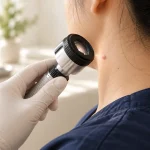
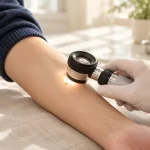
Dermoscopy may be useful when the diagnosis is uncertain or when a lesion needs to be distinguished from another pigmented condition.
A Skin Biopsy is not normally necessary for ordinary freckles.
However, if a particular lesion is atypical or suspicious, biopsy may be considered instead of cosmetic laser treatment. Pigmented lesions are usually diagnosed clinically, although histopathologic diagnosis is occasionally required.
Do Freckles Need Treatment?
No.
Freckles are benign and can simply be left untreated.
Treatment is generally cosmetic and should be based on the patient’s preference rather than medical necessity.
Options may include:
- Sun protection
- Cosmetic camouflage
- Selected topical pigmentation treatments
- Chemical Peels in selected situations
- Intense Pulsed Light
- Pigment-targeting lasers
The most appropriate treatment depends on whether the spots are actually freckles and on the patient’s skin type, pigmentation tendency, and expectations.
Sunscreen for Freckles
Sun protection is the foundation of managing freckles.
It can:
- Reduce darkening of existing freckles
- Reduce stimulation of new visible pigmentation
- Help maintain results after treatment
- Reduce cumulative ultraviolet damage
Broad-spectrum SPF 50+ protection is recommended for ephelides.
Practical measures include:
- Apply broad-spectrum sunscreen every morning
- Use sufficient sunscreen
- Reapply during prolonged outdoor exposure
- Reapply after swimming or heavy sweating
- Use hats and shade when practical
- Avoid intentional tanning
For patients living in or visiting Bangkok, protection should continue even after the freckles have faded following treatment.
Can Creams Remove Freckles?
Topical pigmentation treatments may lighten freckles to some degree, but results are generally less predictable than treatment of some other forms of hyperpigmentation.
Depending on the patient’s overall pigmentation pattern, topical agents sometimes used in pigmentation management include:
- Retinoids
- Azelaic Acid
- Hydroquinone in appropriate cases
- Vitamin C
- Other Tyrosinase inhibitors
However, topical treatment should not automatically be prescribed simply because a patient has brown spots.
The diagnosis should first be established, particularly when there are only one or a few unusual lesions.
Can Chemical Peels Treat Freckles?
Superficial Chemical Peels may improve some superficial pigmentation.
However, they affect broader areas of skin rather than selectively targeting individual freckles.
Potential side effects include:
- Redness
- Burning
- Irritation
- Peeling
- PIH
In Asian and darker skin phototypes, the risk of treatment-induced pigmentation needs to be considered carefully.
Chemical Peels may therefore be useful in selected patients but are not automatically the most precise option for discrete freckles.
Can IPL Treat Freckles?
Intense Pulsed Light (IPL) uses filtered broad-spectrum light rather than a single laser wavelength.
It can target melanin and may be useful when numerous superficial pigmented spots are distributed across a larger area.
Potential advantages include treating multiple lesions relatively efficiently.
Limitations include:
- Treatment response varies
- Several sessions may sometimes be required
- Redness or temporary darkening may occur
- PIH can occur
- Recurrence is possible with continued sun exposure
Correct diagnosis remains important because IPL should not be used indiscriminately on unidentified pigmented lesions.
Laser Treatment for Freckles
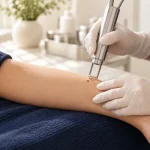
Pigment-targeting lasers are among the procedural options for patients who want freckles lightened.
Laser energy is absorbed by melanin within the pigmented lesion, allowing selective disruption of pigment while attempting to minimize injury to surrounding tissue.
Several laser wavelengths and technologies have been used for freckles.
Examples include:
- Q-Switched 532 nm lasers
- Q-Switched Nd:YAG systems
- Q-Switched Alexandrite Laser
- Picosecond lasers
- Other pigment-targeting systems
The appropriate wavelength and settings depend on:
- Pigment color
- Pigment depth
- Skin phototype
- Treatment area
- Previous treatment history
- Risk of PIH
A review of benign melanocytic lesion treatment emphasizes that laser selection should depend on the specific lesion and location of pigment within the skin.
Q-Switched Laser for Freckles
Q-Switched lasers deliver very short pulses of energy that can target melanin.
A randomized split-face trial comparing a 532 nm Q-Switched laser with intradermal Tranexamic Acid for facial freckles found greater improvement on the laser-treated side. However, some participants developed PIH, illustrating why effectiveness and pigment-related risks both need to be considered.
This is particularly relevant when treating Asian or darker skin.
Picosecond Laser for Freckles
Picosecond Laser systems deliver energy in extremely short pulses and can target pigment using different wavelengths.
Randomized studies in Asian patients have shown that picosecond systems can significantly improve freckles, although outcomes depend on wavelength, device, treatment settings, and patient characteristics.
A 2026 randomized multicenter study of 532 nm picosecond treatment also demonstrated substantial short-term improvement in freckles, while emphasizing the need for longer-term safety data.
This does not mean that every patient requires a picosecond laser or that newer technology automatically produces better results.
Correct diagnosis and appropriate treatment parameters remain more important than the device name alone.
Is Pico Laser Better Than Q-Switched Laser for Freckles?
There is no universal answer.
Both technologies can target superficial melanin effectively.
Treatment choice depends on:
- Skin phototype
- Type of pigmentation
- Wavelength
- Fluence
- Spot size
- Pulse characteristics
- Previous PIH
- Number and distribution of lesions
- Operator experience
Patients should be cautious of claims that one laser technology is always “the best” for every type of pigmentation.
What Happens During Laser Treatment for Freckles?
The exact procedure depends on the device, but treatment commonly involves:
- Confirming that the lesions are appropriate for cosmetic treatment
- Cleaning the skin
- Eye protection
- Laser treatment directed at selected lesions
- Cooling or post-procedure care as appropriate
- Instructions regarding skincare and sun protection
Patients may feel:
- Brief stinging
- Snapping sensations
- Heat
The treated freckles may temporarily become darker before gradually fading.
What Is Recovery Like After Freckle Laser Treatment?
Recovery depends on the laser and treatment intensity.
Temporary changes may include:
- Redness
- Mild swelling
- Darkening of treated spots
- Fine crusting
- Mild tenderness or sensitivity
Pigmented spots may look darker before improving.
Patients should avoid picking or scratching treated areas because premature removal of crusts can increase the risk of PIH, hypopigmentation, infection, or scarring.
Aftercare After Freckle Treatment
After treatment, patients are generally advised to:
- Cleanse gently
- Avoid scrubbing
- Avoid picking crusts
- Use moisturizer as directed
- Avoid unnecessary irritating skincare
- Use broad-spectrum sunscreen
- Minimize excessive sun exposure during healing
- Follow procedure-specific instructions
Sun protection is especially important because ultraviolet exposure can darken pigmentation and contribute to recurrence.
Can Freckles Return After Laser?
Yes.
This is one of the most important expectations to understand before treatment.
Laser can reduce the pigment that is visible at the time of treatment, but it does not remove the genetic tendency to form freckles.
New freckles may develop and previously treated areas may become pigmented again after ultraviolet exposure.
Pigment laser treatment may produce temporary lightening rather than guaranteeing permanent removal.
Therefore, long-term sun protection is important even when the initial laser result is excellent.
How Many Laser Sessions Are Needed?
There is no universal number.
Some freckles may respond substantially after a limited number of treatments, while others require additional sessions.
The number depends on:
- Number of freckles
- Pigment density
- Skin phototype
- Laser type
- Treatment parameters
- Previous treatment
- Individual response
- Sun exposure after treatment
Patients should be cautious of guarantees that all freckles will disappear permanently after a fixed number of sessions.
Possible Side Effects of Freckle Treatment
Depending on the procedure, possible side effects include:
- Redness
- Swelling
- Burning or tenderness
- Temporary darkening
- Crusting
- PIH
- Hypopigmentation
- Blistering
- Infection
- Prolonged pigment alteration
- Scarring
Most appropriately performed pigment procedures cause temporary rather than permanent effects, but complications are possible.
The risk depends on skin type, treatment method, energy settings, sun exposure, aftercare, and individual healing response.
Post-Inflammatory Hyperpigmentation After Laser
PIH is one of the most important concerns when treating pigmentation in Asian and darker skin.
It occurs when inflammation from treatment stimulates additional melanin production.
The treated area may initially appear improved and subsequently become darker.
Risk may increase with:
- Excessive treatment energy
- Excessive treatment overlap
- Skin irritation
- Recent tanning
- Significant sun exposure
- Picking crusts
- Previous tendency to develop PIH
A history of pigmentation after acne, wounds, peels, or previous laser treatment should therefore be discussed before treatment.
Can Laser Cause White Spots?
Yes, although this is less common.
Excessive injury to pigment-producing cells can potentially produce Hypopigmentation, in which treated skin becomes lighter than the surrounding skin.
This can be temporary or, less commonly, prolonged.
This is another reason pigment treatment should be appropriately matched to the patient’s skin type and lesion.
Can Freckle Laser Cause Scarring?
Scarring is possible but should be uncommon when an appropriate lesion is treated with suitable parameters and aftercare.
Risk can increase with:
- Excessive energy
- Significant blistering or burns
- Infection
- Picking or removing crusts
- Abnormal wound healing
Patients with a history of Keloid or unusual scarring should inform their dermatologist before undergoing a procedure.
Should Every Brown Spot Be Lasered?
No.
This is one of the most important safety principles in pigmentation treatment.
A laser destroys or alters the visible lesion. If a suspicious pigmented lesion is treated without proper diagnosis, it may delay appropriate investigation and make subsequent clinical assessment more difficult.
A lesion should therefore be medically assessed before cosmetic destruction when it is:
- New
- Changing
- Significantly different from surrounding spots
- Asymmetrical
- Irregularly bordered
- Multicolored
- Bleeding
- Ulcerated
- Persistently crusting
- Painful or itchy
- Growing
Evaluation is recommended for new, changing, unusual, itching, or bleeding pigmented lesions.
When Should You See a Dermatologist for Freckles?
Consider seeing a dermatologist when:
- You are unsure whether the spots are actually freckles
- One spot looks different from the others
- A spot is changing
- Pigmentation appeared suddenly
- You have several different types of pigmentation
- Previous laser treatment caused worsening pigmentation
- You have a history of significant PIH
- You are considering laser or IPL
- You want to distinguish freckles from melasma or sunspots
- A lesion bleeds, ulcerates, hurts, itches, or repeatedly crusts
A dermatology consultation is particularly valuable when diagnosis is uncertain.
What to Expect During a Freckle Consultation in Bangkok
Before recommending treatment, a dermatologist may assess:
- Whether the lesions are true freckles
- Whether Solar Lentigines are also present
- Whether there is melasma
- Whether PIH is present
- Skin phototype
- Number and distribution of lesions
- History of sun exposure
- Previous pigment treatments
- Previous laser or IPL
- History of PIH
- History of abnormal scarring
- Any atypical or suspicious pigmented lesions
Dermoscopy may be used when appropriate.
Treatment can then be selected according to the actual diagnosis rather than treating every brown spot in the same way.
Freckle Treatment in Bangkok for Tourists and International Patients
Patients visiting Bangkok for freckle treatment should consider their travel plans when scheduling procedures.
This is particularly relevant in Thailand because many visitors combine treatment with:
- Beach holidays
- Island trips
- Swimming
- Diving
- Golf
- Outdoor sightseeing
- Other prolonged sun exposure
If treatment causes temporary redness, crusting, or increased sun sensitivity, immediate intense outdoor exposure may not be ideal.
International patients should discuss:
- Length of stay in Bangkok
- Upcoming beach or outdoor activities
- Expected recovery
- Makeup use
- Swimming
- Sun exposure
- Need for follow-up
- Whether additional sessions may be required
Scheduling treatment at the beginning of an intense beach holiday may be less practical than arranging it when appropriate aftercare can be followed.
Freckles, Sun Exposure, and Long-Term Prevention
Freckles have a strong genetic component, so they cannot always be completely prevented.
However, ultraviolet protection can reduce how dark and noticeable they become.
Long-term strategies include:
- Daily broad-spectrum sunscreen
- Reapplication during significant outdoor exposure
- Hats and protective clothing
- Seeking shade when practical
- Avoiding intentional tanning
- Avoiding unnecessary ultraviolet exposure
For patients who undergo treatment, these measures also help maintain cosmetic improvement.
Frequently asked questions
What are freckles?
Freckles are small, flat areas of increased pigmentation, medically known as ephelides. They commonly occur on sun-exposed skin.
Are freckles dangerous?
True freckles are benign and do not require medical treatment.
Can freckles become skin cancer?
True freckles do not turn into melanoma. However, melanoma and other pigmented lesions can sometimes resemble a freckle, which is why unusual or changing spots should be assessed.
What causes freckles?
Freckles result primarily from genetic susceptibility combined with ultraviolet exposure.
Why do freckles get darker in the sun?
Ultraviolet radiation stimulates melanocytes to produce more melanin, making freckles more visible.
Can freckles disappear naturally?
They can become lighter when sun exposure decreases and may become less noticeable with age in some people.
What is the difference between freckles and sunspots?
Freckles are strongly genetically influenced and commonly fluctuate with sun exposure. Solar Lentigines are more strongly associated with cumulative sun damage and tend to persist.
What is the difference between freckles and melasma?
Freckles are usually small individual spots, while melasma typically produces larger symmetrical patches of pigmentation.
What is the difference between freckles and moles?
Freckles represent increased pigment production without an increased number of melanocytes, while melanocytic moles represent proliferations of melanocytes.
Can freckles be removed?
Freckles can often be lightened cosmetically, but permanent removal cannot be guaranteed because new pigmentation can develop with future sun exposure.
What is the best treatment for freckles?
There is no single best treatment for everyone. Sun protection is fundamental, while pigment-targeting lasers or IPL may be considered for cosmetic improvement after appropriate diagnosis.
Can creams remove freckles?
Some pigmentation treatments may lighten freckles, but response varies and topical treatment is not necessarily the most effective option for discrete lesions.
Can Chemical Peels remove freckles?
They may improve superficial pigmentation in selected patients but can cause irritation and PIH, particularly in pigmentation-prone skin.
Can IPL treat freckles?
Yes, IPL may be useful for multiple superficial pigmented spots in appropriately selected patients.
Can Q-Switched Laser treat freckles?
Yes. Q-Switched pigment lasers have been used successfully for ephelides, although PIH and other pigment changes can occur.
Can Pico Laser treat freckles?
Yes. Picosecond lasers have evidence supporting their use for freckles, including randomized studies in Asian patients.
Is Pico Laser better than Q-Switched Laser?
Not necessarily for every patient. Wavelength, skin type, diagnosis, treatment parameters, and clinician experience are all important.
Does freckle laser hurt?
Patients may experience brief stinging, snapping, or heat during treatment. Discomfort depends on the device and settings.
Will freckles become darker after laser?
Temporary darkening can occur before treated pigment fades.
How long is recovery after freckle laser?
Recovery varies by device and intensity. Temporary redness, darkening, sensitivity, or fine crusting may occur.
Can freckles come back after laser?
Yes. Laser does not remove the genetic tendency to develop freckles, and ultraviolet exposure can stimulate pigmentation again.
How many laser sessions do I need?
There is no fixed number for everyone. Treatment requirements depend on the lesions, skin type, device, settings, and individual response.
Can laser cause PIH?
Yes. PIH is an important potential complication, particularly in darker or pigmentation-prone skin.
Can laser cause white spots?
Yes. Hypopigmentation can occur if pigment-producing cells are excessively affected.
Can laser cause scars?
Scarring is possible but uncommon with appropriate patient selection, technique, and aftercare.
Should all freckles be removed?
No. Freckles are harmless and do not require treatment unless the patient wants cosmetic improvement.
Should a suspicious brown spot be lasered?
Not before appropriate evaluation. A suspicious lesion may require Dermoscopy or Skin Biopsy rather than cosmetic destruction.
What changes in a freckle should concern me?
A new or changing spot, asymmetry, irregular borders, multiple colors, growth, bleeding, ulceration, persistent itching, or a lesion that looks different from the others should be assessed.
Is sunscreen necessary after freckle treatment?
Yes. Sun protection helps reduce recurrent pigmentation and protects against additional ultraviolet damage.
Can Asian skin be treated for freckles?
Yes, but treatment should account for skin phototype and the increased importance of avoiding treatment-induced pigmentation.
Can tourists have freckle laser treatment in Bangkok?
Yes, when medically appropriate, but treatment timing should account for sun exposure, beach activities, swimming, recovery, and follow-up.
Related conditions
-
Melasma Melasma Melasma is a common acquired pigmentation disorder that causes symmetrical brown, gray-brown, or sometimes darker patches, most often on the cheeks, forehead, nose, upper lip, and jawline.
-
Sun Spots Sun Spots A sun spot is a common term for a flat brown mark that develops on sun-exposed skin. In dermatology, many of these spots are solar lentigines—benign areas of increased pigmentation associated with cumulative sun exposure.

-
Post-inflammatory Hyperpigmentation Post-inflammatory Hyperpigmentation Post-inflammatory hyperpigmentation (PIH) is the flat brown, dark brown, or grayish discoloration that remains after inflammation or injury to the skin. It commonly follows acne, eczema, insect bites, burns, scratching, irritation, and some dermatologic procedures.
-
Mole Check Mole Check Most moles are harmless. However, a new mole, a changing mole, or a spot that looks different from your other moles deserves closer attention.