















Skin Cancer & Mole Check
Screening, diagnosis and care plans for moles, suspicious lesions and skin cancer.
12 services
-
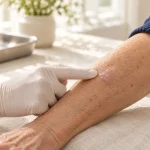
Actinic Keratosis / Precancerous Lesions Actinic Keratosis / Precancerous Lesions A rough, scaly spot that repeatedly crusts, feels tender, or does not heal may be more than simple dry or sun-damaged skin. Actinic keratosis (AK) is a precancerous skin lesion caused mainly by cumulative ultraviolet (UV) damage and is particularly important to recognize because some lesions can progress to cutaneous squamous cell carcinoma (SCC).
-
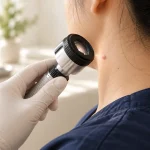
Basal Cell Carcinoma Basal Cell Carcinoma Basal cell carcinoma (BCC) is a common type of skin cancer that usually grows slowly and is most often found on sun-exposed skin. Although BCC rarely spreads to distant parts of the body, it can continue growing into surrounding skin and deeper structures if left untreated. Treatment is therefore recommended after the diagnosis is confirmed.
-
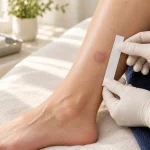
Bowen’s Disease Bowen's Disease Bowen’s disease, also called squamous cell carcinoma in situ, is an early form of squamous cell skin cancer in which abnormal cancerous cells remain confined to the outermost layer of the skin, the epidermis. Because the abnormal cells have not invaded into the deeper skin, Bowen’s disease is considered non-invasive. It is nevertheless a true form of skin cancer and should usually be treated or monitored because a small proportion of lesions can progress to invasive squamous cell carcinoma.
-
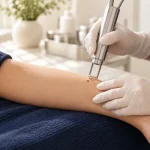
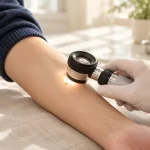
Dermoscopy Dermoscopy Dermoscopy is a non-invasive examination technique that allows a dermatologist to inspect skin lesions with greater detail than is possible with the naked eye alone.
-
Full Body Skin Examination Full Body Skin Examination A full body skin examination is a head-to-toe assessment of the skin performed to look for suspicious moles, abnormal growths, precancerous changes and signs of skin cancer.

-
High-Risk Skin Cancer Surveillance High-Risk Skin Cancer Surveillance High-risk skin cancer surveillance is structured, ongoing follow-up for people who have a higher-than-average risk of developing a new skin cancer or having a previous skin cancer return.

-
Histopathology Histopathology Histopathology is the microscopic examination of tissue to identify disease. In dermatology, this usually means examining a piece of skin removed during a skin biopsy or surgical excision.

-
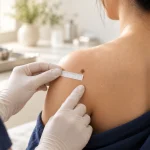
Melanoma Melanoma Melanoma is a serious type of skin cancer that develops from melanocytes, the cells that produce pigment in the skin. Unlike most basal cell carcinomas and many cutaneous squamous cell carcinomas, melanoma has a greater potential to spread to lymph nodes and other organs if it becomes invasive.
-
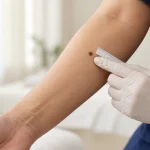
Mole Check Mole Check Most moles are harmless. However, a new mole, a changing mole, or a spot that looks different from your other moles deserves closer attention.
-
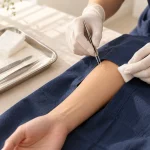
Skin Biopsy (การวินิจฉัย / Diagnosis) Skin Biopsy (การวินิจฉัย / Diagnosis) A skin biopsy is a minor medical procedure in which a dermatologist removes a small sample of skin so it can be examined under a microscope. It is one of the most important diagnostic tools in dermatology because many skin conditions cannot be confirmed by appearance alone.

-
Squamous Cell Carcinoma Squamous Cell Carcinoma Squamous cell carcinoma, often abbreviated as SCC, is a common form of skin cancer arising from squamous cells in the epidermis, the outer layer of the skin. It frequently develops on chronically sun-exposed areas such as the face, scalp, ears, lips, forearms and backs of the hands, although it can occur elsewhere.

-
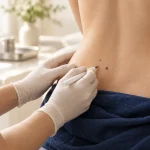
Suspicious Mole Assessment Suspicious Mole Assessment A suspicious mole assessment is a focused dermatology evaluation of a mole or pigmented skin lesion that is new, changing, unusual, bleeding, itching, or simply looks different from your other moles.
No conditions found.
Treatment articles
-
Aesthetic & Skin Rejuvenation XERF vs Ultraformer for Sagging Skin: Which Works Better for the Jawline and Jowls? A less defined jawline, sagging cheeks, and early jowls are among the most common concerns associated with facial aging. Many people want to restore a firmer, more defined lower face without undergoing surgery.
-
Aesthetic & Skin Rejuvenation XERF (Monopolar RF) for Skin Tightening: Who Is It Best For and How Long Do Results Last? Facial skin gradually loses firmness as we age. Collagen and elastin undergo structural changes, while facial fat, connective tissues, and bone support also change over time. Together, these processes contribute to sagging cheeks, early jowls, a less defined jawline, and loose skin beneath the chin.
-
Aesthetic & Skin Rejuvenation Ultraformer vs XERF: What’s the Difference and Which One Should You Choose? If you are considering facial lifting or skin tightening without surgery, you may have heard of Ultraformer and XERF. Both are energy-based treatments designed to improve skin firmness and reduce the appearance of mild to moderate sagging, but they use different technologies.

Connect With Our Care Team
Good skin care starts with a conversation
Leave your contact details, and our team will be happy to answer your questions and help arrange a convenient consultation.
Clear Skin Dermatology