

Sun Spots
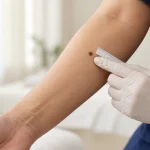
A sun spot is a common term for a flat brown mark that develops on sun-exposed skin. In dermatology, many of these spots are solar lentigines—benign areas of increased pigmentation associated with cumulative sun exposure.

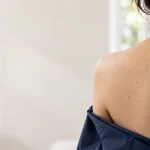
They commonly appear on the face, cheeks, temples, forehead, backs of the hands, shoulders, and other areas frequently exposed to sunlight.
Sun spots can often be improved with pigment-targeting laser, intense pulsed light (IPL), cryotherapy, chemical treatment, or topical medication. However, the first step should not automatically be laser treatment.
A brown spot should be diagnosed before it is destroyed.
Freckles, melasma, seborrheic keratoses, pigmented actinic keratoses, moles, and even early melanoma can sometimes resemble an ordinary sun spot. Dermatological guidelines recommend dermoscopic assessment and biopsy when the diagnosis is uncertain or there are concerning features.
For patients seeking sun spot treatment in Bangkok, another important consideration is skin type. Thai and other Asian skin can develop post-inflammatory hyperpigmentation (PIH) following overly aggressive laser, freezing, or other treatments, so treatment should be selected according to both the diagnosis and the patient’s pigment response.
What Is a Sun Spot?
The term “sun spot” is not a precise medical diagnosis.
When patients use this term, they often mean a solar lentigo—also called a solar lentigine, age spot, or liver spot.
Solar lentigines are:
- Flat
- Brown to dark brown
- Usually clearly visible against the surrounding skin
- Often round, oval, or slightly irregular
- Common on chronically sun-exposed areas
- Benign
They develop as ultraviolet exposure causes long-term changes in pigment-producing cells and surrounding skin structures.
Solar lentigines themselves do not require treatment for health reasons. Treatment is usually performed because the patient wants a more even skin tone.
What Causes Sun Spots?
The main factor is cumulative ultraviolet exposure.
Unlike a sunburn, which may result from one intense episode of sun exposure, solar lentigines generally reflect the effect of sunlight accumulated over many years.
Factors that may increase their likelihood include:
- Frequent sun exposure
- Living in a high-UV environment
- Outdoor occupations or activities
- Repeated tanning
- Increasing age
- Individual skin type and genetic tendency
- Previous sun damage
Bangkok and Thailand have substantial year-round sun exposure, so daily photoprotection is important not only after treatment but also for preventing new pigmentation.
Where Do Sun Spots Usually Appear?
Common locations include:
- Cheeks
- Temples
- Forehead
- Nose
- Upper chest
- Shoulders
- Forearms
- Backs of the hands
A spot located on sun-exposed skin is more likely to represent sun-related pigmentation, but location alone cannot establish the diagnosis.
What Does a Typical Sun Spot Look Like?
A typical solar lentigo may appear as:
- A flat brown patch
- Light brown to dark brown
- Clearly separated from surrounding skin
- Round, oval, or irregularly shaped
- Usually without pain or itching
Some solar lentigines have slightly uneven borders and can vary somewhat in color.
That is one reason visual inspection alone may occasionally be insufficient.
Atypical solar lentigines can be difficult to distinguish from melanoma in situ and other pigmented lesions, making dermoscopy or biopsy appropriate when there is uncertainty.
Sun Spot vs Freckle: What Is the Difference?
Freckles and solar lentigines are related to sunlight but are not identical.
Freckles
Freckles usually:
- Appear earlier in life
- Are small
- Become darker with sun exposure
- May fade when sun exposure decreases
- Often occur in people genetically prone to freckling
Solar Lentigines
Solar lentigines typically:
- Develop later
- Reflect cumulative sun damage
- Tend to remain visible throughout the year
- May become larger over time
- Usually do not disappear simply by avoiding sunlight
Freckles and lentigines also differ histologically: freckles mainly involve increased melanin production, whereas lentigines show an increased number of melanocytes along the basal epidermis.
Sun Spots vs Melasma
This distinction is especially important in Asian patients.
Both conditions produce brown facial pigmentation, but they behave differently.
Sun Spots
Solar lentigines are usually:
- Individual discrete spots
- Clearly separated from surrounding skin
- Associated with cumulative sun exposure
Melasma
Melasma more often appears as:
- Larger patches
- Symmetrical pigmentation
- Brown or gray-brown discoloration
- Commonly involving both cheeks, forehead, upper lip, or jawline
Melasma is influenced by more than UV exposure. Visible light, hormones, genetics, heat, and other factors may contribute.
The difference matters because a laser approach suitable for an isolated sun spot may not be appropriate for melasma.
Treating melasma as though it were a collection of individual sun spots can cause irritation or worsening pigmentation in susceptible patients.
Sun Spots vs Post-Inflammatory Hyperpigmentation
Post-inflammatory hyperpigmentation (PIH) develops after inflammation or injury.
Common triggers include:
- Acne
- Eczema
- Insect bites
- Burns
- Scratching
- Cosmetic procedures
- Laser treatment
A useful clue is the history.
If a brown mark appeared exactly where an inflammatory lesion had previously been, PIH may be more likely than a solar lentigo.
Again, treatment differs.
Sun Spots vs Seborrheic Keratosis
Seborrheic keratoses are common benign skin growths.
Early or flat seborrheic keratoses may sometimes appear simply as brown patches and can resemble sun spots.
As they develop, many become:
- Slightly elevated
- Waxy
- Rough
- “Stuck-on” in appearance
Pigmented seborrheic keratoses may also resemble melanocytic lesions.
When diagnosis is uncertain, the lesion should be assessed before cosmetic destruction.
Sun Spots vs Actinic Keratosis
Actinic keratosis is a sun-damaged lesion with potential to progress to squamous cell carcinoma.
Unlike a typical smooth solar lentigo, actinic keratosis often feels:
- Rough
- Scaly
- Dry
- Sandpaper-like
However, some actinic keratoses can also be pigmented and resemble brown spots.
Pigmented actinic keratosis is specifically among the conditions that can resemble a solar lentigo.
A new brown spot that is also persistently rough or scaly deserves dermatologic assessment rather than routine cosmetic pigment treatment.
Can a Sun Spot Actually Be Skin Cancer?
A typical solar lentigo is benign and does not become melanoma simply because it is a solar lentigo.
The problem is different:
Some skin cancers can look like an ordinary brown spot.
Conditions that may enter the differential diagnosis include:
- Melanoma in situ
- Lentigo maligna
- Pigmented basal cell carcinoma
- Pigmented Bowen disease
- Other melanocytic lesions
Dermatologists advise having apparent age spots evaluated because lesions including actinic keratoses and skin cancers can resemble them.
This becomes particularly important before laser treatment because laser destroys the target tissue and may make later histopathologic diagnosis more difficult.
Warning Signs: When a Brown Spot Should Be Checked Before Laser
See a dermatologist if a spot:
- Is new and looks different from your other spots
- Is growing
- Changes shape
- Changes color
- Has several colors within one lesion
- Has a very irregular border
- Becomes unusually dark
- Bleeds without being scratched
- Repeatedly crusts
- Becomes persistently itchy or painful
- Develops a new raised area
- Does not heal
- Looks noticeably different from surrounding spots
The ABCDE rule is useful for identifying possible melanoma:
A – Asymmetry: one half differs from the other.
B – Border: irregular or poorly defined edges.
C – Color: multiple colors within the lesion.
D – Diameter: melanoma is often larger than 6 mm when diagnosed, although it can be smaller.
E – Evolving: the lesion is changing in size, shape, or color.
Evolution and a lesion looking different from others are particularly important reasons for assessment.
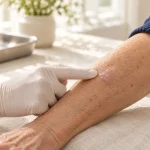
How Does a Dermatologist Diagnose a Sun Spot?
Diagnosis usually starts with a clinical examination.
A dermatologist considers:
- Color
- Shape
- Border
- Surface
- Distribution
- Number of lesions
- History of change
- Sun exposure
- Skin type
- Other pigmentation on the face
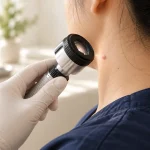
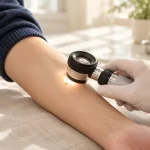
Dermoscopy
If necessary, the dermatologist may use dermoscopy, a magnified examination of structures beneath the skin surface.
Typical solar lentigines may show characteristic patterns under dermoscopy, such as fingerprint-like structures or a moth-eaten border.
Dermoscopy can help differentiate a benign sun spot from other pigmented lesions.
When Is a Biopsy Needed?
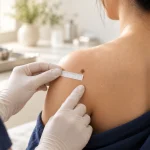
A skin biopsy may be recommended when:
- The diagnosis is uncertain
- Melanoma needs to be excluded
- A lesion has unusual pigmentation
- The lesion has changed
- Dermoscopic findings are atypical
Biopsy is recommended whenever there is diagnostic uncertainty or concern for malignancy.
In other words:
Diagnosis first. Cosmetic treatment second.
Do Sun Spots Need Treatment?
No.
A confirmed solar lentigo is benign and does not need removal for medical reasons.
Treatment is generally optional and performed for cosmetic improvement.
It is also perfectly reasonable to leave a typical solar lentigo untreated and simply monitor it.
What Is the Best Treatment for Sun Spots?
There is no universal best treatment.
Options include:
- Pigment-targeting laser
- Picosecond laser
- Q-switched laser
- IPL
- Cryotherapy
- Chemical peels
- Prescription or topical lightening treatments
- Combination treatment
A 2025 systematic review of 41 clinical trials involving treatments for solar lentigines found benefit from multiple modalities, including lasers, IPL, cryotherapy, topical therapies, and peels. The authors concluded that laser-based approaches were among the more effective treatments but emphasized variation among studies and the need for further high-quality trials.
The right treatment depends on:
- Whether the diagnosis is definitely a solar lentigo
- Number of spots
- Depth and amount of pigmentation
- Skin tone
- History of PIH
- Presence of melasma
- Desired downtime
- Previous treatments
- Sun exposure
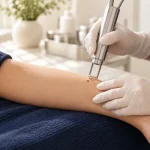
Laser Treatment for Sun Spots
Pigment-targeting lasers work by delivering energy that is absorbed preferentially by melanin.
The treated pigment is fragmented or damaged and gradually cleared as the skin heals.
Different laser systems use different wavelengths and pulse durations.
Examples used in pigment treatment include:
- Q-switched lasers
- Picosecond lasers
- Selected other pigment-specific laser systems
Not every brown lesion is appropriate for laser.
Laser treatment should be directed at a diagnosed benign pigmented lesion, not simply any dark spot.
Q-Switched Laser for Sun Spots
Q-switched lasers deliver very short pulses of energy that target pigment.
Depending on the wavelength, they may be used for selected solar lentigines.
Potential advantages include:
- Targeting individual spots
- Relatively quick treatment
- Minimal effect on surrounding areas when appropriately performed
Potential disadvantages include:
- Temporary darkening
- Crusting
- PIH
- Hypopigmentation
- Need for repeat treatment
- Recurrence or development of new sun spots
Clinical trials show benefit from Q-switched lasers, although response rates can vary considerably.
Picosecond Laser for Sun Spots
Picosecond lasers deliver pulses measured in trillionths of a second.
They are used for several pigment-related indications, including selected solar lentigines.
The extremely short pulse duration produces a strong photoacoustic effect that can fragment pigment.
Potential advantages may include:
- Precise pigment targeting
- Short treatment sessions
- Limited visible downtime in some treatment settings
Possible side effects still include:
- Redness
- Temporary darkening
- Crusting
- PIH
- Hypopigmentation
Picosecond technology should not be assumed to be superior simply because it is newer.
The appropriate wavelength, settings, diagnosis, skin type, and operator technique remain important.
Recent clinical trials of solar lentigo treatments reported favorable results with picosecond lasers, while also noting that treatment studies were heterogeneous.
IPL for Sun Spots
Intense Pulsed Light (IPL) is often grouped with laser treatments, but technically it is not a laser.
A laser typically produces a specific wavelength of light.
IPL delivers a broader spectrum of filtered light.
This can make IPL useful when a patient has multiple areas of superficial pigmentation spread across the face or other sun-exposed skin rather than one isolated lesion.
IPL may also influence:
- General photodamage
- Uneven pigmentation
- Some superficial vascular redness
Recent clinical trials found IPL among the better-performing treatment categories for solar lentigines.
Limitations of IPL
IPL is not appropriate for every brown lesion.
Caution is particularly important with:
- Darker skin
- Recent tanning
- Melasma
- PIH-prone skin
- Uncertain pigmented lesions
Incorrect settings may result in burns, PIH, or lightening of the skin.
Picosecond Laser vs IPL for Sun Spots
Neither is universally better.
Picosecond or pigment laser may be useful when:
- There are individual well-defined spots
- Targeted treatment is preferred
- A specific pigment target is appropriate
IPL may be useful when:
- There are many superficial brown spots
- Pigmentation is spread across a broader area
- General photoaging is also being addressed
But the patient’s skin type matters.
In a pigment-prone patient, a less aggressive strategy may sometimes be preferable to treating every visible spot strongly in one session.
Fractional Laser for Sun Spots
Fractional laser is sometimes used in photoaging treatment and may improve pigmentation as part of broader skin resurfacing.
However, for an isolated solar lentigo, a pigment-targeting approach may make more sense than treating a large area with fractional resurfacing.
Fractional CO2 laser has been evaluated in solar lentigo treatments, but reported responses were less impressive than several pigment-specific approaches.
Therefore, a patient with one or several distinct sun spots should not assume that Fractional CO2 is automatically the best laser simply because it is a stronger resurfacing procedure.
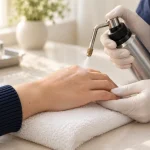
Cryotherapy for Sun Spots
Cryotherapy uses liquid nitrogen to freeze the pigmented lesion.
As the treated skin heals, pigmentation may lighten.
Advantages
- Quick procedure
- Does not require a laser
- Useful for selected individual spots
Limitations
Possible effects include:
- Pain
- Blistering
- Crusting
- Redness
- PIH
- Hypopigmentation
- Rare scarring
Cryosurgery is an established option for age spots, though permanent darkening or lightening is possible.
Cryotherapy is effective in some cases, though outcomes can be variable.
This is especially relevant in darker skin, where an apparently successful removal of brown pigment can occasionally be replaced by a conspicuous pale mark.
Chemical Peels for Sun Spots
Chemical peels use acids to create controlled exfoliation or injury.
Depending on the agent and depth, they may help:
- Superficial pigmentation
- Uneven skin tone
- Photodamaged skin
- Other superficial texture problems
However, chemical peels are not appropriate for every pigmented lesion.
Deeper or stronger peels also increase the potential for:
- Irritation
- Prolonged redness
- PIH
- Hypopigmentation
- Scarring
Chemical peels can improve solar lentigines, although outcomes tend to be less consistent than some laser-based treatments.
Topical Treatment for Sun Spots
Some solar lentigines can be lightened with topical treatment.
Options used in dermatology may include:
- Retinoids
- Hydroquinone
- Cysteamine
- Mequinol-containing treatment where available
- Other pigment-modulating agents
Topical retinoids and depigmenting creams are recognized options among non-procedural treatments for solar lentigines.
The advantage of topical treatment is that there is no laser wound.
The disadvantages are:
- Improvement is slower
- Daily adherence is necessary
- Irritation can occur
- Results may be incomplete
- Some medications are unsuitable for prolonged unsupervised use
Topical therapy is particularly useful when pigmentation is broader or when a patient wants to avoid procedural downtime.
Can Vitamin C Remove Sun Spots?
Vitamin C may help support a pigmentation skincare routine and is included among topical approaches for lentigines, but it should not be expected to reliably erase a well-established solar lentigo on its own.
For a discrete longstanding dark spot, procedural treatment may provide more noticeable improvement than cosmetic skincare alone.
Can Retinoids Help Sun Spots?
Topical retinoids can gradually improve pigmentation and photoaged skin.
They may be useful for:
- Mild sun-related pigmentation
- Uneven skin tone
- Broader photoaging
However, they work slowly.
Irritation can also worsen pigmentation in patients who are PIH-prone, so more is not necessarily better.
Is Hydroquinone Good for Sun Spots?
Hydroquinone can suppress melanin production and may lighten pigmentation.
However:
- It works gradually
- Irritation can occur
- It should not be used indefinitely without appropriate guidance
- It does not substitute for diagnosis of an uncertain brown lesion
A lesion that is changing or atypical should not simply be treated at home with a bleaching cream.
Why Skin Type Matters in Bangkok
Treatment of pigmentation in Thai and Asian skin requires particular attention to the skin’s response to inflammation.
After laser, freezing, peels, burns, or even acne, some patients develop PIH.
In practice, this means the treatment plan should balance:
How effectively can we remove the pigment?
with:
How much inflammation will this patient’s skin tolerate without creating new pigment?
The most aggressive treatment is not always the best treatment.
Sun Spots and PIH in Asian Skin
PIH is a dark mark that appears after skin inflammation.
It can occur after:
- Laser
- IPL
- Cryotherapy
- Chemical peeling
- Burns
- Picking crusts
- Other skin procedures
This is particularly frustrating in pigment treatment because the original sun spot may improve while a new inflammatory dark mark develops in its place.
Risk may be influenced by:
- Baseline skin tone
- Treatment energy
- Treatment density
- Number of passes
- Recent tanning
- Sun exposure after treatment
- Individual pigment tendency
- History of melasma
- Picking or scratching during healing
Sun Spots and Melasma Can Exist Together
This is common and clinically important.
A patient may have:
- Individual solar lentigines
- Background melasma
- Freckles
- PIH
all on the same face.
Treating every brown area identically may produce poor results because each type of pigmentation behaves differently.
For example, a laser spot may be appropriate for a clearly defined solar lentigo while the surrounding melasma requires a more conservative pigment-control strategy.
This is why a pigmentation consultation should evaluate the whole pattern of pigmentation, not just individual spots.
What Happens During Sun Spot Laser Treatment?
The exact procedure varies by laser.
Typically:
1. Diagnosis
The lesion is examined first.
Dermoscopy may be used when appropriate.
2. Photography
Baseline photographs may be useful for monitoring pigmentation and response.
3. Skin Preparation
Makeup and sunscreen are removed.
4. Treatment
Laser energy is delivered to the selected pigment.
Patients may feel a:
- Snap
- Sting
- Brief heat sensation
5. Immediate Reaction
The spot may:
- Look darker
- Become red
- Become mildly swollen
- Develop a fine crust later
These changes vary by laser and treatment intensity.
Is Sun Spot Laser Painful?
Most focal pigment laser treatments produce brief discomfort.
Patients may describe:
- Snapping
- Pricking
- Heat
- Stinging
Pain depends on:
- Device
- Treatment area
- Number of lesions
- Energy
- Individual sensitivity
Treatment of a few small spots is very different from treating a large area of photodamaged skin.
What Does a Sun Spot Look Like After Laser?
Depending on the laser, a treated spot may initially become darker rather than lighter.
This can be normal.
The pigment may subsequently:
- Darken
- Form a superficial crust
- Gradually flake away
- Fade as healing continues
Patients should avoid picking at the treated area because premature removal of crusts can increase the risk of PIH or scarring.
How Long Does Sun Spot Laser Take to Heal?
Recovery depends on:
- Type of laser
- Energy
- Size of lesion
- Number of lesions
- Skin type
- Treatment location
Some treatments cause mainly temporary redness and darkening.
Others produce visible crusting for several days.
It is more useful to ask about the specific device and treatment settings than to assume every “sun spot laser” has the same downtime.
How Many Treatments Are Needed?
There is no fixed number.
Some well-defined superficial spots may respond substantially to a small number of treatments, while others require repeat sessions.
Factors include:
- Pigment depth
- Lesion thickness
- Laser type
- Skin tone
- Previous treatment
- Treatment intensity
- Healing response
If a presumed sun spot does not respond as expected, the diagnosis should also be reconsidered rather than repeatedly increasing treatment strength.
Can Sun Spots Come Back?
Yes.
Two different things can happen.
The treated spot can recur
Pigmentation may gradually return in the same area.
New spots can develop
This is especially common when there is continued UV exposure and background sun damage.
Strict sun protection reduces the development of new solar lentigines and may reduce recurrence after treatment.
Can Sun Spots Be Permanently Removed?
A treated solar lentigo may clear very well, but it is not responsible to promise permanent removal.
Sun-damaged skin remains capable of developing additional pigmentation.
Long-term management therefore includes both:
Treatment of existing pigmentation + prevention of future UV damage.
Sun Protection After Sun Spot Treatment
Sun protection is essential after treatment.
Dermatological recommendations include:
- Broad-spectrum sunscreen
- SPF 30 or higher
- Water resistance
- Shade
- Protective clothing
- Hats
for preventing further age spots and protecting treated skin.
In Thailand, this matters particularly because incidental UV exposure can occur during everyday activities, not only at the beach.
Can I Go to the Beach After Sun Spot Laser?
It is generally sensible to avoid intensive sun exposure while the skin is healing.
If treatment produces crusting, blistering, or disrupted skin, swimming may also need to be postponed.
For tourists planning to visit:
- Phuket
- Krabi
- Koh Samui
- Pattaya
- Other beach destinations
it may be better to plan stronger pigment procedures at a time when post-treatment sun exposure can be minimized.
Sun Spot Treatment for Tourists in Bangkok
For international patients, treatment choice should take the travel schedule into account.
Before treatment, consider:
- How long are you staying in Bangkok?
- Will the treatment leave visible crusting?
- Can you avoid strong sun?
- Are you traveling to a beach afterward?
- Do you need follow-up?
- Will repeat sessions be needed?
- What should you do if PIH develops after returning home?
For a patient staying only a few days, the most aggressive possible treatment may not necessarily be the most practical option.
Sun Spot Treatment Side Effects
Possible temporary effects include:
- Redness
- Swelling
- Mild burning
- Darkening of the treated spot
- Crusting
- Tenderness
Potential complications include:
- PIH
- Hypopigmentation
- Blistering
- Infection
- Persistent redness
- Scarring
- Incomplete clearance
Destructive treatments such as laser or cryotherapy can occasionally result in lighter or darker areas after treatment.
Why Can a White Spot Appear After Treatment?
If treatment damages pigment-producing cells too strongly, the treated area may become lighter than the surrounding skin.
This is called hypopigmentation.
In darker skin, even a small pale patch can be more noticeable than the original brown spot.
For that reason, the goal is not simply to use enough energy to make the pigmentation disappear immediately.
Controlled treatment is usually more appropriate than excessive treatment.
How to Care for Skin After Sun Spot Treatment
Instructions vary according to treatment, but general principles include:
- Clean gently
- Avoid picking crusts
- Do not scrub treated skin
- Use moisturizer or wound care as instructed
- Avoid irritating acids temporarily when advised
- Pause retinoids when instructed
- Avoid strong sun
- Use appropriate sunscreen
- Avoid unnecessary heat or friction
- Follow instructions for makeup and exercise
Seek medical review if the area develops:
- Increasing pain
- Pus
- Spreading redness
- Significant blistering
- Abnormal swelling
- Delayed healing
Can Sun Spots Be Prevented?
Not completely, but sun protection can reduce further UV damage and the development of additional solar lentigines.
Useful measures include:
- Broad-spectrum sunscreen
- Regular reapplication when exposed
- Hats
- Shade
- UV-protective clothing
- Avoiding intentional tanning
- Avoiding unnecessary intense midday sun
Sun protection is particularly important after successful treatment because otherwise new pigmentation may gradually replace the spots that were removed.
Should I Use Sunscreen Even If I Already Have Sun Spots?
Yes.
Sunscreen may not erase established solar lentigines, but it serves several important functions:
- Helps prevent additional pigmentation
- Reduces ongoing photoaging
- Protects recently treated areas
- Supports management of other pigment conditions such as melasma and PIH
- Reduces UV-related skin damage
When Should You See a Dermatologist?
Consider assessment if:
- You are unsure whether a brown spot is a sun spot
- One spot looks different from the others
- A lesion is growing or changing
- A spot contains several colors
- The border is irregular
- It bleeds
- It crusts repeatedly
- It is rough or persistently scaly
- You have many different types of facial pigmentation
- You have melasma
- You previously developed PIH after laser
- Previous pigment treatments made your skin darker
- You want laser or IPL treatment
- You have a personal history of skin cancer
This is particularly important before destructive treatment.
What to Expect During a Pigmentation Consultation in Bangkok
A useful consultation should answer more than:
“Which laser should I use?”
The dermatologist should first determine:
“What is each brown spot?”
Assessment may include:
- Distribution of pigmentation
- Solar lentigines
- Freckles
- Melasma
- PIH
- Seborrheic keratoses
- Actinic keratoses
- Moles
- Atypical pigmented lesions
- Skin phototype
- History of PIH
- Previous laser treatment
- Sun exposure
- Current skincare
- Medications
- Travel plans
- Desired downtime
Dermoscopy may be useful for individual lesions.
If a spot is suspicious or uncertain, biopsy may be more appropriate than laser.
Only after diagnosis should the discussion move to treatment options such as laser, IPL, cryotherapy, topical therapy, or observation.
Sun Spot Treatments: Quick Comparison
| Treatment | Often considered for | Main advantage | Important limitation |
|---|---|---|---|
| Pigment-specific laser | Individual solar lentigines | Precise treatment | PIH or hypopigmentation possible |
| Picosecond laser | Selected pigmented spots | Short pigment-targeting pulses Not automatically best for every skin type | |
| Q-switched laser | Selected solar lentigines | Established pigment treatment | Crusting and pigment change possible |
| IPL | Multiple superficial spots/photoaging | Treats broader areas | Requires caution in darker or tanned skin |
| Cryotherapy | Selected individual spots | Quick treatment | White or dark marks can occur |
| Chemical peel | Superficial pigmentation | Broader skin treatment | PIH possible |
| Topical treatment | Mild/broader pigmentation | No procedural wound | Slower and often incomplete |
| Observation | Confirmed benign sun spots | No procedure risk | Pigmentation remains |
Q-switched laser Selected solar lentigines Established pigment
treatment
Crusting and pigment change possible
IPL Multiple superficial spots/photoaging Treats broader areas Requires caution in darker or tanned skin
Cryotherapy Selected individual spots Quick treatment White or dark marks can occur
Chemical peel Superficial pigmentation Broader skin treatment PIH possible
Topical treatment Mild/broader pigmentation No procedural wound Slower and often incomplete
Observation Confirmed benign sun spots No procedure risk Pigmentation remains
Frequently asked questions
What is a sun spot?
A sun spot commonly refers to a solar lentigo—a benign flat brown spot associated with cumulative sun exposure.
Are sun spots the same as age spots?
Usually yes.
“Age spot” and “sun spot” are commonly used names for solar lentigines.
Are sun spots the same as liver spots?
“Liver spot” is another traditional name for solar lentigines. They are not caused by liver disease.
Are sun spots dangerous?
A typical solar lentigo is benign. The important issue is that some other pigmented lesions, including melanoma, can sometimes look similar.
Can a sun spot turn into skin cancer?
A typical solar lentigo itself is benign. However, a lesion assumed to be a sun spot may occasionally be another diagnosis, which is why atypical lesions should be examined.
How can I tell whether a brown spot is melanoma?
Asymmetry, irregular borders, multiple colors, change over time, bleeding, or a lesion that looks different from others are warning signs. Suspicious lesions require medical assessment rather than self-diagnosis.
Should sun spots be checked before laser?
Yes, particularly if there is any diagnostic uncertainty. A suspicious pigmented lesion should not simply be destroyed by laser.
How does a dermatologist diagnose a sun spot?
Diagnosis is often clinical. Dermoscopy may be used, and biopsy can be performed when melanoma or another diagnosis needs to be excluded.
What is the best treatment for sun spots?
There is no universally best treatment. Pigment lasers, IPL, cryotherapy, topical treatment, and peels can all be considered depending on the lesion and the patient.
What laser is best for sun spots?
The appropriate laser depends on the diagnosis, pigment characteristics, skin tone, and PIH risk. Q-switched and picosecond pigment-targeting lasers are commonly studied options.
Is picosecond laser good for sun spots?
It can improve selected solar lentigines. However, treatment still needs to be adjusted for skin type and pigment characteristics.
Is Q-switched laser good for sun spots?
Yes, it is an established treatment for selected solar lentigines, although response and adverse effects vary.
Does IPL remove sun spots?
IPL can improve multiple superficial solar lentigines and other aspects of photodamage in appropriately selected patients.
Is IPL a laser?
No. IPL uses a broad spectrum of filtered light, whereas lasers use more specific wavelengths.
Which is better, IPL or picosecond laser?
Neither is universally better. Individual discrete spots may suit targeted pigment laser treatment, while IPL can be useful for broader areas containing multiple superficial lesions.
Can Fractional CO2 remove sun spots?
It may improve solar pigmentation as part of resurfacing, but it is not automatically the most appropriate treatment for individual solar lentigines.
Can sun spots be frozen?
Yes. Cryotherapy with liquid nitrogen can treat selected solar lentigines, although pigment changes can occur afterward.
Can chemical peels remove sun spots?
Chemical peels may improve superficial pigmentation, but results and risks depend on peel depth and skin type.
Can creams remove sun spots?
Topical medications can lighten some solar lentigines but generally work more slowly than procedural treatment.
Does hydroquinone work for sun spots?
It can lighten pigmentation in selected patients, but it should be used appropriately and does not replace medical evaluation of an uncertain lesion.
Does retinol remove sun spots?
Retinoid-based skincare may gradually improve photoaging and pigmentation, but a well-established solar lentigo may not disappear with retinol alone.
Can vitamin C remove sun spots?
Vitamin C may support treatment of uneven pigmentation but should not be expected to reliably remove a pronounced solar lentigo on its own.
Do sun spots go away naturally?
Established solar lentigines generally tend to persist, although pigmentation may vary over time.
Can sun spots come back after laser?
Yes. The treated pigmentation may recur and new sun spots can develop with further UV exposure.
Can sun spots be permanently removed?
Some spots can clear very well after treatment, but permanent clearance cannot be guaranteed and new lesions may develop.
How many laser sessions are needed?
It varies according to the lesion, device, skin type, and treatment intensity.
Do sun spots become darker after laser?
They can temporarily become darker before flaking or fading. The expected response depends on the laser used.
Does sun spot laser cause crusting?
Some pigment lasers produce temporary darkening and fine crusting.
Can laser cause PIH?
Yes. PIH is an important potential complication, particularly in pigment-prone skin.
Can laser cause white spots?
Yes. Excessive pigment-cell injury can cause hypopigmentation.
Is sun spot laser safe for Asian skin?
It can be used in Asian skin, but device selection and treatment settings should account for PIH and hypopigmentation risk.
Is sun spot treatment suitable for Thai skin?
Yes, but individual skin tone, tanning, melasma, PIH history, and treatment intensity should be considered.
Are sun spots and melasma the same?
No. Sun spots are usually discrete lesions, whereas melasma commonly produces broader symmetrical patches.
Can I have both sun spots and melasma?
Yes, and this is relatively common. Different areas may require different treatment approaches.
Can laser make melasma worse?
Inflammation and heat may worsen melasma in susceptible patients, so the presence of melasma should be recognized before treatment.
Can I go outside after sun spot laser?
Normal daily activity may be possible depending on treatment, but unnecessary strong sun exposure should be avoided and photoprotection is important.
Can I go to the beach after sun spot treatment?
It is preferable to avoid intense sun exposure while treated skin is healing, especially after procedures that produce crusting or inflammation.
Can I swim after sun spot laser?
If the treatment disrupts the skin barrier, swimming should generally wait until healing is adequate.
Can tourists have sun spot treatment in Bangkok?
Yes, but treatment should be planned around sun exposure, onward travel, downtime, and the possibility of follow-up.
When should I worry about a sun spot?
Seek assessment if it changes, grows, develops irregular color or borders, bleeds, repeatedly crusts, or looks different from your other spots.
Related conditions
-
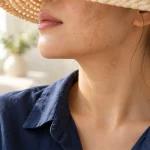
Melasma Melasma Melasma is a common acquired pigmentation disorder that causes symmetrical brown, gray-brown, or sometimes darker patches, most often on the cheeks, forehead, nose, upper lip, and jawline.
-
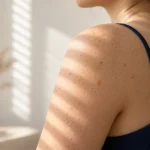
Freckles Freckles Freckles, medically called ephelides, are small, flat, light-brown to darker-brown spots that commonly appear on sun-exposed skin, especially the face, nose, cheeks, shoulders, arms, and upper chest.
-
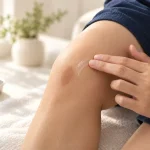
Post-inflammatory Hyperpigmentation Post-inflammatory Hyperpigmentation Post-inflammatory hyperpigmentation (PIH) is the flat brown, dark brown, or grayish discoloration that remains after inflammation or injury to the skin. It commonly follows acne, eczema, insect bites, burns, scratching, irritation, and some dermatologic procedures.
-
Mole Check Mole Check Most moles are harmless. However, a new mole, a changing mole, or a spot that looks different from your other moles deserves closer attention.