






Genital Warts
Genital warts are benign growths caused by certain types of human papillomavirus (HPV). They can appear on the penis, vulva, groin, scrotum, perineum, around the anus, inside the anal canal, and sometimes on the cervix, vagina or urethral opening.

Most genital warts are not cancer. The HPV types that most often cause visible genital warts are usually different from the high-risk HPV types associated with cervical and other HPV-related cancers. However, not every bump in the genital area is a wart, and unusual, pigmented, bleeding, ulcerated or hard lesions may require further evaluation or biopsy.
Treatment can remove visible warts, reduce symptoms and improve comfort or appearance, but it does not guarantee immediate elimination of HPV from the surrounding skin. This is why genital warts may return after apparently successful treatment.
For Thai patients, expats, tourists and international patients seeking genital wart treatment in Bangkok, the most useful first step is a confidential clinical examination to confirm the diagnosis before choosing treatment.
What Are Genital Warts?
Genital warts are also called anogenital warts or condyloma acuminata.
They are caused by HPV infection of genital or perianal skin and mucous membranes.
Warts may be:
- Small or large
- Single or multiple
- Flat or raised
- Smooth or rough
- Skin-colored, pink or slightly darker
- Clustered into a cauliflower-like shape
They are often painless, but some people experience:
- Itching
- Burning
- Irritation
- Pain
- Bleeding, particularly if the wart is rubbed or traumatized
Genital warts can occur both externally and internally.
What Causes Genital Warts?
Genital warts are caused by HPV.
HPV is a large family of viruses. Some HPV types infect ordinary skin and cause hand or foot warts, while others preferentially infect the genital area.
Most visible genital warts are associated with low-risk, non-oncogenic HPV types, especially HPV 6 and 11. These are different from the high-risk HPV types most strongly associated with cervical cancer and other HPV-related cancers.
This distinction is important:
Having genital warts does not mean that you have cancer.
However, it also does not replace normal cervical screening or other clinically appropriate cancer-prevention care.
How Are Genital Warts Transmitted?
HPV is mainly transmitted through intimate skin-to-skin sexual contact.
Transmission can occur during:
- Vaginal sex
- Anal sex
- Genital-to-genital contact
- Other close sexual skin contact
HPV can spread even when there are no visible warts.
Partners commonly share HPV without either person necessarily knowing when the infection occurred.
Can You Get Genital Warts Without Penetrative Sex?
Yes.
Because HPV spreads through skin-to-skin contact, penetrative intercourse is not required for transmission.
Contact involving infected genital skin can be sufficient.
How Long After HPV Exposure Do Genital Warts Appear?
There is no reliable way to determine exactly when HPV was acquired.
Warts may become visible months or even years after infection.
For this reason, a new genital wart does not necessarily represent a recent infection.
Does Genital Warts Mean My Partner Cheated?
No.
This is one of the most common and distressing misconceptions.
Because HPV can remain clinically silent for a long time, it is generally impossible to identify:
- When HPV was acquired
- Which partner transmitted it
- Whether the infection is recent
- Who had HPV first
A diagnosis of genital warts therefore does not prove infidelity.
Where Can Genital Warts Appear?
In Men
Genital warts may occur on:
- Penile shaft
- Glans
- Foreskin
- Scrotum
- Groin
- Pubic area
- Perineum
- Around the anus
- Inside the anal canal
- Urethral opening
In Women
They may occur on:
- Vulva
- Labia
- Vaginal opening
- Groin
- Perineum
- Perianal skin
- Inside the vagina
- Cervix
- Urethral opening
Around the Anus
Perianal warts can occur in people with or without a history of receptive anal intercourse.
Patients with visible external anal warts may sometimes also have lesions inside the anal canal, so further examination may be appropriate in selected cases.
What Do Genital Warts Look Like?
Typical genital warts may appear as:
- Tiny skin-colored bumps
- Soft papules
- Flat lesions
- Raised rough growths
- Finger-like projections
- Multiple clustered lesions
- Cauliflower-like growths
Some are obvious.
Others are extremely subtle and can resemble normal skin structures.
Not Every Genital Bump Is HPV
This is particularly important.
Several benign conditions may be mistaken for genital warts.
These include:
Pearly Penile Papules
Pearly penile papules are small smooth bumps commonly arranged around the corona of the penis.
They are a normal anatomical variant.
They are:
- Not HPV
- Not contagious
- Not an STI
Fordyce Spots
Fordyce spots are visible sebaceous glands.
They may appear as multiple pale, yellowish or skin-colored dots on genital skin.
They are benign and not caused by HPV.
Skin Tags
Skin tags are soft benign growths that commonly occur in friction areas.
Some genital skin tags may resemble pedunculated warts.
Molluscum Contagiosum
Molluscum is caused by a different virus and usually causes small smooth bumps with a central depression.
It can spread through close contact, including sexual contact in adults.
Seborrheic Keratosis
Certain benign keratotic growths can appear rough or wart-like.
Condyloma Lata
Condyloma lata occurs in secondary syphilis and can resemble genital warts.
This is clinically important because treatment is completely different.
Precancerous or Cancerous Lesions
Some precancerous and malignant lesions can resemble warts, particularly if they are:
- Pigmented
- Hard
- Fixed
- Ulcerated
- Bleeding
- Rapidly changing
These should not simply be destroyed without considering biopsy.
How Does a Dermatologist Diagnose Genital Warts?
Diagnosis is usually made by clinical examination.
The dermatologist evaluates:
- Shape
- Surface
- Color
- Distribution
- Number of lesions
- Location
- Whether the lesions are soft or firm
- Whether internal involvement is possible
Most typical genital warts do not require blood tests or HPV testing to confirm the diagnosis.
HPV testing is not recommended for diagnosing visible genital warts, because the result does not confirm that a specific lesion is a wart and does not guide treatment.
When Is a Biopsy Needed?
Biopsy may be appropriate if a lesion is:
- Pigmented
- Hard or indurated
- Fixed to underlying tissue
- Bleeding
- Ulcerated
- Unusual in appearance
- Growing unexpectedly
- Not responding to standard wart treatment
- Worsening during treatment
Biopsy may also be considered more readily in immunocompromised patients.
Suspicious lesions should be diagnosed before repeated destructive treatment.
Do I Need an HPV Test?
Usually not for the diagnosis of genital warts.
HPV testing has established roles in cervical cancer screening and follow-up of abnormal cervical findings, but it is not used as a general test to diagnose genital warts.
Do I Need Other STI Tests?
It may be appropriate.
Because genital warts are sexually transmitted, evaluation for other sexually transmitted infections may be useful depending on:
- Sexual history
- Symptoms
- Partner history
- Previous STI testing
- Individual risk
CDC guidance notes that people with genital warts can benefit from testing for other STIs.
This does not mean everyone requires the same panel. Testing should be individualized.
Are Genital Warts Cancer?
Most genital warts are benign.
The HPV types that most commonly cause genital warts are generally different from the high-risk HPV types responsible for most HPV-related cancers.
However, a wart-like lesion can occasionally represent:
- High-grade squamous intraepithelial lesion
- Squamous cell carcinoma
- Another genital skin condition
Atypical lesions therefore require proper examination.
Can You Have Both Low-Risk and High-Risk HPV?
Yes.
A person can be infected with more than one HPV type.
Having visible genital warts does not tell us whether high-risk HPV is present or absent elsewhere.
This is why appropriate cervical screening should continue according to recommended schedules rather than being based solely on whether genital warts are present.
Do Women With Genital Warts Need More Frequent Pap Tests?
Not simply because they have genital warts.
CDC guidance states that women with genital warts do not automatically require Pap testing more frequently than other women. Screening frequency should follow the appropriate cervical screening recommendations for the individual patient.
Can Genital Warts Go Away Without Treatment?
Yes.
Untreated genital warts may:
- Disappear spontaneously
- Remain unchanged
- Increase in size
- Increase in number
Observation can therefore be reasonable for selected patients who are comfortable waiting and have typical benign lesions.
However, many patients choose treatment because of:
- Spread
- Irritation
- Bleeding
- Difficulty with hygiene
- Cosmetic concerns
- Anxiety
- Sexual-health concerns
No single treatment is best for every wart.
What Is the Goal of Genital Wart Treatment?
Treatment aims to:
- Remove visible lesions
- Reduce symptoms
- Improve comfort
- Improve hygiene when necessary
- Reduce cosmetic or psychological burden
Treatment does not guarantee eradication of HPV.
This distinction is central to understanding recurrence.
Genital Wart Treatment Options
Treatment is selected according to:
- Number of warts
- Size
- Location
- External vs internal disease
- Pregnancy
- Immune status
- Previous treatment
- Patient preference
- Expected side effects
- Need for rapid physical removal
Treatment can be divided into patient-applied medication and provider-administered procedures.
Cryotherapy With Liquid Nitrogen
Cryotherapy freezes genital wart tissue using liquid nitrogen.
The frozen tissue undergoes controlled damage and subsequently heals.
Advantages
Cryotherapy can be useful because it:
- Can treat individual visible lesions directly
- Does not require daily home application
- Can be used on several external locations
- Can be repeated if necessary
Limitations
It may require multiple sessions.
Treatment can cause:
- Pain
- Burning
- Swelling
- Blistering
- Crusting
- Temporary tenderness
Pigment changes can occur after destructive treatment, particularly in patients prone to post-inflammatory pigmentation.
What Happens After Cryotherapy?
The area may become:
- Red
- Swollen
- Tender
- Blistered
- Crusted
This can be an expected response.
The treated tissue then gradually heals.
Patients should follow wound-care instructions and avoid unnecessarily traumatizing the area.
Trichloroacetic Acid — TCA
TCA is a provider-applied chemical treatment that destroys wart tissue through chemical coagulation.
It can be useful for selected genital warts.
Advantages
- Office-based
- Useful for small external lesions
- Can be used in certain mucosal locations under professional supervision
Limitations
TCA can spread to surrounding skin if applied improperly and may cause significant burning or tissue injury.
It therefore requires controlled application rather than self-treatment.
Imiquimod
Imiquimod is a prescription topical immune-response modifier used for certain external genital warts.
Rather than directly burning the wart, it stimulates local immune responses.
Possible local reactions include:
- Redness
- Burning
- Irritation
- Erosion
- Ulceration
- Crusting
- Swelling
These reactions can be part of the treatment response, but excessive inflammation may require adjustment.
Imiquimod is not simply a cosmetic wart-removal cream and should be used according to a proper treatment plan.
Podofilox
Podofilox is a prescription patient-applied medication that destroys wart tissue.
It is used for selected external genital warts.
It can cause:
- Local irritation
- Pain
- Erosion
Correct identification of the lesions and instructions for application are important.
Podofilox should not be used during pregnancy.
Sinecatechins
Sinecatechins is another prescription topical option for selected external genital and perianal warts.
Possible side effects include:
- Redness
- Itching
- Burning
- Pain
- Swelling
- Ulceration
It is not appropriate in every clinical setting, and pregnancy safety requires consideration.
Electrosurgery
Electrosurgery destroys wart tissue using electrical energy.
Advantages
It can physically remove visible wart tissue, sometimes in a single procedure for selected lesions.
Limitations
Potential issues include:
- Need for local anesthesia
- Pain afterward
- Wound care
- Pigment change
- Scarring
- Recurrence
Depth control is important to minimize unnecessary tissue injury.
Surgical Removal or Curettage
Larger or selected warts can sometimes be excised, shaved or curetted under local anesthesia.
An advantage is that much of the visible wart burden may be removed at one visit.
However, recurrence remains possible because physical removal does not guarantee that surrounding HPV infection has disappeared.
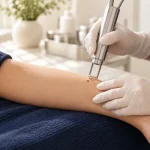
Laser Treatment for Genital Warts
Laser treatment can be used for selected genital warts.
It may be considered when lesions are:
- Large
- Numerous
- Difficult to access
- Resistant to other treatments
- Located in selected anatomical areas
CO₂ laser is one example of a destructive technique used for selected extensive or resistant lesions.
Advantages
Laser can allow precise physical destruction of visible lesions.
It may be useful when a large amount of wart tissue needs to be removed.
Limitations
Possible drawbacks include:
- Local anesthesia
- Open wounds
- Pain
- Swelling
- Bleeding
- Downtime
- Pigment changes
- Scarring
- Recurrence
Laser is not automatically superior to cryotherapy, topical treatment or surgery.
The best treatment is the one most appropriate for the location and type of lesion.
CO₂ Laser for Genital Warts
CO₂ laser vaporizes tissue.
It may be useful for selected:
- Large lesions
- Extensive clustered lesions
- Resistant warts
- Anatomically difficult lesions
When ablating HPV-related tissue, appropriate smoke evacuation and infection-control measures are important because procedure-generated plume can contain biological material.
Which Treatment Is Best?
There is no universally best treatment.
Current guidance emphasizes that treatment should be selected according to:
- Wart size
- Wart number
- Location
- Patient preference
- Adverse-effect profile
- Convenience
- Clinician experience
No single recommended method has been proven superior for all genital warts.
For example:
A few small external warts may be suitable for cryotherapy or prescription topical treatment.
Large clustered lesions may benefit from a destructive procedure.
A wart at the urethral opening requires different management from one on external groin skin.
Cervical or intra-anal disease may require additional specialist assessment.
Internal Anal Warts
Visible perianal warts can sometimes be associated with lesions inside the anal canal.
Internal disease may require examination using:
- Digital rectal examination
- Anoscopy
- Other selected anal assessment
Intra-anal warts may require colorectal or other relevant specialist involvement.
Cervical Warts
Visible cervical warts require particular caution.
Before treating exophytic cervical lesions, evaluation may be required to exclude high-grade precancerous disease.
Management generally involves an appropriate specialist.
Genital Warts During Pregnancy
Genital warts can sometimes enlarge or become more friable during pregnancy.
Treatment choices are more limited.
Certain medications should not be used during pregnancy, including podofilox, podophyllin and sinecatechins according to CDC guidance. Imiquimod is generally avoided until more human pregnancy data are available.
Pregnant patients should therefore not self-treat genital warts.
Can Genital Warts Affect Childbirth?
Usually genital warts do not automatically require cesarean delivery.
CDC guidance does not recommend cesarean delivery solely to prevent HPV transmission to the infant.
Cesarean delivery may be considered when warts obstruct the pelvic outlet or when vaginal delivery would be expected to cause excessive bleeding.
Genital Warts in People With Reduced Immunity
People with HIV infection or other causes of immunosuppression may develop:
- More numerous warts
- Larger lesions
- More persistent disease
- More frequent recurrence
Suspicious wart-like lesions in immunocompromised patients may also warrant a lower threshold for biopsy because malignant lesions can occasionally resemble genital warts.
Can I Use an Ordinary Wart Remover on Genital Warts?
No.
Over-the-counter salicylic-acid wart medicines intended for hands and feet should not be used on genital skin.
The genital area is much more sensitive, and these products can cause chemical burns.
Genital warts require a different treatment approach.
Should I Cut or Burn Genital Warts Myself?
No.
Self-cutting, burning or applying unregulated acids can cause:
- Bleeding
- Infection
- Chemical burns
- Scarring
- Pigmentation
- Delayed diagnosis if the lesion was not actually a wart
It may also make subsequent examinations more difficult.
Can Shaving Spread Genital Warts?
It can potentially contribute to spread.
Shaving creates microscopic skin injuries and may carry HPV-containing material across nearby skin.
If there are visible genital warts, avoiding shaving directly across them is sensible until the condition has been assessed or treated.
Should I Have Sex While I Have Genital Warts?
HPV can be transmitted while visible warts are present.
Patients should discuss the diagnosis with current partners.
Some topical treatments also require avoiding sexual contact while medication is on the skin.
Even after the visible warts disappear, it is not possible to say exactly when HPV is no longer transmissible.
Do Condoms Prevent Genital Warts?
Condoms can reduce HPV transmission risk but do not provide complete protection.
HPV can infect genital or perianal skin that is not covered by a condom.
Should I Tell My Partner?
Current partners should generally be informed because HPV can be transmitted even if they do not have visible lesions.
Partners may already share HPV without knowing it.
A partner may benefit from:
- Clinical examination if lesions are present
- STI assessment depending on risk
Routine HPV testing of the partner is not recommended solely because one partner has genital warts.
Does My Partner Need an HPV Test?
Usually not for this purpose.
There is no routine HPV test used to determine whether the partner of someone with genital warts has acquired the same wart-causing HPV type.
Partners may already share the virus despite having no visible symptoms.
Does Removing Genital Warts Cure HPV?
No treatment can guarantee immediate eradication of HPV.
Treatment removes visible disease.
The immune system may subsequently suppress the infection, but HPV may remain clinically silent for a period of time.
This is why recurrence can occur.
Why Do Genital Warts Come Back?
Possible reasons include:
- HPV remaining in surrounding skin
- Microscopic infected tissue that was not visible
- Incomplete treatment
- Individual immune response
- Immunosuppression
Recurrence does not automatically mean:
- The treatment failed technically
- Your partner reinfected you
- Your partner has been unfaithful
CDC guidance notes that recurrence is particularly common during the first months after treatment.
How Long Does Treatment Take?
There is no fixed timeline.
Some small lesions respond relatively quickly.
Others require:
- Repeated cryotherapy
- Several weeks of topical treatment
- Combination treatment
- A procedure for larger lesions
CDC guidance notes that anogenital warts commonly respond within approximately three months of therapy, although response varies according to lesion characteristics, treatment adherence and immune status.
What Are the Possible Side Effects of Treatment?
Depending on the treatment, possible side effects include:
- Pain
- Burning
- Redness
- Swelling
- Blistering
- Erosion
- Ulceration
- Crusting
- Bleeding
- Post-inflammatory hyperpigmentation
- Hypopigmentation
- Scarring
Persistent color change can occur after destructive procedures such as cryotherapy and electrosurgery.
Scarring is less common but possible.
Pigmentation After Treatment in Asian Skin
Post-inflammatory hyperpigmentation can be particularly noticeable in Thai and other Asian skin types.
This does not mean treatment should be avoided, but it should influence decisions about:
- Treatment intensity
- Repeated procedures
- Wound care
- Healing time between sessions
Aggressive destruction is not automatically better.
Aftercare After Genital Wart Treatment
Aftercare depends on the procedure.
General principles may include:
- Keep the area clean
- Follow wound-care instructions
- Avoid picking crusts
- Avoid applying unapproved acids or creams
- Avoid friction if the area is painful
- Allow adequate healing between procedures
- Contact the clinician if there is significant swelling, pus, worsening pain or fever Sexual activity may need to be temporarily avoided if the treated area is painful, raw or healing.
HPV Vaccination
HPV vaccination helps prevent new infections with important HPV types, including types associated with genital warts and HPV-related cancers.
However:
The HPV vaccine does not treat an existing HPV infection or remove an existing genital wart.
A person who has already had genital warts may still potentially benefit from vaccination because previous infection does not necessarily mean exposure to every HPV type covered by the vaccine.
Whether vaccination is appropriate depends on age, previous vaccine history and individual circumstances.
Can I Get the HPV Vaccine After Having Genital Warts?
Potentially, yes.
The vaccine will not make existing warts disappear, but previous genital warts do not automatically mean that vaccination has no value.
For example, current CDC recommendations include routine catch-up vaccination through age 26 in people not adequately vaccinated earlier, while selected adults aged 27–45 may consider vaccination after discussion with a clinician. Local Thai recommendations and vaccine availability should also be considered.
Does the HPV Vaccine Cause Genital Warts?
No.
HPV vaccines are preventive vaccines and do not contain live HPV capable of producing genital warts.
When Should You See a Dermatologist?
Consider medical evaluation if:
- You have a new genital bump
- You are unsure whether the lesion is HPV
- Warts are increasing
- Warts are spreading
- The lesion bleeds
- The lesion is painful
- There is persistent itching
- The lesion is pigmented
- It feels unusually hard
- It is ulcerated
- Treatment has not worked
- Warts repeatedly recur
- Lesions are around the anus
- Lesions involve the urethral opening
- You are pregnant
- You have HIV or another cause of immunosuppression
Warning Signs That Need Further Evaluation
A wart-like lesion deserves closer evaluation if it is:
- Hard or indurated
- Fixed to deeper tissue
- Spontaneously bleeding
- Persistently ulcerated
- Irregularly pigmented
- Rapidly enlarging
- Significantly painful
- Worsening despite appropriate treatment
These features may warrant biopsy rather than repeated wart destruction.
What to Expect During a Genital Wart Consultation in Bangkok
A consultation is usually straightforward and confidential.
The clinician may ask:
- When did you first notice the lesion?
- Has it increased in number?
- Has it changed?
- Does it itch or bleed?
- Have you used any treatment?
- Have you previously had genital warts?
- Have you received HPV vaccination?
- Are you pregnant or planning pregnancy?
- Are you taking immunosuppressive medication?
- Do you have any other STI symptoms?
The affected skin is then examined.
Depending on the location, examination may include:
- External genital examination
- Perianal examination
- Assessment of the urethral opening
- Additional examination if internal anal disease is suspected
- Referral for cervical or internal disease when appropriate
Most typical external genital warts do not require biopsy or HPV testing.
Treatment can then be chosen according to the individual lesion.
What Should International Patients Bring?
For expats, tourists and international patients seeking genital wart treatment in Bangkok, useful information includes:
- Previous diagnosis
- Previous treatment
- Dates of cryotherapy or laser treatment
- Medication names
- HPV vaccination history
- Previous biopsy results
- Relevant STI test results
- Previous cervical screening results when applicable
- Pregnancy status
- Current medications
Photographs of previous lesions may be useful if some have disappeared before the consultation.
The Most Important Step Is Confirming the Diagnosis
A genital bump can cause significant anxiety, but not every genital bump is HPV.
It could represent:
- Genital warts
- Pearly penile papules
- Fordyce spots
- Skin tags
- Molluscum contagiosum
- Seborrheic keratosis
- Condyloma lata
- Another benign condition
- A precancerous or malignant lesion
Before treatment, the clinically useful questions are:
Is this actually a genital wart?
Are the lesions external only or could there be internal involvement?
Are any lesions atypical enough to require biopsy?
Is treatment necessary now, or is observation reasonable?
Would topical treatment, cryotherapy, TCA or physical removal be most appropriate?
Is pregnancy affecting treatment choices?
Should the patient be offered testing for other STIs?
Is HPV vaccination still relevant?
What should the patient know about recurrence and partner transmission?
The goal is not simply to remove every visible bump.
Good genital-wart care should combine accurate diagnosis, appropriate lesion treatment, realistic counseling about HPV, recurrence prevention, sexual-health guidance and avoidance of unnecessary procedures.
Frequently asked questions
What causes genital warts?
They are caused by certain types of human papillomavirus, or HPV.
Are genital warts an STI?
Yes. Genital HPV is primarily transmitted through intimate sexual skin-to-skin contact.
Are genital warts dangerous?
Most are benign, but unusual wart-like lesions should be evaluated to exclude other diagnoses.
Are genital warts cancer?
Most genital warts are caused by low-risk HPV types that are different from the high-risk HPV types most strongly associated with cancer.
Can genital warts turn into cancer?
Typical genital warts themselves are generally caused by non-oncogenic HPV. However, precancerous or cancerous lesions can occasionally resemble warts.
What does a genital wart look like?
It may appear as a small skin-colored bump, a flat papule, a rough growth or a cauliflower-like cluster.
Do genital warts itch?
They may be asymptomatic, but some cause itching, burning, pain or bleeding.
Can genital warts be completely flat?
Yes.
Can genital warts occur around the anus?
Yes.
Can anal warts occur without anal sex?
Yes.
Can genital warts occur inside the vagina?
Yes.
Can they occur on the cervix?
Yes, although cervical lesions require appropriate specialist assessment.
Can genital warts occur at the urethral opening?
Yes.
Are pearly penile papules genital warts?
No. Pearly penile papules are a benign normal anatomical variation.
Are Fordyce spots HPV?
No.
Are skin tags genital warts?
No, although they may sometimes look similar.
Is molluscum the same as genital warts?
No. Molluscum contagiosum is caused by a different virus.
Can syphilis look like genital warts?
Yes. Condyloma lata from secondary syphilis can resemble warts.
How are genital warts diagnosed?
Usually by visual clinical examination.
Do I need an HPV test to diagnose genital warts?
Usually no.
Do genital warts need a biopsy?
Not usually, but atypical, pigmented, hard, bleeding, ulcerated or treatment-resistant lesions may need one.
Do genital warts go away by themselves?
They can. Some resolve spontaneously, while others persist or increase.
Should genital warts always be treated?
Not necessarily. Observation may be reasonable in selected cases, although many patients prefer treatment.
What is the best treatment for genital warts?
There is no single best treatment for everyone.
Can genital warts be frozen?
Yes. Cryotherapy is a commonly used provider-administered treatment.
Does freezing genital warts hurt?
It can cause burning, pain and temporary tenderness.
Can cryotherapy cause blisters?
Yes.
Can cryotherapy cause dark marks?
Yes, post-inflammatory pigment change can occur.
Can TCA remove genital warts?
TCA is a provider-applied treatment used for selected lesions.
Does imiquimod treat genital warts?
It is a prescription immune-response modifier used for selected external genital warts.
Can I use salicylic acid on genital warts?
No. Ordinary wart removers for hands and feet should not be used on genital skin.
Can genital warts be removed with laser?
Yes, in selected patients.
Is CO₂ laser effective for genital warts?
It can physically remove selected large, extensive or resistant lesions, but it does not guarantee that HPV has been eliminated.
Is laser better than cryotherapy?
Not necessarily.
Can genital warts come back after laser?
Yes.
Does removing a genital wart cure HPV?
No treatment guarantees immediate eradication of HPV.
Why did my genital warts return?
HPV may remain in nearby clinically normal skin, allowing recurrence.
Does recurrence mean my partner reinfected me?
Not necessarily.
Does genital warts mean my partner cheated?
No.
How long can HPV stay dormant?
The exact timing of infection usually cannot be determined, and warts may appear months or years after HPV acquisition.
Should I tell my partner?
Current partners should generally be informed.
Does my partner need an HPV test?
Routine HPV testing of partners for this purpose is not recommended.
Should my partner see a doctor?
A partner may benefit from examination if lesions are present and from STI testing according to individual risk.
Do condoms prevent genital warts?
They reduce risk but cannot provide complete protection against HPV.
Can I have sex after wart removal?
It depends on healing and treatment. Sexual activity should generally be avoided while a treatment area is raw, painful or when topical medication is still on the skin.
Can HPV spread when there are no warts?
Yes.
Does the HPV vaccine treat genital warts?
No.
Should I get the HPV vaccine after having genital warts?
It may still be appropriate depending on age, previous vaccination and individual circumstances.
Can genital warts be treated during pregnancy?
Yes, but treatment choices are restricted and several medications should be avoided.
Do genital warts mean I need Pap tests more frequently?
Not automatically.
Should I be tested for other STIs?
It may be appropriate depending on your history and individual risk.
Related conditions
-
Viral Warts Viral Warts Viral warts are common skin growths caused by infection with human papillomavirus (HPV). They can develop almost anywhere on the skin, but frequently affect the hands, fingers, feet, knees, face and genital area.
-
Molluscum Contagiosum Molluscum Contagiosum Molluscum contagiosum is a common viral skin infection that causes small, smooth bumps, often with a characteristic tiny indentation in the center. It can affect children and adults and can spread through direct skin contact, shared personal items, sexual contact, or from one area of the body to another.
-
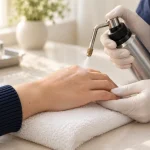
Cryotherapy Cryotherapy Cryotherapy is a dermatologic procedure that uses extreme cold—most commonly liquid nitrogen—to freeze and destroy selected abnormal skin tissue. Dermatologists commonly use it for conditions such as viral warts, actinic keratoses, some seborrheic keratoses, molluscum contagiosum, and selected skin tags.
-
CO2 Laser Removal CO2 Laser Removal CO2 laser removal is a dermatologic procedure used to remove or flatten selected superficial skin growths with high precision. In dermatology, it may be considered for conditions such as skin tags, seborrheic keratoses, selected warts, sebaceous hyperplasia, syringomas, and certain other benign skin lesions. CO2 lasers are also used for resurfacing and scar treatment, although these are different procedures with different treatment settings and recovery.