


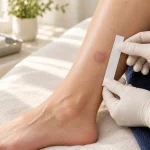
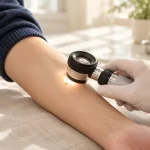


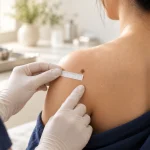





Post-Acne Redness & Pigmentation
After acne clears, the skin may remain red, pink, brown, gray, or uneven in color for weeks or months. These flat marks are often called “acne scars,
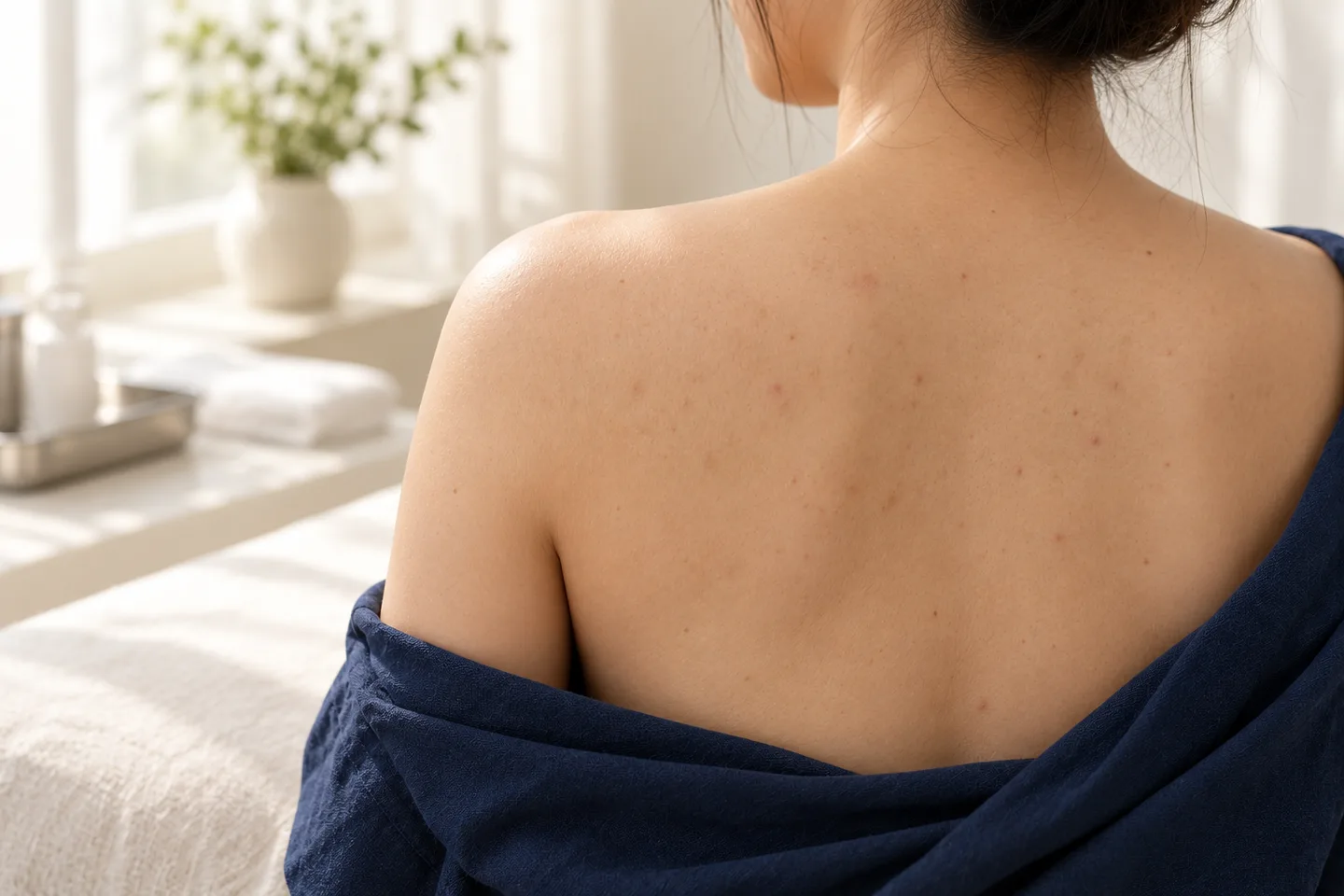
” but many are actually post-acne redness or pigmentation rather than true scars. Dermatological guidelines similarly distinguish flat discoloration after acne from structural acne scarring.
The two most important conditions are:
- Post-inflammatory erythema (PIE): flat pink, red, or reddish-purple marks caused mainly by persistent vascular changes after inflammation.
- Post-inflammatory hyperpigmentation (PIH): flat brown, dark brown, gray-brown, or sometimes blue-gray marks caused by excess melanin after inflammation.
A patient can have PIE, PIH, and true acne scars at the same time. This is particularly important in Thai and Asian skin, where pigmentation after inflammation can be prominent.
The most useful treatment strategy is therefore not simply:
“Which laser removes acne marks?”
It is:
“Is the mark red, brown, structurally scarred—or a combination of all three?”
What Are Post-Acne Redness and Pigmentation?
Inflammatory acne does not necessarily end when the pimple becomes flat.
The inflammatory process can leave temporary or persistent changes in:
- Small blood vessels
- Melanin production
- Skin barrier function
- Collagen and dermal structure
This means that after an acne lesion heals, several different problems may remain.
| What remains after acne | Typical appearance | Main issue |
|---|---|---|
| PIE | Pink, red, red-purple | Vascular/inflammatory change |
| PIH | Brown, dark brown, gray-brown | Excess melanin |
| Atrophic acne scar | Indented or uneven | Structural collagen loss/remodeling |
| Hypertrophic scar or keloid | Raised and firm | Excess scar tissue |
| Active acne | Red raised papule/pustule | Ongoing inflammation |
Correct classification is the foundation of treatment.
Are Red and Brown Acne Marks Actually Scars?
Usually not.
A flat red or brown mark after acne represents discoloration, whereas an acne scar involves a lasting structural change in the skin.
Flat pigmented spots after acne are usually not scars and often fade over time.
A practical way to think about it is:
Color problem: the skin remains flat but looks red or dark.
Scar problem: the surface or depth of the skin has changed.
However, the same acne lesion can leave both.
For example, a depressed rolling scar may also have red or brown discoloration over it. Improving the color does not necessarily correct the depression.
What Is PIE?
Post-inflammatory erythema (PIE) is persistent pink or red discoloration after inflammation.
When it occurs following acne, it is also called post-acne erythema (PAE).
Inflammatory acne increases blood flow and affects tiny superficial blood vessels. Even after the pimple has flattened, residual vascular dilation and inflammation may remain visible as redness.
Post-acne erythema is described as persistent erythematous lesions and telangiectatic vascular changes following acne inflammation.
PIE usually looks:
- Pink
- Bright red
- Dark red
- Reddish-purple
It is usually flat.
What Is PIH?
Post-inflammatory hyperpigmentation (PIH) occurs when inflammation stimulates increased melanin production and deposition.
After the acne resolves, this leaves a flat dark mark.
PIH may appear:
- Light brown
- Medium brown
- Dark brown
- Gray-brown
- Blue-gray when pigment is deeper
PIH can occur in any skin tone but tends to be more prominent and persistent in people with more richly pigmented skin.
For many Thai and Asian patients, PIH is therefore just as important as the acne itself.
PIE vs PIH: How Can You Tell the Difference?
The simplest clue is color.
PIE
Usually:
- Pink
- Red
- Red-purple
Main target: blood vessels and residual inflammation.
PIH
Usually:
- Brown
- Dark brown
- Gray-brown
- Blue-gray
Main target: melanin.
However, not every mark is neatly one or the other.
A lesion may be red-brown, particularly in Asian skin, because it contains both vascular redness and pigmentation.
This is why a patient can sometimes say:
“The vascular laser improved the redness, but the mark is still there.
”
The red component may have improved while the brown component remains.
Can PIE and PIH Occur Together?
Yes.
One inflammatory acne lesion can produce:
redness + pigmentation + structural scarring
in the same location.
This matters when choosing treatment.
A vascular laser targets the red component.
Pigment-focused treatment targets the brown component.
Subcision, microneedling, fractional laser, or other scar procedures address structural changes.
One treatment does not automatically correct all three.
Why Does Acne Leave Red or Dark Marks?
Inflammatory acne activates multiple biological pathways.
Why redness develops
Inflammation increases local blood flow and changes superficial vessels.
When the acne lesion heals, some vascular changes may remain visible.
Why pigmentation develops
Inflammatory mediators stimulate melanocytes—the cells that produce melanin—to produce and distribute more pigment.
This response is particularly important in pigment-prone skin. Reviews of acne-associated pigmentation describe PIH as a consequence of inflammation-driven melanogenesis and abnormal melanin deposition.Which Types of Acne Are Most Likely to Leave Marks?
More inflammatory lesions are particularly likely to leave prolonged discoloration.
These include:
- Inflamed papules
- Pustules
- Nodules
- Cysts
- Recurrent lesions in the same area
Picking, squeezing, scratching, or repeatedly traumatizing acne can increase inflammation and may increase both discoloration and scarring.
This is why treating acne early is part of treating post-acne marks—not a separate issue.
Why Do I Keep Getting New Acne Marks Even Though I Am Treating Them?
Because treating old marks without controlling new acne creates a cycle:
new acne → inflammation → new red/brown mark → treat mark → another acne lesion appears
This can make treatment appear ineffective even when individual older marks are improving.
Consensus recommendations for acne-associated hyperpigmentation emphasize early, effective acne treatment alongside treatment of pigmentation.
For many patients, the most effective long-term strategy is:
stop producing new marks while gradually treating the old ones.
Do Post-Acne Marks Fade Naturally?
Many do.
Flat red and brown marks often gradually become less noticeable with time.
However, the speed varies considerably.
Factors affecting fading include:
- Severity of the original inflammation
- Skin tone
- Depth of pigment
- Recurrent acne
- Picking or squeezing
- Sun exposure
- Skin irritation
- Treatment being used
- Individual healing response
PIE and PIH may both persist for months, and deeper pigment can sometimes remain considerably longer.
There is no medically reliable promise that every acne mark will disappear within a fixed number of weeks.
Why Are Acne Marks More Complicated in Thai and Asian Skin?
Thai and Asian patients frequently have a mixture of vascular redness and pigment after acne.
PIH is particularly relevant because inflammation can stimulate substantial pigmentation in darker phototypes. An Asian-focused review specifically identifies acne and aesthetic procedures as important causes of PIH in Asian skin.
This creates an important treatment dilemma:
A treatment used to remove acne marks can itself cause inflammation—and inflammation can create more PIH.
Reviews of PIH in skin of color therefore recommend caution with procedures such as lasers and chemical peels because treatment itself can sometimes worsen pigmentation.
For pigment-prone skin, more aggressive treatment is not automatically better treatment.
How Does a Dermatologist Diagnose Post-Acne Redness and Pigmentation?
Most cases are diagnosed clinically.
A dermatologist may assess:
- Whether the mark is red, brown, gray, or mixed
- Whether it is flat or depressed
- Whether active acne remains
- Whether visible vessels are present
- Depth and type of acne scars
- Skin tone
- Tendency toward PIH
- Background facial redness
- Rosacea
- Melasma
- Skin irritation
- Current skincare
- Previous acne medication
- Previous lasers or procedures
The goal is to answer:
What exactly remains after the acne?
rather than assuming every mark requires the same procedure.
Is Every Red Mark After Acne PIE?
No.
Other conditions can produce persistent facial redness, including:
- Active inflammatory acne
- Rosacea
- Irritant dermatitis
- Allergic contact dermatitis
- Seborrheic dermatitis
- Steroid-related facial inflammation
- Visible facial vessels
- Recent procedures
- Infection
If redness extends well beyond previous acne sites, flushes repeatedly, burns, stings, scales, or is associated with visible blood vessels, the diagnosis should be reconsidered.
Is Every Brown Mark After Acne PIH?
Not necessarily.
Brown facial lesions may also represent:
- Melasma
- Sun spots
- Freckles
- Seborrheic keratoses
- Moles
- Other pigmented lesions
Multiple flat spots that arise exactly where acne previously occurred are much more suggestive of PIH.
A single unusual pigmented lesion should not simply be assumed to be “an acne mark.
”
Warning Signs: When a Mark Needs Medical Evaluation
Most typical post-acne redness and pigmentation are benign.
However, seek dermatologic assessment when a lesion:
- Develops without preceding acne
- Keeps enlarging
- Changes shape or color
- Has irregular borders
- Becomes raised unexpectedly
- Bleeds without trauma
- Repeatedly crusts
- Ulcerates or does not heal
- Is significantly painful
- Looks distinctly different from the patient’s other acne marks
Also seek assessment if redness is associated with:
- Rapid spreading
- Significant warmth
- Increasing pain
- Pus
- Fever
These features may suggest active inflammation or infection rather than ordinary post-acne discoloration.
Should Active Acne Be Treated Before the Marks?
Usually, active acne should be controlled early, although treatment for existing marks can sometimes begin at the same time.
This is particularly important for PIH.
Expert consensus on acne-associated hyperpigmentation recommends early effective acne treatment, commonly including topical retinoids and benzoyl peroxide, while adding treatments for pigmentation when appropriate.
The plan therefore often has two parallel goals:
Prevent new marks
Treat the acne itself.
Fade existing marks
Address redness and pigmentation according to their dominant component.
What Is the Best Treatment for Post-Acne Redness & Pigmentation?
There is no single best treatment because “post-acne marks” can represent several different biological problems.
A useful treatment hierarchy is:
1. Control active acne
2. Reduce skin irritation
3. Protect against sunlight
4. Treat PIH with appropriate topical therapy
5. Consider vascular treatment for persistent PIE
6. Add scar treatment separately if structural scars are present
This prevents a common mistake: using the strongest available laser on every type of post-acne mark.
Skincare for Post-Acne Redness and Pigmentation
A complicated routine is not automatically better.
The foundation usually includes:
Gentle cleanser
Avoid aggressive scrubbing or cleansing that leaves the skin tight and irritated.
Moisturizer
Supporting the skin barrier may reduce irritation from acne treatments.
Sunscreen
Photoprotection is particularly important for PIH.
Acne treatment
Use appropriate acne therapy to prevent new inflammatory lesions.
Targeted pigmentation treatment
If brown marks remain, selected ingredients may be added based on skin tolerance.
The skincare routine should reduce inflammation, not create more of it.
Does Sunscreen Help Acne Marks?
Yes, especially pigmentation.
Sun exposure can darken existing PIH and make discoloration more persistent.
Photoprotection is a central part of PIH management.
Sunscreen does not physically close the blood vessels responsible for established PIE, but it helps protect healing skin and reduces additional pigment stimulation.
In Bangkok and Thailand, regular photoprotection is particularly practical because outdoor UV exposure can occur throughout everyday activities.
Retinoids for Post-Acne Marks
Topical retinoids are particularly useful when active acne and PIH coexist.
Their biggest advantage is that they address the underlying acne while also helping pigment gradually improve.
Clinical reviews support topical retinoids for acne and PIH in patients with skin of color.
However, irritation matters.
Too much retinoid can produce:
- Redness
- Burning
- Peeling
- Dryness
Excess irritation may make PIE look worse and can potentially trigger additional PIH.
The correct approach is therefore effective but tolerable treatment, not maximum irritation.
Azelaic Acid for Acne Marks
Azelaic acid can be particularly useful when patients have a combination of:
- Active acne
- PIH
- Sensitive skin
- Rosacea-like inflammation in selected cases
It is included among treatment options for acne-associated hyperpigmentation in expert recommendations.
Its role in persistent pure PIE is less direct because it does not physically remove established blood vessels.
Hydroquinone for Post-Acne Pigmentation
Hydroquinone is an established depigmenting agent used for selected cases of PIH.
It works by interfering with melanin production.
It may be useful for brown epidermal PIH but is not a treatment for red vascular marks.
Hydroquinone should be used thoughtfully because irritation can occur, and prolonged or inappropriate unsupervised use is not advisable.
Treatment reviews continue to include hydroquinone among options for PIH, particularly alongside management of the underlying inflammatory condition.Niacinamide for Post-Acne Marks
Niacinamide may support the skin barrier and has a role in some pigmentation-focused skincare.
It can be a useful supportive ingredient, particularly for patients trying to avoid irritation.
However, it should not be presented as a substitute for:
- Effective acne therapy
- Prescription PIH treatment when needed
- Vascular laser for persistent vascular redness
- Structural acne-scar treatment
Vitamin C for Post-Acne Marks
Vitamin C is commonly used as an antioxidant and as part of pigmentation skincare.
It may support treatment of uneven tone, but should not be expected to rapidly erase established PIH or PIE when used alone.
For patients with sensitive or irritated skin, product tolerability remains important.
Can Tranexamic Acid Help?
Tranexamic acid is increasingly used in pigment disorders, particularly in topical formulations.
Evidence for PIH continues to evolve, and it should be viewed as one potential option rather than a universal first-line solution.
Oral tranexamic acid is a systemic medication and should not be treated like an ordinary cosmetic supplement. It requires consideration of contraindications and thrombotic risk.
Chemical Peels for Post-Acne Pigmentation
Superficial chemical peels may be used as an adjunct for selected patients with acne and epidermal PIH.
Examples include formulations based on:
- Glycolic acid
- Salicylic acid
- Other superficial peeling agents
Expert consensus places peels more appropriately as adjunctive or second-line options for acne-associated hyperpigmentation rather than mandatory first-line treatment.
Advantages
They may help:
- Superficial pigmentation
- Comedonal acne
- Surface texture
Limitations
They can produce:
- Redness
- Peeling
- Irritation
- PIH
- Rarely, more significant skin injury when overly aggressive
PIH reviews in skin of color specifically caution that chemical peels can sometimes exacerbate pigmentation.Vascular Laser for Post-Acne Redness
Persistent red marks may respond to treatments targeting blood vessels.
A systematic review of post-acne erythema found laser and light-based treatments to be the most frequently studied procedural approaches.
The most frequently studied laser category was pulsed dye laser (PDL).
The goal is not to “resurface” the mark but to target the vascular component contributing to persistent redness.
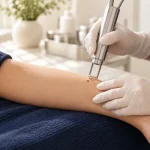
PDL and V-Beam for PIE
Pulsed Dye Laser (PDL) targets hemoglobin within blood vessels.
It is one of the better-studied procedural treatments for persistent post-acne erythema.
V-Beam is a commonly recognized platform within the PDL category.
PDL may be considered for:
- Persistent flat red marks
- Vascular post-acne erythema
- Visible small vessels associated with previous inflammation
Possible temporary effects include:
- Redness
- Swelling
- Warmth
- Bruising
- Purpura
It does not directly correct brown PIH or deep acne scars.
IPL for Red and Brown Acne Marks
Intense Pulsed Light (IPL) is not technically a laser.
It produces a range of wavelengths that can be filtered to target different chromophores, including hemoglobin and melanin.
For selected patients, this makes IPL potentially useful when there is:
diffuse redness + superficial pigmentation
However, treating two targets does not automatically make IPL the best treatment.
Device characteristics, filters, skin tone, recent tanning, and treatment settings all affect safety.
In pigment-prone skin, excessive inflammation or heat can cause new PIH.
Nd:YAG Laser for Post-Acne Redness
Nd:YAG lasers have also been investigated for post-acne erythema.
The systematic review of PAE treatments found Nd:YAG to be among the commonly studied laser approaches after PDL.
Whether it is appropriate depends on the vascular target, wavelength, skin tone, device, and treatment parameters.
There is no universal rule that Nd:YAG is better than PDL or vice versa.
Pigment Lasers for PIH
Pigment-targeting lasers may be considered for selected persistent PIH, but they are not automatically first-line treatment.
This is especially important in Asian and pigment-prone skin because the procedure itself can cause inflammation.
A systematic review of PIH treatment in skin of color found variable results from laser treatment and also documented cases in which laser worsened PIH.
Therefore:
A laser that can target pigment can also create new pigment if treatment is too inflammatory.
For straightforward PIH, topical therapy and photoprotection are often more logical starting points.
Picosecond Laser for Post-Acne Pigmentation
Picosecond lasers can target pigment using very short pulses and are used for several pigmentary indications.
They may be considered for selected persistent acne-related pigmentation.
However, the word “picosecond” does not mean:
- No risk of PIH
- No downtime
- Suitable for every skin tone
- Better than topical treatment
- Appropriate for every brown acne mark
The diagnosis and treatment parameters remain more important than the marketing category of the device.
Q-Switched Laser for PIH
Q-switched pigment lasers may also be used in selected pigmentation disorders.
For PIH, treatment should be cautious because repeated or overly aggressive pigment-laser treatment may produce:
- Increased pigmentation
- Uneven pigmentation
- Hypopigmentation
- Irritation
This is why resistant PIH should not simply lead to progressively stronger laser treatment.
Fractional Laser: When Does It Make Sense?
Fractional laser is primarily a skin-remodeling treatment rather than a first-line treatment for simple flat red or brown marks.
Its role becomes more relevant if the patient has:
- Atrophic acne scars
- Rough texture
- Enlarged-appearing pores
- Structural irregularity
with discoloration occurring at the same time.
A patient with:
PIE + PIH + boxcar scars
may eventually benefit from a combined treatment plan, but that does not mean one fractional laser session addresses all three equally.
RF Microneedling for Red Marks, Pigmentation, and Acne Scars
Radiofrequency microneedling is primarily used for dermal remodeling and acne scars.
It is not mainly a pigment laser or vascular laser.
It may make sense when the dominant problem is:
- Rolling scars
- Boxcar-type scars
- Texture
- Enlarged-appearing pores
with some associated redness.
If the main problem is purely flat vascular PIE, a vascular-targeting treatment may be more direct.
Microneedling for Post-Acne Marks
Traditional microneedling is also principally a remodeling procedure.
Its strongest rationale is for structural acne scars rather than isolated discoloration.
Using an invasive procedure purely because the face has “acne marks” can miss the actual target.
The first question should always be:
Is this a color problem or a structural problem?
Can Acne Scars and Discoloration Be Treated Together?
Sometimes, yes.
But combination treatment should be planned according to what the skin contains.
For example:
Rolling scar + PIE
May require treatment of tethering plus a vascular approach.
Ice-pick scar + PIH
May require focal scar treatment plus pigmentation management.
Boxcar scar + mixed red-brown discoloration
May require staged structural and color-focused treatments.
Combination therapy should not mean performing every available procedure at once.
The treatment sequence should minimize unnecessary inflammation.
Which Should Be Treated First: Redness, Pigmentation, or Acne Scars?
There is no universal sequence.
However, a sensible hierarchy often looks like:
- Control active acne
Stop creating new lesions.
- Stabilize irritation and the skin barrier
Do not perform aggressive procedures on inflamed, damaged skin.
- Begin PIH treatment and photoprotection
Particularly important in pigment-prone patients.
- Consider vascular treatment for persistent PIE
If redness remains bothersome.
- Plan structural scar treatment
According to scar morphology.
In some patients, steps overlap.
Does Treating Acne Scars Cause More PIH?
It can.
Procedures such as:
- Fractional laser
- RF microneedling
- Microneedling
- Chemical peels
- TCA-based procedures
produce controlled inflammation or injury.
That is part of how they work—but it also means PIH is possible.
This is particularly relevant in Asian skin.
PIH management reviews emphasize that aesthetic procedures can both improve and worsen pigmentation depending on patient selection and treatment intensity.What Is the Best Laser for Red and Brown Acne Marks?
There is no single laser that is automatically best for both.
A useful framework is:
Predominantly red
Consider vascular-targeting treatment.
Predominantly brown
Begin with pigment management; consider pigment procedures selectively.
Red + brown
May require treatment of both vascular and pigment components.
Red/brown + indented scars
May require color treatment plus scar remodeling.
The best laser is not determined by the name of the mark. It is determined by the biological target.
How Many Treatment Sessions Are Needed?
There is no universal number.
The answer depends on:
- PIE vs PIH
- Pigment depth
- Skin tone
- Active acne
- Scar type
- Device
- Treatment parameters
- Previous treatments
- Clinical response
The evidence for both PIE and PIH includes substantial variation in treatment protocols, which is one reason it is inappropriate to promise that everyone requires the same number of sessions.How Long Until Results Are Visible?
It depends on what is being treated.
PIH
Topical treatment generally requires patience. Acne itself may improve before pigmentation resolves.
PIE
Vascular redness may gradually fade spontaneously, while procedural treatment is generally assessed over subsequent weeks rather than immediately.
Acne scars
Structural remodeling takes longer and results develop progressively.
Immediately after a procedure, swelling can temporarily make skin look smoother or redness can temporarily look worse. Neither should be mistaken for the final result.Downtime After Treatment
Downtime depends on the procedure.
Vascular laser
May cause:
- Redness
- Swelling
- Purpura or bruising
IPL
May cause:
- Redness
- Mild swelling
- Temporary darkening of pigment
Chemical peel
May cause:
- Dryness
- Peeling
- Redness
Fractional laser
May cause:
- Redness
- Swelling
- Roughness or crusting
- Temporary pigment changes
Microneedling or RF microneedling
May cause:
- Redness
- Swelling
- Pinpoint crusting
- Temporary sensitivity
Actual recovery varies with the device and treatment intensity.
Aftercare for Post-Acne Redness and Pigmentation Treatments
Specific instructions depend on the procedure, but general principles usually include:
- Cleanse gently
- Avoid picking
- Use moisturizer when needed
- Avoid unnecessary scrubs and strong exfoliation while healing
- Use appropriate sunscreen
- Avoid intentional tanning
- Follow instructions about retinoids, acids, and acne medication around procedures
- Follow advice about exercise, heat, swimming, and makeup
A simple rule is:
Do not create more inflammation while trying to treat inflammation-related marks.
Why Does My Skin Look Darker After Laser?
Temporary darkening can occur after some treatments.
Potential explanations include:
- Temporary darkening of treated pigment
- Inflammation
- Crusting
- New PIH
The important point is that not every darkening after a procedure should be treated immediately with a stronger procedure.
The skin first needs to be assessed.
If the change represents PIH, additional inflammation may worsen it.
Can Post-Acne Marks Return?
A successfully faded mark does not necessarily “return” in the same way a chronic disease does.
However, new acne produces new marks.
Someone who continues to have inflammatory acne can repeatedly develop new PIE and PIH.
Long-term success therefore depends partly on maintaining acne control.
Post-Acne Redness & Pigmentation in Thai and Asian Skin
Treatment in Thai skin should account for both vascular and pigment response.
Some patients primarily develop brown PIH.
Others develop visible red PIE.
Many develop both.
A procedure that works well for a light-skinned patient with predominantly vascular redness may not be the ideal first approach for a patient with darker, recently tanned skin and mixed red-brown marks.
Treatment planning should consider:
- Baseline skin tone
- Recent tanning
- PIH history
- Pigment depth
- Degree of redness
- Acne activity
- Scar morphology
- Previous procedure reactions
There is no single treatment protocol for “Asian skin.
”
Post-Acne Mark Treatment for Tourists in Bangkok
For international patients visiting Bangkok, treatment selection should consider the travel itinerary.
Important questions include:
- How long will you stay in Thailand?
- Can you return for follow-up?
- Is a series of treatments required?
- Are you going to the beach afterward?
- Will you have substantial outdoor sun exposure?
- Is visible bruising or peeling acceptable?
- Are you attending an important event?
- What happens if a delayed reaction develops after you leave?
A more aggressive treatment is not necessarily useful if the recovery period is incompatible with the trip.
What to Expect During a Dermatology Consultation in Bangkok
A useful consultation for post-acne marks should evaluate more than “which laser to use.
”
The dermatologist may assess:
- Active acne
- Comedones
- PIE
- PIH
- Red-brown mixed marks
- Ice-pick scars
- Boxcar scars
- Rolling scars
- Hypertrophic scars or keloids
- Enlarged-appearing pores
- Rosacea
- Melasma
- Skin sensitivity
- Skin tone
- PIH tendency
- Current acne treatment
- Previous isotretinoin use when relevant
- Previous procedures
- Recent sun exposure
- Desired downtime
The treatment plan should then prioritize the most important problem rather than simply adding procedures.
Post-Acne Redness & Pigmentation: Treatment Comparison
Treatment Main target Advantages Important limitations
| Acne treatment | Active acne | Prevents new marks | Does not instantly remove old marks |
|---|---|---|---|
| Sunscreen | PIH prevention/support | Helps prevent pigment darkening | Does not directly close PIE vessels |
| Topical retinoid | Acne + PIH | Treats acne and pigmentation together | Irritation can worsen redness/PIH |
| Azelaic acid | Acne + PIH | Useful for several acne-related concerns | Gradual results |
| Hydroquinone | Selected PIH | Direct depigmenting therapy | Not for vascular redness; can irritate |
| Chemical peel | Superficial PIH/acne | Treats broad areas | Can provoke PIH |
| PDL | PIE/vascular redness | Direct vascular target | Does not treat brown pigment or deep scars |
| IPL | Diffuse redness ± superficial pigment | Can address broader areas | Highly device- |
, setting-
, and skin-dependent
| Pigment laser | Selected persistent PIH | Direct pigment targeting | Can worsen PIH |
|---|---|---|---|
| Fractional laser | Structural acne scars | Improves scars/texture | Can trigger PIH; not primarily a red-mark treatment |
| RF microneedling | Acne scars/texture | Structural remodeling | Not a primary vascular or pigment treatment |
| Subcision | Tethered rolling scars | Releases scar tethering | Does not directly remove red/brown color |
The most important clinical principle is:
Treat the acne, the color, and the scar as separate problems—even when they occur in the same spot.
When Should You See a Dermatologist?
Consider seeing a dermatologist if:
- Acne marks persist and are bothersome
- You cannot tell whether marks are red or brown
- Active acne continues
- Acne scars are developing
- You have mixed red and brown discoloration
- Your skin frequently develops PIH
- Previous peels or lasers made pigmentation worse
- You are considering vascular or pigment laser treatment
- You have keloid-prone skin
- Facial redness occurs outside previous acne areas
- You suspect rosacea
- A pigmented lesion is changing or looks unusual
Early assessment is especially useful when inflammatory acne is already beginning to produce scars.
Frequently asked questions
What causes red and brown marks after acne?
Inflammation can cause both persistent vascular changes and increased melanin production. The vascular component produces PIE, while excess melanin produces PIH.
Is post-acne redness an acne scar?
Usually not. A flat red mark represents vascular discoloration rather than a structural scar.
Is a dark acne mark a scar?
Usually not if it is flat. Flat brown discoloration is more consistent with PIH.
What is the difference between PIE and PIH?
PIE is usually pink or red and primarily vascular. PIH is usually brown or gray and primarily related to melanin.
Can PIE and PIH occur in the same spot?
Yes. Mixed red-brown acne marks are common.
Can PIE, PIH, and acne scars all occur together?
Yes. One acne lesion can leave vascular redness, pigmentation, and structural scarring.
Which fades faster, PIE or PIH?
There is no universal answer. Duration depends on inflammation, pigment depth, skin tone, and individual healing.
Do post-acne marks go away naturally?
Many gradually fade, although some persist for months or longer.
Why do my acne marks stay for months?
Inflammatory changes in vessels and melanin can persist long after the acne lesion itself resolves.
Why do my marks become darker in the sun?
UV exposure can stimulate pigmentation and make PIH more noticeable.
Should I treat acne before treating acne marks?
Controlling acne is a major priority because ongoing inflammation continuously creates new marks.
Can I treat acne and PIH at the same time?
Often yes. Retinoids, azelaic acid, and other appropriately selected acne treatments can address acne while supporting pigmentation improvement.
What is the best cream for brown acne marks?
There is no universal best product. Options may include retinoids, azelaic acid, hydroquinone, and other pigmentation treatments depending on the individual.
Does retinol help post-acne pigmentation?
Retinoids can help acne and pigmentation, but irritation should be minimized.
Does azelaic acid help PIH?
It can be useful, particularly when acne and PIH coexist.
Does hydroquinone help acne marks?
It may help selected brown PIH but does not treat red vascular marks.
Does niacinamide help acne marks?
It may support the skin barrier and pigmentation management but is not a universal treatment for established PIE or significant PIH.
Does vitamin C help acne pigmentation?
It may be a useful adjunct for uneven pigmentation but should not be expected to rapidly clear significant PIH alone.
Does sunscreen help acne marks?
Yes, particularly PIH. It helps reduce additional pigment stimulation.
Can chemical peels remove PIH?
Superficial peels can help selected epidermal PIH but can also trigger additional pigmentation if they cause excessive inflammation.
What laser is best for red acne marks?
PDL is one of the most frequently studied laser treatments for post-acne erythema, but no device is best for every patient.
Does V-Beam help PIE?
V-Beam is a PDL platform, and PDL is used to target the vascular component of persistent red marks.
Does IPL help red acne marks?
It may help selected diffuse vascular redness, especially when other superficial color changes coexist.
What laser is best for brown acne marks?
There is no single best pigment laser. PIH often begins with acne control, photoprotection, and topical treatment, with procedures reserved for selected cases.
Does picosecond laser remove PIH?
It may be considered in selected persistent pigmentation, but it can still cause PIH and is not automatically superior to topical treatment.
Can lasers make PIH worse?
Yes. A systematic review in skin of color documented worsening PIH after laser in some patients.
Is fractional laser good for acne pigmentation?
Fractional laser is primarily used for scars and texture. It is not generally the first treatment for uncomplicated PIH.
Does RF microneedling remove red or brown acne marks?
Its main role is dermal remodeling for acne scars and texture rather than direct vascular or pigment treatment.
Can microneedling treat PIH?
It is not usually the primary treatment for simple PIH and can itself create inflammation.
What should I treat first: PIE, PIH, or acne scars?
Usually active acne and skin irritation are controlled first. The sequence of redness, pigmentation, and scar treatment then depends on which problem is most prominent.
Is treatment different for Asian skin?
The principles are similar, but greater attention may be needed to PIH risk, skin tone, tanning, and procedure intensity.
Can Thai skin have vascular laser treatment?
Yes, in appropriately selected patients. Device and parameter selection should consider skin tone and pigmentation risk.
Can Thai skin have pigment laser treatment?
Potentially, but PIH risk needs to be considered carefully and pigment lasers are not necessarily first-line treatment for every acne mark.
Can I treat redness and pigmentation in the same session?
Sometimes, but this depends on the procedures, skin type, and risk of cumulative inflammation. More procedures at once are not automatically better.
Why did my pigmentation become worse after laser?
The treatment itself may have produced sufficient inflammation to trigger new PIH.
What should I do if acne marks keep returning?
The key is controlling the acne that is creating new marks, rather than repeatedly treating discoloration alone.
Can tourists treat acne marks in Bangkok?
Yes, but treatment should account for length of stay, sun exposure, follow-up, downtime, and whether multiple sessions are required.
Related conditions
-
Acne Acne Acne is one of the most common skin conditions and can affect teenagers and adults alike. It may appear as blackheads, whiteheads, inflamed pimples, or deeper painful nodules and cysts.
-
Post-Acne Redness Post-Acne Redness Post-acne redness refers to flat red or pink marks that remain after an inflamed pimple has healed. Dermatologists often call this post-inflammatory erythema (PIE) or post-acne erythema (PAE).
-
Post-inflammatory Hyperpigmentation Post-inflammatory Hyperpigmentation Post-inflammatory hyperpigmentation (PIH) is the flat brown, dark brown, or grayish discoloration that remains after inflammation or injury to the skin. It commonly follows acne, eczema, insect bites, burns, scratching, irritation, and some dermatologic procedures.
-
Fractional RF Fractional RF Fractional RF is a minimally invasive dermatology treatment used to improve atrophic acne scars, enlarged pores, and uneven skin texture by delivering controlled radiofrequency energy into the skin.