












Fractional RF
Fractional RF is a minimally invasive dermatology treatment used to improve atrophic acne scars, enlarged pores, and uneven skin texture by delivering controlled radiofrequency energy into the skin.
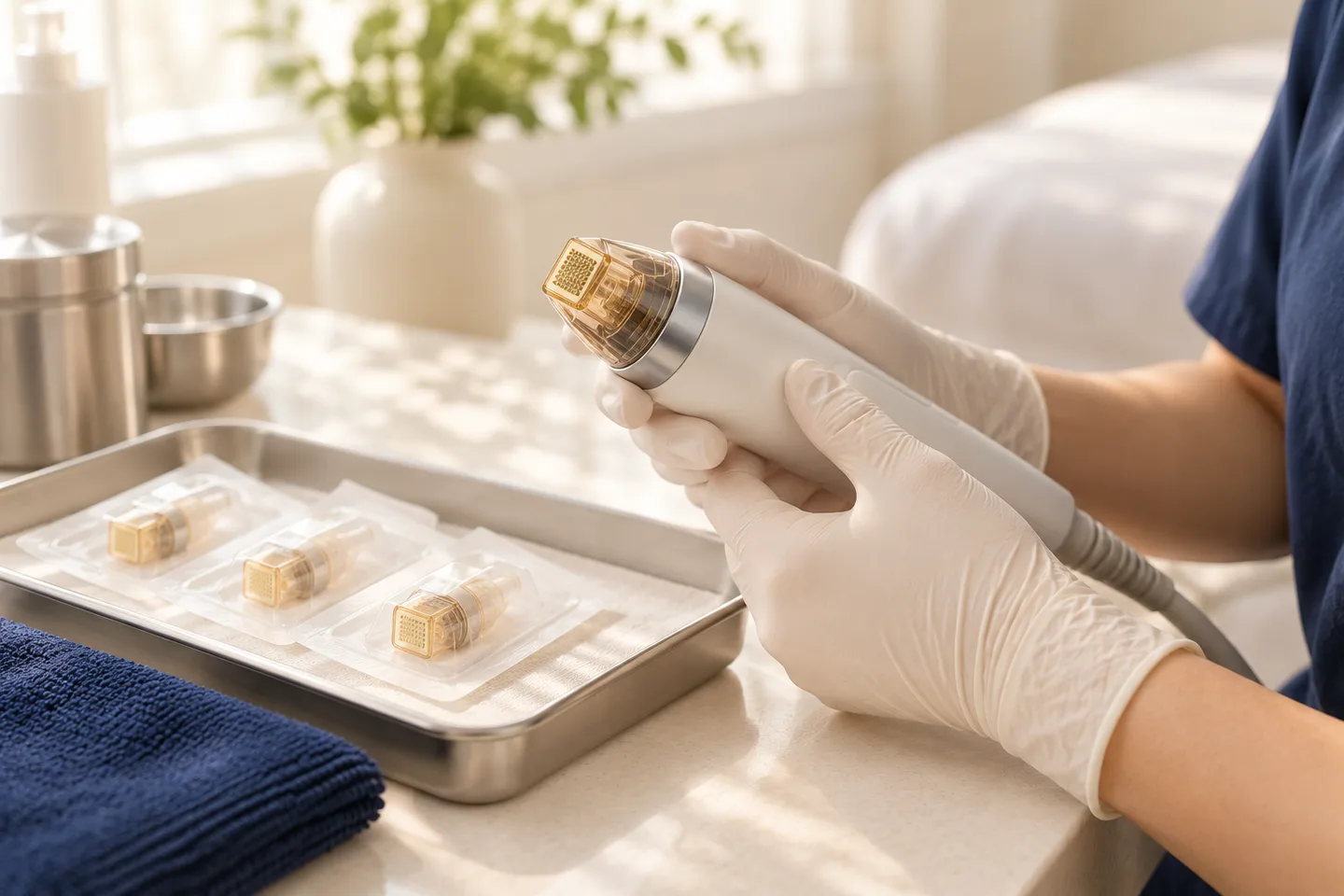
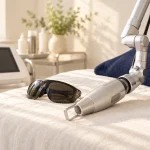
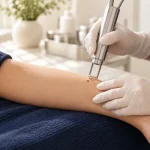
One of the most commonly used forms is Fractional Radiofrequency Microneedling, also called RF Microneedling. Tiny needles deliver radiofrequency energy at controlled depths within the skin, creating microscopic treatment zones that stimulate collagen remodeling.
Current evidence supports Fractional RF as a treatment option for atrophic acne scars. A 2025 systematic review including 16 studies and 481 patients found consistent improvement across the included studies, although treatment protocols varied considerably and further high-quality trials are needed to establish standardized settings.
Fractional RF may also improve the appearance of enlarged pores, particularly when pore visibility is related to skin texture and reduced support around the follicle. However, pores are normal structures of the skin and cannot be permanently “closed” or removed.
For patients with acne scars, the most important question is not simply whether Fractional RF works. It is which type of acne scar is present. Ice pick, boxcar, and rolling scars have different structures and may require different treatments. Fractional RF may therefore be used alone or as part of a treatment plan that includes procedures such as TCA CROSS or Subcision.
What Is Fractional RF?
Fractional RF uses Radiofrequency energy to create controlled microscopic thermal zones within the skin.
Unlike treatments that affect the entire skin surface uniformly, fractional technology leaves areas of untreated tissue between treatment zones. This allows the skin to heal while stimulating remodeling in the treated areas.
When microneedles are used, the procedure is commonly called:
- Fractional Radiofrequency Microneedling
- RF Microneedling
- Microneedling Radiofrequency
- Fractional Microneedle RF
The needles penetrate to predetermined depths and deliver RF energy directly into the tissue.
The resulting controlled thermal injury can stimulate:
- Collagen remodeling
- New collagen formation
- Dermal remodeling
- Changes in elastin
- Improvement in skin texture
- Remodeling of atrophic scars
The treatment does not physically “fill” an acne scar. Improvement develops gradually as the skin remodels.
Is Fractional RF the Same as RF Microneedling?
Not always.
Fractional RF is a broader term describing fractional delivery of radiofrequency energy.
RF Microneedling is a type of Fractional RF in which microneedles penetrate the skin and deliver RF energy at controlled depths.
Different Fractional RF systems may vary significantly in:
- Needle design
- Needle depth
- Insulated or non-insulated needles
- Number of needles
- Energy delivery
- Pulse duration
- Treatment density
- Number of passes
- Maximum treatment depth
For this reason, results from one RF device or protocol cannot automatically be assumed to apply to every Fractional RF system.
What Can Fractional RF Treat?
In aesthetic dermatology, Fractional RF may be considered for:
- Atrophic acne scars
- Boxcar scars
- Selected rolling scars
- Enlarged pores
- Uneven skin texture
- Some other types of scars
- Skin rejuvenation
For acne scars, treatment should ideally begin with identifying the scar type rather than choosing a device first.
Understanding Acne Scars Before Fractional RF Treatment
Acne scars are not all the same.
Atrophic acne scars are depressed scars caused by loss and abnormal remodeling of collagen following acne inflammation.
They are generally classified into three major types:
Ice Pick Scars
Ice pick scars are narrow, deep scars that extend vertically into the skin.
They may look like small holes or enlarged pores, but their depth can make them difficult to treat with resurfacing alone.
Boxcar Scars
Boxcar scars are wider depressions with relatively defined edges.
They may be shallow or deep.
Rolling Scars
Rolling scars are broader depressions with less-defined borders. They can create a wave-like or uneven appearance.
Some rolling scars are tethered to deeper tissue by fibrous bands.
Most patients do not have only one scar type. A combination of ice pick, boxcar, and rolling scars is common.
This is why acne scar treatment frequently requires more than one technique.
Fractional RF for Acne Scars
Fractional RF is primarily used to stimulate remodeling within the dermis.
The combination of microneedle penetration and controlled RF heating creates microscopic areas of injury, initiating wound healing and collagen remodeling.
A recent systematic review found Fractional Radiofrequency Microneedling to be a promising monotherapy for facial acne scars, but also highlighted substantial variation between studies in devices, treatment parameters, outcome measurements, and follow-up.
This means Fractional RF can be useful, but there is no single treatment setting or number of sessions that is appropriate for every patient.
Fractional RF for Boxcar Scars
Fractional RF can be useful for many boxcar scars because it treats a broader area of abnormal dermal texture rather than individual scars alone.
It may be particularly relevant when a patient has:
- Multiple boxcar scars
- Shallow-to-moderate depressed scars
- Uneven surrounding texture
- Enlarged pores together with acne scars
However, very deep boxcar scars with sharply defined edges may respond incompletely to generalized fractional treatment.
Selected scars may require additional procedures depending on their shape and depth.
Fractional RF for Rolling Scars
Fractional RF can improve dermal remodeling in rolling scars, but an important question is whether the scar is tethered.
Some rolling scars are pulled downward by fibrous bands beneath the skin.
If significant tethering is present, stimulating collagen from above may not fully correct the structural problem.
In these cases, Subcision may be considered to release the fibrous attachment.
Fractional RF may subsequently or additionally be used to improve surrounding texture and collagen remodeling.
Fractional RF for Ice Pick Scars
Ice pick scars present a different problem.
They are usually narrow but extend relatively deeply into the skin.
Fractional RF may improve the overall texture surrounding ice pick scars, but deep individual ice pick scars may respond better to a targeted treatment such as TCA CROSS in appropriately selected patients.
This distinction is important.
A patient with predominantly ice pick scars should not automatically receive the same treatment plan as someone with predominantly boxcar scars.
Fractional RF for Enlarged Pores
Fractional RF may also improve the appearance of enlarged facial pores.
Pores can become more visible because of several factors, including:
- Increased sebum production
- Larger hair follicles
- Reduced skin elasticity
- Acne and comedones
- Changes in dermal support around the follicle
- Photoaging
- Genetics
Fractional RF primarily addresses the structural component by remodeling the dermis around the follicular openings.
Clinical studies have reported improvement in enlarged pores after Fractional Microneedle RF treatment, although available studies are relatively small and treatment protocols differ. A retrospective study of 75 patients found improvement increased with additional treatment sessions.
A separate study of 22 patients treated over three sessions also reported improvement in enlarged cheek pores.
These findings are encouraging, but they should not be interpreted as evidence that RF permanently removes pores.
Can Fractional RF Permanently Close Pores?
No.
Pores are normal anatomical openings associated with hair follicles and sebaceous glands.
Aesthetic treatment can make them less visible, but cannot eliminate them.
The goal of Fractional RF treatment is usually to improve:
- Skin texture
- Dermal support
- The appearance of pore size
- Associated acne scarring
If excessive oil production, blackheads, or active acne are major contributors to visible pores, these problems may also need to be treated.
How Does Fractional RF Work?
In RF Microneedling systems, small needles penetrate the skin to a predetermined depth.
Radiofrequency energy is then delivered through the needles.
The energy creates controlled thermal injury within the dermis while limiting unnecessary surface injury.
The healing response involves processes such as:
- Fibroblast activation
- Collagen production
- Collagen remodeling
- Extracellular matrix remodeling
Because collagen remodeling takes time, results are not immediate.
Some early improvement may simply reflect temporary swelling after treatment. More meaningful changes generally develop gradually over subsequent weeks and months.
Insulated vs Non-Insulated RF Needles
RF Microneedling systems may use different types of needles.
Insulated Needles
Part of the needle is electrically insulated, allowing RF energy to be concentrated at selected exposed portions of the needle.
This can provide greater control over where thermal energy is delivered.
Non-Insulated Needles
Energy can be delivered along a greater portion of the needle within the tissue.
The resulting thermal pattern is therefore different.
Neither design is automatically superior.
The appropriate system depends on the treatment objective, anatomical area, scar characteristics, treatment depth, and device design.
How Deep Should Fractional RF Go?
There is no single ideal depth for the entire face.
Treatment depth may depend on:
- Scar type
- Scar depth
- Skin thickness
- Facial location
- Amount of subcutaneous tissue
- Device design
- Needle configuration
- Treatment objective
A thick cheek should not necessarily be treated in exactly the same way as a thin temple or forehead.
More depth is not automatically better.
Appropriate depth should be selected according to anatomy and the structure being treated.
Does Fractional RF Hurt?
RF Microneedling can cause discomfort.
Patients may describe:
- Pricking
- Heat
- Stinging
- Pressure
- Tenderness
Topical local anesthetic is commonly used before treatment to improve comfort.
Pain varies according to treatment depth, energy level, device, number of passes, anatomical location, and individual pain sensitivity.
What Happens During Fractional RF Treatment?
1. Acne Scar Assessment
The dermatologist first evaluates the scar pattern.
This may include identifying:
- Ice pick scars
- Boxcar scars
- Rolling scars
- Tethered scars
- Enlarged pores
- Active acne
- Post-inflammatory pigmentation
- Red acne marks
- Previous treatment scars
2. Treatment Planning
Depth and treatment intensity can then be selected according to the anatomy and scar pattern.
Different parts of the face may require different settings.
3. Skin Preparation
The skin is cleansed and topical anesthetic may be applied.
4. Fractional RF Treatment
The treatment tip is systematically applied over the selected areas.
Depending on the device and treatment plan, different depths or treatment passes may be used.
5. Immediate Aftercare
The skin is assessed after treatment and appropriate post-procedure skincare instructions are provided.
What Does the Skin Look Like After Fractional RF?
Temporary effects may include:
- Redness
- Mild swelling
- Warmth
- Tenderness
- Pinpoint bleeding
- Small needle marks
- Dryness
- Fine crusting
- Temporary darkening in some patients
Most expected reactions gradually settle as the skin heals.
A 2023 systematic review examining RF and RF Microneedling in Fitzpatrick skin types III–VI found that post-inflammatory hyperpigmentation was reported in some studies but was generally transient; permanent scarring was uncommon in the reviewed literature.
Fractional RF Downtime
Downtime varies substantially according to:
- Treatment intensity
- Needle depth
- RF energy
- Number of passes
- Skin sensitivity
- Anatomical area
During the first few days, patients may experience redness, swelling, dryness, and small crusts or needle marks.
More intensive treatment may produce longer recovery.
For patients traveling in Bangkok, treatment should therefore not necessarily be scheduled immediately before an important event, long period of sun exposure, beach holiday, or other activity where visible redness would be inconvenient.
When Will I See Results?
Fractional RF does not produce its final result immediately.
Temporary swelling may make the skin appear smoother shortly after treatment, but this should not be mistaken for the final outcome.
Collagen remodeling occurs progressively.
Changes in acne scars and texture may continue to develop over the following weeks and months.
For this reason, treatments should not be repeated simply because the scar has not reached its final appearance within a few days.
How Many Fractional RF Sessions Are Needed?
There is no universal number.
Treatment requirements depend on:
- Scar type
- Scar severity
- Treatment depth
- Device and protocol
- Skin type
- Treatment goals
- Previous procedures
- Response to earlier sessions
Published studies use different treatment intervals, devices, depths, energy settings, and numbers of sessions. Current evidence does not support one standardized Fractional RF protocol for every acne scar patient.
Patients should generally think of acne scar improvement as a treatment course rather than a one-session procedure.
Is Fractional RF Suitable for Asian Skin?
Fractional RF has an important practical advantage for Asian and darker skin types.
Radiofrequency energy does not depend on melanin as its primary target in the way that many light-based treatments do.
This may reduce certain pigment-related risks compared with some laser procedures.
A systematic review of RF and RF Microneedling in Fitzpatrick skin types III–VI found an overall low reported risk of scarring and hyperpigmentation, although temporary PIH did occur.
This does not mean Fractional RF is free from pigment complications.
For Thai and other Asian patients, treatment planning should still consider:
- Fitzpatrick skin type
- Previous PIH
- Current pigmentation
- Recent sun exposure
- Treatment intensity
- Needle depth
- Number of passes
- Active inflammation
- Aftercare
Can Fractional RF Cause Post-Inflammatory Hyperpigmentation?
Yes.
Post-Inflammatory Hyperpigmentation (PIH) is excess pigmentation that develops after skin inflammation or injury.
It is particularly relevant in patients with medium-to-dark skin tones.
Fractional RF may have a relatively favorable pigment safety profile compared with some more aggressive resurfacing procedures, but PIH can still occur.
Risk may be influenced by:
- Skin type
- Previous PIH
- Treatment intensity
- Excessive inflammation
- Sun exposure
- Picking or scratching treated skin
- Inappropriate aftercare
Possible Side Effects of Fractional RF
Common temporary reactions can include:
- Redness
- Swelling
- Pain or tenderness
- Pinpoint bleeding
- Needle marks
- Dryness
- Fine crusting
Less common complications may include:
- Post-inflammatory hyperpigmentation
- Prolonged redness
- Infection
- Persistent pigment changes
- Delayed healing
- Burns
- Scarring
The risk profile depends partly on the device, settings, technique, treatment depth, and individual skin characteristics.
Can Fractional RF Cause Facial Fat Loss?
This is a concern patients increasingly ask about.
Radiofrequency produces heat within tissue. Treatment depth and energy therefore matter.
For acne scar treatment, the objective is controlled remodeling of the skin and scar tissue—not intentional destruction of facial fat.
Treatment should take facial anatomy into account, particularly in areas with thinner soft tissue.
This is one reason why simply increasing depth or energy does not necessarily produce a better acne scar result.
Can Fractional RF Cause Scarring?
Scarring is possible after any procedure that intentionally injures the skin, although it appears uncommon when RF Microneedling is appropriately performed.
Risk can increase with excessive tissue injury, infection, impaired wound healing, or inappropriate treatment parameters.
Patients with a history of abnormal scarring should discuss this before treatment.
Fractional RF Aftercare
Exact instructions depend on the treatment intensity, but general principles may include:
- Cleanse the skin gently
- Avoid scrubbing or exfoliating the treated area
- Do not pick crusts or needle marks
- Use gentle moisturization
- Temporarily avoid irritating active skincare ingredients
- Resume Retinoids or exfoliating acids only when appropriate
- Protect the skin carefully from ultraviolet exposure
- Avoid unnecessary heat and irritation during early healing
Patients should follow the specific instructions given after their procedure rather than applying a generic post-laser routine to every RF treatment.
Fractional RF vs Microneedling
Traditional Microneedling creates controlled mechanical micro-injuries with needles.
RF Microneedling combines needle penetration with Radiofrequency energy delivered into the tissue.
Therefore, RF Microneedling produces both:
- Mechanical micro-injury from the needles
- Controlled thermal injury from RF energy
This does not mean RF Microneedling is automatically the better treatment for every patient.
Scar morphology, skin type, downtime, cost, previous treatments, and treatment goals all matter.
Fractional RF vs Fractional Laser
Both approaches use fractional treatment principles but deliver different forms of energy.
Fractional RF
Uses Radiofrequency energy delivered into tissue, often through microneedles.
Fractional Laser
Uses laser energy to create microscopic treatment zones.
Fractional lasers may be:
- Ablative
- Non-ablative
The relative advantages depend on the type of scar, laser wavelength, skin type, treatment intensity, and acceptable downtime.
Fractional RF should therefore not simply be described as “better than laser.
” They are different tools.
Fractional RF vs Fractional CO₂ Laser
Fractional CO₂ is an ablative fractional laser that creates microscopic columns of tissue ablation.
It can provide substantial resurfacing and collagen remodeling, but this greater epidermal injury can also mean more redness, crusting, downtime, and pigment risk.
Recent comparative evidence suggests this trade-off clearly.
A 2026 meta-analysis of eight randomized trials involving 249 patients found that Fractional CO₂ produced greater acne-scar improvement than Microneedling RF in the pooled analysis, but was also associated with more pain, a higher risk of PIH, and longer-lasting redness.
This is why treatment selection should not be reduced to asking which machine is “stronger.
”
For some patients, greater resurfacing may be desirable. For others—particularly those concerned about downtime or pigmentation—a less aggressive approach may be more appropriate.
Fractional RF vs TCA CROSS
These treatments address different scar structures.
Fractional RF
May be useful for:
- Multiple atrophic scars
- Boxcar scars
- Selected rolling scars
- General uneven texture
- Enlarged pores
TCA CROSS
Is a highly targeted chemical reconstruction technique particularly useful for selected:
- Ice pick scars
- Narrow, deep boxcar scars
A patient with predominantly deep ice pick scars may therefore require a very different plan from someone with widespread shallow boxcar scars.
In patients with mixed scars, Fractional RF and TCA CROSS may both have roles.
Fractional RF vs Subcision
The difference is primarily structural.
Fractional RF
Stimulates remodeling within the dermis.
Subcision
Targets fibrous attachments beneath depressed scars.
If a rolling scar is tethered to deeper tissue, the underlying attachment may need to be released.
Fractional RF cannot be assumed to replace Subcision in this situation.
Conversely, Subcision does not necessarily correct all surface texture abnormalities.
The procedures can therefore be complementary in selected patients.
Can Fractional RF, TCA CROSS, and Subcision Be Combined?
Potentially, yes.
Mixed acne scars often require a multimodal approach because each procedure addresses a different structural problem.
For example:
- Ice pick scars → TCA CROSS
- Tethered rolling scars → Subcision
- Widespread boxcar scars and texture → Fractional RF
However, combination treatment does not automatically mean performing every procedure during the same appointment.
Timing should consider:
- Skin inflammation
- Wound healing
- PIH risk
- Treatment intensity
- Recovery time
- Previous response
More treatment is not always better treatment.
Should Active Acne Be Treated Before Fractional RF?
Usually, active acne should be appropriately controlled as part of the acne scar treatment plan.
Fractional RF can improve existing scars, but it does not prevent new scars if inflammatory acne continues to develop.
Areas with active infection or significant inflammation may also be inappropriate for elective scar procedures until the underlying problem has been addressed.
For many patients, controlling acne is therefore the first step in scar management.
Which Acne Scar Treatment Is Best?
There is no single best acne scar treatment.
A useful treatment plan matches the procedure to the scar structure.
| Main Problem | Treatments That May Be Considered |
|---|---|
| Ice pick scars | TCA CROSS, selected punch techniques |
| Narrow deep boxcar scars | TCA CROSS or selected focal procedures |
| Shallow boxcar scars | Fractional RF, Fractional Laser, Microneedling |
| Tethered rolling scars | Subcision |
| Widespread uneven texture | Fractional RF or Fractional Laser |
| Enlarged pores with texture changes | Fractional RF and appropriate skincare |
| Active acne with scars | Control acne first or concurrently |
| Mixed acne scars | Combination treatment based on scar type |
The important principle is that acne scar morphology should guide treatment selection.
Who May Be a Good Candidate for Fractional RF?
Fractional RF may be considered for patients with:
- Atrophic acne scars
- Multiple boxcar scars
- Selected rolling scars
- Mixed acne scars
- Enlarged pores
- Uneven skin texture
- A preference for a treatment with controlled downtime
Expectations should be realistic.
The goal is improvement—not completely scar-free or pore-free skin.
When Fractional RF May Need to Be Postponed
Treatment may need to be delayed or modified in patients with:
- Active skin infection
- Open wounds
- Significant active inflammatory acne in the treatment area
- Active dermatitis
- Recent significant sunburn
- Impaired wound healing
- Certain medical conditions affecting healing
- Previous abnormal scarring
Medication, medical history, previous procedures, and any history of pigment complications should be discussed during consultation.
When Should You Contact a Dermatologist After Fractional RF?
Some redness, swelling, warmth, and tenderness can be expected after treatment.
Medical assessment is appropriate if you develop:
- Increasing rather than improving pain
- Spreading redness
- Significant swelling
- Pus or discharge
- Fever
- Blistering
- Deep wounds
- Delayed healing
- Unexpected loss of skin color
- Rapidly worsening pigmentation
- New abnormal scarring
These findings should not simply be assumed to represent normal downtime.
What to Expect During a Fractional RF Consultation in Bangkok
A useful acne scar consultation should begin with the skin and scar pattern, not with a machine.
A dermatologist may assess:
- Current acne activity
- Ice pick scars
- Boxcar scars
- Rolling scars
- Scar tethering
- Scar depth
- Enlarged pores
- Sebum and comedones
- Skin texture
- Post-inflammatory hyperpigmentation
- Skin type
- Previous acne treatments
- Previous laser treatments
- Previous TCA CROSS
- Previous Subcision
- History of PIH or abnormal scarring
The treatment plan can then determine whether Fractional RF should be the main procedure or one component of a broader acne scar strategy.
Fractional RF in Bangkok for International Patients and Tourists
Bangkok is a common destination for dermatology and aesthetic procedures, but acne scar treatment often requires more planning than a single appointment.
International patients should consider:
- Expected downtime
- Redness and swelling
- Sun exposure after treatment
- Outdoor activities
- Beach travel
- Swimming
- Timing before flights or important events
- Whether multiple sessions may be required
- Follow-up after returning home
Patients visiting Thailand for only a short period should also understand that collagen remodeling continues after they leave Bangkok.
If several treatment sessions are recommended, one procedure during a holiday may represent only the beginning of the treatment course.
Frequently asked questions
What is Fractional RF?
Fractional RF uses Radiofrequency energy delivered into microscopic treatment zones to stimulate dermal remodeling. RF Microneedling is one commonly used form.
Does Fractional RF work for acne scars?
Current evidence supports Fractional Radiofrequency Microneedling as a treatment option for atrophic acne scars, although results and treatment protocols vary.
Which acne scars respond to Fractional RF?
It may be useful for boxcar scars, selected rolling scars, mixed atrophic scars, and generalized uneven texture. Deep ice pick scars may require more targeted treatment.
Does Fractional RF work for ice pick scars?
It may improve surrounding texture, but deep ice pick scars may be better suited to targeted procedures such as TCA CROSS.
Does Fractional RF work for rolling scars?
It can improve dermal texture, but tethered rolling scars may require Subcision to release deeper fibrous attachments.
Does Fractional RF improve enlarged pores?
Studies have reported improvement in enlarged pores after Fractional Microneedle RF, although pores cannot be permanently removed.
Can Fractional RF permanently close pores?
No. Pores are normal anatomical structures.
Is Fractional RF suitable for Asian skin?
It can be used in Asian and darker skin types. Reviews suggest a relatively low risk of pigment complications when appropriately performed, but PIH can still occur.
Can Fractional RF cause PIH?
Yes. Temporary post-inflammatory hyperpigmentation has been reported, particularly in darker skin types.
Is Fractional RF better than Fractional CO₂ Laser?
Neither is universally better. Recent comparative evidence suggests Fractional CO₂ may produce greater scar improvement but with more pain, PIH risk, and redness, while Microneedling RF may offer better tolerability.
Fractional RF or TCA CROSS—which is better?
They treat different scar structures. Fractional RF is useful for broader dermal remodeling, while TCA CROSS is particularly useful for selected narrow, deep scars such as ice pick scars.
Fractional RF or Subcision—which is better?
For scars tethered by deep fibrous bands, Subcision may address the underlying cause more directly. Fractional RF can be useful for surrounding dermal texture and collagen remodeling.
Can Fractional RF and TCA CROSS be combined?
Yes, in selected patients with mixed scar types. They do not necessarily need to be performed at the same appointment.
Can Fractional RF and Subcision be combined?
Yes. This may be considered when tethered rolling scars coexist with broader textural abnormalities.
Does Fractional RF hurt?
It can cause pricking, heat, and discomfort. Topical local anesthetic is commonly used.
How long is Fractional RF downtime?
Downtime varies with treatment intensity. Redness, swelling, needle marks, dryness, and fine crusting may occur during the early recovery period.
How many Fractional RF sessions do I need?
There is no fixed number. Treatment depends on scar type, severity, device, settings, skin type, and response to previous sessions.
When will Fractional RF results appear?
Improvement develops gradually because collagen remodeling takes time. Changes may continue over the following weeks and months.
Are Fractional RF results permanent?
Structural improvement in an existing scar may persist, but skin continues to age and new acne can create new scars.
Can Fractional RF cause facial fat loss?
Treatment depth and energy matter because RF produces thermal energy. Acne scar treatment should target appropriate skin and scar structures rather than intentionally treating facial fat.
Can Fractional RF cause scarring?
Scarring is possible but appears uncommon when treatment is appropriately performed. Excessive tissue injury, infection, and abnormal wound healing can increase risk.
Should acne be treated before Fractional RF?
Active acne should usually be appropriately controlled because continuing inflammatory acne can create new scars.
Can tourists have Fractional RF in Bangkok?
Yes, when medically appropriate, but patients should plan around downtime, sun exposure, travel, and the possibility that several treatment sessions may be required.
Related conditions
-
Acne Scar Treatment Acne Scar Treatment Acne scars are not all the same, and this is the most important thing to understand before choosing treatment.
-
Enlarged Pores Enlarged Pores Enlarged pores are visible openings of hair follicles that appear larger or more noticeable than usual, particularly on the nose, cheeks, forehead, and central face.
-
TCA CROSS TCA CROSS TCA CROSS is a targeted dermatologic procedure used mainly to improve deep atrophic acne scars, particularly ice pick scars and selected deep, narrow boxcar scars.

-
Fractional Laser Fractional Laser Fractional laser is a skin-resurfacing treatment commonly used to improve atrophic acne scars, uneven skin texture, enlarged-looking pores, and selected signs of photoaging.