


















Broken Capillaries
Broken capillaries are small, visible red, pink, or purple blood vessels that commonly appear around the nose, cheeks, chin, and other areas of the face. The medical term is telangiectasia—small superficial blood vessels that have become permanently widened and visible through the skin.

Despite the common name, these vessels are usually not literally “broken.
” They are dilated superficial blood vessels.
Common causes include rosacea, cumulative sun exposure, genetics, aging, and certain medical or skin conditions. Treatment is not always necessary, but when visible vessels are cosmetically bothersome, vascular lasers and intense pulsed light (IPL) are among the main treatment options.
For patients considering broken capillary treatment in Bangkok, the first step is identifying why the vessels are visible. Treating an isolated facial vessel is different from treating widespread redness caused by rosacea.
What Are Broken Capillaries?
“Broken capillaries” is a common non-medical term for tiny visible blood vessels near the surface of the skin.
Dermatologists usually call these vessels telangiectasias.
They may look like:
- Fine red lines
- Branching red vessels
- Spider-like vessels
- Small pink or purple vessels
- Networks of tiny vessels around the nose or cheeks
They are particularly common on the face.
Facial telangiectasia represents dilation of small blood vessels within the skin rather than actual rupture of the vessels.
Where Do Broken Capillaries Commonly Appear?
Common areas include:
- Sides of the nose
- Nose
- Cheeks
- Chin
- Around the mouth
- Upper face
- Neck and upper chest in some conditions
The location and pattern can provide clues to the underlying cause.
What Causes Broken Capillaries on the Face?
There is no single cause.
Some people simply have a genetic tendency to develop visible superficial blood vessels, while others develop them as part of rosacea, chronic sun exposure, or another skin condition.
Rosacea
Rosacea is one of the most important causes of persistent facial redness and visible blood vessels.
A patient may have:
- Persistent central facial redness
- Flushing
- Visible facial vessels
- Sensitive or easily irritated skin
- Acne-like bumps or pustules
- Burning or stinging
Some patients predominantly have redness and visible vessels without many inflammatory bumps.
When rosacea is the underlying problem, treating individual vessels may improve their appearance, but the overall rosacea also needs to be managed. Laser or light treatment is therefore often only one part of the treatment plan.
Sun Exposure
Long-term sun exposure contributes to changes in the skin and superficial blood vessels.
Telangiectasia can occur as part of chronically sun-damaged and aging skin.
This is particularly relevant for people living in Thailand or spending significant time outdoors.
Genetics
Some people naturally develop more visible superficial vessels.
Family history can influence how easily telangiectasias appear, and facial telangiectasia can sometimes occur as a normal familial characteristic.
Aging
As the skin changes with age and accumulated sun exposure, superficial vessels may become more noticeable.
Pregnancy and Hormonal Changes
Pregnancy can be associated with the development of superficial visible blood vessels, including spider-like vessels.
Some may improve after pregnancy, while others remain visible.
Skin Conditions and Medical Causes
Telangiectasia can also occur in association with certain skin or systemic conditions.
Examples include rosacea, chronic sun damage, spider angiomas and, less commonly, inherited vascular disorders or systemic disease.
This is one reason widespread or unusual telangiectasia should not automatically be considered a purely cosmetic problem.
Are Broken Capillaries the Same as Spider Veins?
The terms are often used interchangeably in everyday language, particularly when discussing small facial vessels.
However,
“spider vein” is descriptive rather than a precise diagnosis.
A spider angioma, for example, typically has a central red point with small vessels radiating outward.
A facial telangiectasia may instead appear as a single linear vessel or branching network.
Correct identification matters because different vascular lesions may respond differently to treatment.
Broken Capillaries vs Facial Redness
These are related but not identical problems.
Broken Capillaries
Individual vessels can usually be seen.
They may look like:
thin red or purple lines under the skin
Diffuse Facial Redness
Instead of individual vessels, an entire area of skin appears pink or red.
This may occur with:
- Rosacea
- Flushing
- Skin irritation
- Sun damage
- Inflammatory skin disease
Many patients have both visible vessels and background redness.
This distinction matters because a treatment that works well for a few discrete vessels may not necessarily be the best treatment for widespread redness.
Broken Capillaries vs Rosacea
Broken capillaries are a physical finding.
Rosacea is a chronic inflammatory facial skin condition.
Rosacea can cause broken capillaries, but having a few visible vessels does not automatically mean that you have rosacea.
Signs that suggest rosacea may include:
- Persistent facial redness
- Recurrent flushing
- Visible vessels across the central face
- Burning or stinging
- Sensitive skin
- Acne-like bumps
- Eye irritation or eyelid symptoms
If rosacea is present, treatment should address the condition as a whole rather than focusing only on visible vessels.
Broken Capillaries vs Acne Red Marks
Red marks left after acne are not necessarily broken capillaries.
After acne inflammation settles, patients may develop persistent flat red marks known as post-inflammatory erythema (PIE).
PIE is different from an obvious enlarged superficial blood vessel.
This distinction is important because treatment strategy may differ.
Broken Capillaries vs Pigmentation
Brown marks are usually related to pigment rather than blood vessels.
For example:
- Brown post-acne marks may represent PIH
- Brown facial patches may represent melasma
- Brown individual spots may represent sun spots
- Red linear marks may represent telangiectasia
Patients sometimes describe all of these as “spots,
” but they require different treatment approaches.
A pigment-targeting laser is not automatically the appropriate treatment for a vascular lesion.
Are Broken Capillaries Dangerous?
Most isolated facial telangiectasias are benign.
They commonly represent a cosmetic concern rather than a dangerous medical problem.
However, there are situations where visible vessels deserve medical evaluation.
When Should Broken Capillaries Be Checked by a Dermatologist?
Consider evaluation if you have:
- Sudden development of many visible vessels
- Unexplained widespread telangiectasia
- Frequent spontaneous nosebleeds
- Recurrent bleeding from vascular spots
- Similar vascular lesions inside the mouth
- A strong family history of recurrent nosebleeds or abnormal blood vessels
- Other unexplained systemic symptoms
- A lesion that does not look like a typical superficial vessel
- Persistent facial redness with eye symptoms
One uncommon but important condition is hereditary hemorrhagic telangiectasia (HHT). Features can include multiple telangiectasias, recurrent spontaneous nosebleeds, involvement of internal organs, and affected close family members.
This does not mean that ordinary facial broken capillaries suggest HHT. Most facial telangiectasias are unrelated to this disorder. The point is that an unusual pattern should be evaluated rather than automatically treated cosmetically.
How Are Broken Capillaries Diagnosed?
Most facial telangiectasias can be diagnosed by clinical examination.
A dermatologist may assess:
- Distribution of the vessels
- Vessel color
- Vessel diameter
- Whether vessels are isolated or diffuse
- Background facial redness
- Signs of rosacea
- Sun damage
- Pigmentation
- Skin tone
- Previous laser treatment
- Tendency to bruise
- Medications
- History of flushing
- Eye symptoms
- History of nosebleeds when relevant
This assessment also helps determine whether a vascular laser, IPL, another procedure, treatment for rosacea, or simply observation is most appropriate.
Do Broken Capillaries Go Away on Their Own?
Persistent facial telangiectasias generally do not behave like temporary flushing.
Once a superficial vessel has become persistently enlarged and visible, skincare alone is unlikely to physically eliminate that vessel.
Temporary redness, however, may improve when the underlying trigger or inflammation resolves.
This distinction is important.
A patient who says,
“I have red veins,
” may actually have:
visible vessels, rosacea, flushing, irritation, acne-related redness—or a combination of these.
Can Skincare Remove Broken Capillaries?
Skincare cannot usually make an established dilated vessel disappear.
However, appropriate skincare may still be valuable, particularly when rosacea or sensitive skin is present.
Useful measures can include:
- Gentle cleansing
- Moisturizer
- Sun protection
- Avoiding unnecessary irritation
- Identifying rosacea triggers when relevant
Topical rosacea medications may help inflammatory lesions or persistent background redness, but visible established vessels often respond better to vascular procedures.
What Is the Best Treatment for Broken Capillaries?
There is no single best treatment for every visible vessel.
Treatment depends on:
- Vessel size
- Vessel depth
- Vessel color
- Location
- Background redness
- Skin tone
- Presence of rosacea
- Recent tanning
- Previous treatment
- Desired downtime
Common procedural options include:
- Pulsed dye laser (PDL)
- Other vascular lasers
- IPL
- Selected electrical treatment techniques
Laser and light-based devices are established approaches for facial telangiectasia.
Pulsed Dye Laser (PDL) for Broken Capillaries
Pulsed dye laser (PDL) is one of the best-studied vascular laser technologies for facial redness and telangiectasia.
Common PDL systems use a wavelength around 595 nm, which targets hemoglobin within blood vessels.
The absorbed energy heats the targeted vessel while treatment parameters are selected to limit unnecessary injury to surrounding skin.
PDL is used for conditions such as:
- Facial telangiectasia
- Rosacea-related visible vessels
- Persistent facial redness
- Selected vascular lesions
Studies in Asian populations have shown improvement of facial telangiectasia with PDL treatment.
Advantages of PDL
Potential advantages include:
- Specifically designed to target vascular structures
- Can treat individual visible vessels
- Can also address background vascular redness
- Well-established use in dermatology
Limitations of PDL
Depending on treatment settings, patients may experience:
- Redness
- Swelling
- Temporary bruising or purpura
- Temporary pigment changes
More than one treatment may be necessary.
IPL for Broken Capillaries
Intense Pulsed Light (IPL) is not technically a laser.
Instead of producing one specific wavelength, IPL emits a broad range of light wavelengths that can be filtered to target different structures.
IPL can be useful when patients have:
- Diffuse facial redness
- Multiple fine vessels
- Rosacea-associated redness
- Selected combinations of vascular and pigment concerns
Both IPL and PDL have evidence supporting their use for facial telangiectasia. Comparative studies show that outcomes depend considerably on the device, wavelength/filter and treatment parameters rather than simply whether treatment is called “IPL” or “laser.
”
PDL vs IPL: Which Is Better?
There is no universal winner.
A recent systematic review of rosacea literature found both PDL and IPL effective for erythema and telangiectasia across multiple treatment sessions.
The practical choice depends on what is being treated.
For example:
A few clearly defined vessels may favor a highly vessel-specific approach.
Diffuse redness with many fine vessels may sometimes benefit from broader-area treatment.
But this should not be reduced to a simple rule. Vessel depth, diameter, color and skin tone also matter.
Other Vascular Lasers
Different vascular lasers target hemoglobin at different wavelengths.
Depending on the vessel, options may include lasers such as:
- KTP-type vascular lasers
- Longer-wavelength vascular lasers
- Other vascular-specific systems
A longer wavelength may penetrate differently from a shorter wavelength, while superficial red vessels behave differently from deeper or larger vessels.
Therefore, choosing a vascular laser based only on the machine’s brand name is less useful than asking:
What type of vessel are we treating, and what wavelength and treatment parameters are appropriate for it?
Can Electrocautery Treat Broken Capillaries?
Selected small facial vessels can sometimes be treated using an electrical procedure.
Electrodesiccation is another procedural option for visible vessels associated with rosacea.
It may be useful for certain isolated vessels but is not automatically preferable to vascular laser treatment.
Potential risks include:
- Crusting
- Pigment changes
- Small scars
- Incomplete clearance
Treatment choice depends on vessel characteristics and location.
Does Laser Permanently Remove Broken Capillaries?
A successfully treated vessel may remain closed, but this does not mean the patient can never develop visible vessels again.
New vessels can appear over time because of:
- Rosacea
- Sun exposure
- Aging
- Genetics
- Other underlying factors
Treated vessels in rosacea may remain improved for years, while new vessels can subsequently form.
Therefore, it is more accurate to discuss long-term improvement and maintenance rather than promising permanent removal.
How Many Laser Treatments Are Needed?
There is no universal number.
The number of sessions depends on:
- Number of vessels
- Diameter
- Depth
- Location
- Background redness
- Underlying rosacea
- Laser or light technology
- Treatment settings
- Skin response
Some individual vessels may respond quickly, while diffuse facial telangiectasia may require a series of treatments.
Clinical studies of vascular lasers and IPL commonly use multiple sessions, and several treatments may be required for visible vessels.
What Happens During Vascular Laser Treatment?
A typical appointment may involve:
- Skin assessment
The dermatologist evaluates whether the redness represents visible vessels, rosacea, another vascular condition, or something else.
- Skin preparation
Makeup, sunscreen and skincare products are removed from the treatment area.
- Eye protection
Appropriate protective eyewear is used.
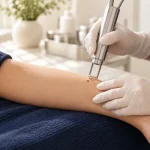
- Laser or light treatment
Light energy is delivered to the target vessels.
Patients may feel brief warmth, stinging, or a snapping sensation.
- Cooling and aftercare
Cooling or other post-treatment care may be used depending on the device and skin response.
Is Broken Capillary Laser Painful?
Discomfort varies according to:
- Device
- Energy settings
- Treatment area
- Vessel size
- Cooling
- Individual pain sensitivity
Patients often describe vascular laser pulses as brief heat, stinging, or a snapping sensation.
Treatment around the nose can sometimes feel more sensitive than other facial areas.
What Does the Skin Look Like Immediately After Treatment?
Depending on the device and settings, temporary changes may include:
- Redness
- Mild swelling
- Warmth
- Increased visibility or darkening of treated vessels
- Bruising
PDL can intentionally produce purpura, or purple bruising, with certain settings.
Not every vascular laser treatment needs to produce visible bruising.
Recovery and Downtime
Recovery depends heavily on the treatment method and settings.
Some treatments cause mainly temporary redness and swelling.
Others may produce noticeable bruising lasting several days.
Laser and light treatments for visible facial vessels may produce temporary redness, swelling or bruising.
If downtime matters—for example, before a wedding, meeting, flight, or holiday—this should be discussed before treatment.
Aftercare After Vascular Laser or IPL
Follow the specific instructions provided after treatment.
General principles often include:
- Gentle cleansing
- Moisturizer when needed
- Avoiding scratching or picking
- Avoiding irritating skincare until the skin settles
- Sun protection
- Avoiding intentional tanning
- Following instructions about exercise, heat, swimming and makeup
Sun protection is particularly important after laser and light procedures.
Possible Side Effects
Expected short-term effects can include:
- Redness
- Swelling
- Warmth
- Tenderness
- Bruising
Less common complications can include:
- Blistering
- Crusting
- Post-inflammatory hyperpigmentation
- Hypopigmentation
- Prolonged redness
- Infection
- Scarring
Burns, permanent color changes and scarring can occur when vascular procedures are used incorrectly.
Broken Capillary Treatment in Asian and Thai Skin
Vascular laser treatment can be performed in Asian skin, but skin tone is an important part of treatment planning.
The reason is that melanin and hemoglobin can both absorb light, depending on wavelength.
In darker or recently tanned skin, inappropriate settings may increase the risk of:
- Burns
- Post-inflammatory hyperpigmentation
- Hypopigmentation
This does not mean vascular laser is unsuitable for Thai skin.
It means treatment should account for:
- Baseline skin tone
- Recent tanning
- Vessel depth and diameter
- Wavelength
- Pulse duration
- Energy
- Cooling
- History of pigment changes
Asian studies have demonstrated improvement of facial telangiectasia using both PDL and appropriately configured IPL, although individual results and risks vary.
Can You Have Laser Treatment When Tanned?
Recent tanning can complicate light-based treatment because additional epidermal melanin may absorb more energy.
If you have recently spent significant time in the sun, tell your dermatologist before treatment.
This is particularly relevant for patients visiting Bangkok as part of a Thailand beach holiday.
Scheduling vascular treatment immediately after significant tanning—or immediately before intense sun exposure—may not be ideal.
Broken Capillaries Around the Nose
The sides of the nose are one of the most common places for visible facial vessels.
Patients often notice:
- A few individual red vessels
- Branching vessels around the nostrils
- Persistent redness around the nose
- Vessels associated with rosacea
Treatment depends on whether the problem is a small number of discrete vessels or part of more widespread facial redness.
Broken Capillaries on the Cheeks
Cheek telangiectasia is frequently associated with:
- Rosacea
- Sun exposure
- Genetics
- Aging
If the cheeks are also persistently red or flush easily, evaluation for rosacea is useful.
Treating visible vessels without managing active rosacea may leave the underlying tendency to redness unchanged.
Can Broken Capillaries Be Prevented?
Not every telangiectasia can be prevented, particularly when genetics or an underlying condition contributes.
However, sensible measures may reduce factors that promote redness or vascular damage:
- Consistent sun protection
- Avoiding unnecessary skin irritation
- Managing rosacea
- Avoiding known rosacea triggers when practical
- Avoiding repeated trauma to the skin
Prevention cannot guarantee that new vessels will never form.
Should Rosacea Be Treated Before the Vessels?
Not necessarily “before,
” but the two issues should be considered together.
Rosacea treatment may include:
- Gentle skincare
- Trigger management
- Topical medication
- Oral medication when indicated
- Laser or light procedures for vascular features
Medication can help inflammatory bumps and some types of redness, while vascular laser or light therapy is particularly useful for established visible vessels.
Broken Capillary Treatment for Tourists in Bangkok
For international patients visiting Bangkok, timing matters.
Before scheduling vascular laser or IPL, consider:
- How long you will remain in Bangkok
- Whether you are going to the beach afterward
- Recent tanning
- Upcoming flights
- Important events or photographs
- Whether bruising would be acceptable
- Whether follow-up treatment will be possible
- Your previous reaction to lasers
- History of PIH or abnormal scarring
Thailand’s strong year-round sun exposure makes post-treatment sun protection particularly important.
If your trip includes Phuket, Krabi, Koh Samui or another beach destination immediately afterward, discuss this before choosing the timing of treatment.
What to Expect During a Dermatology Consultation in Bangkok
A useful consultation should begin with the diagnosis—not the machine.
The dermatologist may assess:
- Is this actually telangiectasia?
- Are the vessels isolated or diffuse?
- Is rosacea present?
- Is there background facial redness?
- Are there inflammatory bumps?
- Are there eye symptoms?
- What is the vessel size and depth?
- What is the patient’s skin tone?
- Has the patient recently tanned?
- Is there a history of PIH?
- What treatments have already been tried?
- How much downtime is acceptable?
Only after this assessment does it make sense to decide whether laser, IPL, another procedure, medical treatment, or observation is appropriate.
Broken Capillaries Treatment: Quick Comparison
Treatment Often useful for Advantages Important limitations
PDL Visible red vessels, rosacea-associated vessels and redness
Vascular-specific, well studied May cause swelling or bruising; multiple sessions may be needed
IPL Diffuse redness and multiple fine
vessels
Treats a broader area Results depend strongly on filter, settings and device
Other vascular lasers Selected vessels depending on depth
and size
Can target particular vascular characteristics
Not every wavelength suits every vessel or skin tone
Electrodesiccation Selected small individual vessels Useful for focal treatment Crusting, pigment change or scarring can occur
Rosacea medication Inflammatory rosacea and some forms
of background redness
Treats underlying rosacea features
Usually does not physically remove established vessels
Sun protection Rosacea and sun-related vascular
change
Helps reduce aggravating exposure
Cannot remove existing dilated vessels
Frequently asked questions
What are broken capillaries?
They are persistently enlarged superficial blood vessels that become visible through the skin. The medical term is telangiectasia.
Are broken capillaries actually broken?
Usually not. The term is misleading. They are generally dilated visible vessels rather than vessels that have physically ruptured.
Why do I have broken capillaries on my face?
Common contributors include rosacea, sun exposure, genetics, aging and certain skin or medical conditions.
Why do I have broken capillaries around my nose?
The nose is a common location for superficial facial vessels. They may occur alone or as part of rosacea.
What causes broken capillaries on the cheeks?
Rosacea, sun exposure, genetics and aging are common contributors.
Are broken capillaries rosacea?
Not necessarily. Rosacea can cause visible vessels, but a few isolated telangiectasias do not automatically mean you have rosacea.
Are broken capillaries dangerous?
Most isolated facial telangiectasias are benign.
Can broken capillaries disappear naturally?
Persistent established vessels usually do not disappear as readily as temporary facial flushing.
Can skincare remove broken capillaries?
Skincare can support the skin and manage rosacea, but generally cannot physically remove an established dilated vessel.
Does vitamin C remove broken capillaries?
Vitamin C skincare should not be expected to eliminate established facial telangiectasia.
Can retinol remove broken capillaries?
Retinol does not physically close established superficial vessels.
What is the best treatment for broken capillaries?
The best option depends on vessel size, depth, color, skin tone and whether rosacea or diffuse redness is present.
Can laser remove broken capillaries?
Vascular lasers are established treatments for visible facial vessels.
What laser is best for broken capillaries?
There is no single best laser for every vessel. PDL is well studied, while other vascular wavelengths may be appropriate depending on vessel characteristics.
Is PDL good for broken capillaries?
Yes. PDL is one of the established treatments for facial telangiectasia and rosacea-associated visible vessels.
Is V-Beam the same as PDL?
V-Beam is a brand of pulsed dye laser technology.
“PDL” describes the laser category rather than one specific brand.
Can IPL treat broken capillaries?
Yes. Appropriately configured IPL can improve facial telangiectasia and diffuse vascular redness.
PDL vs IPL: which is better?
Both can be effective. The appropriate choice depends on the vessel pattern, skin tone, treatment area and device parameters.
Does broken capillary laser hurt?
Treatment can cause brief stinging, warmth or a snapping sensation. Discomfort varies by device, settings and treatment area.
Does vascular laser cause bruising?
It can. Some PDL settings can intentionally produce purpura or temporary purple bruising.
How long is the downtime?
It varies. Some patients experience only temporary redness and swelling, while others develop bruising for several days.
How many treatments will I need?
There is no fixed number. Multiple treatments may be necessary depending on the vessels and underlying condition.
Can broken capillaries return after laser?
Successfully treated vessels may remain closed, but new vessels can develop later.
Is vascular laser permanent?
It is more accurate to describe long-term vessel reduction rather than guaranteed permanent removal.
Can laser make redness worse?
Temporary redness after treatment is common. Inappropriate treatment can also cause burns, pigment changes or prolonged redness.
Is vascular laser safe for Asian skin?
It can be used in appropriately selected Asian patients, but skin tone, tanning and pigmentation risk need to be considered carefully.
Can vascular laser cause PIH?
Yes. Post-inflammatory hyperpigmentation is a possible complication, particularly in pigment-prone skin.
Can I have vascular laser if I am tanned?
Recent tanning can increase treatment complexity and risk. Tell the treating dermatologist about recent sun exposure.
Can I go to the beach after vascular laser?
Intense sun exposure immediately after treatment is generally undesirable. If your Bangkok visit includes a beach trip, discuss timing before treatment.
Can I exercise after vascular laser?
This depends on the treatment and your skin response. Follow the specific post-treatment instructions provided by your clinician.
Can I wear makeup after vascular laser?
Timing depends on the treatment and condition of the skin afterward. Follow your clinician's instructions.
Does sunscreen prevent broken capillaries?
It cannot prevent every telangiectasia, but sun protection reduces cumulative UV exposure that can contribute to facial vascular changes.
Can broken capillaries be caused by steroid creams?
Long-term or inappropriate use of potent topical corticosteroids on facial skin can contribute to skin thinning and visible superficial vessels. If steroid-related changes are suspected, seek medical assessment rather than abruptly changing prescribed treatment without advice.
Can broken capillaries be caused by alcohol?
Alcohol can trigger temporary flushing in some people, especially those with rosacea. Persistent telangiectasia has multiple possible causes, so visible facial vessels should not automatically be attributed to alcohol.
When should I worry about multiple broken capillaries?
Seek medical evaluation if numerous telangiectasias appear unexpectedly, particularly with recurrent nosebleeds, bleeding lesions, oral lesions or a strong family history of similar problems.
Can tourists have broken capillary laser treatment in Bangkok?
Potentially, yes. The timing should account for sun exposure, tanning, downtime, follow-up and subsequent travel.
Related conditions
-
Rosacea Rosacea Rosacea is a chronic inflammatory skin condition that mainly affects the central face. It may cause persistent redness, frequent flushing, visible blood vessels, acne-like bumps, burning or sensitive skin, and sometimes eye symptoms.

-
Facial Redness Facial Redness Facial redness can mean many different things.

-
Vascular Laser / V-Beam Vascular Laser / V-Beam Persistent facial redness, visible small blood vessels and recurrent flushing are common reasons patients seek dermatologic care. Although these concerns are often grouped together as “redness,
-
Post-inflammatory Hyperpigmentation Post-inflammatory Hyperpigmentation Post-inflammatory hyperpigmentation (PIH) is the flat brown, dark brown, or grayish discoloration that remains after inflammation or injury to the skin. It commonly follows acne, eczema, insect bites, burns, scratching, irritation, and some dermatologic procedures.