





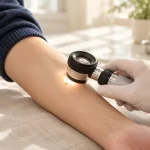




















Urticaria / Hives
Urticaria, commonly called hives, is a skin condition that causes raised, swollen, usually itchy welts that can appear suddenly and disappear again within hours.
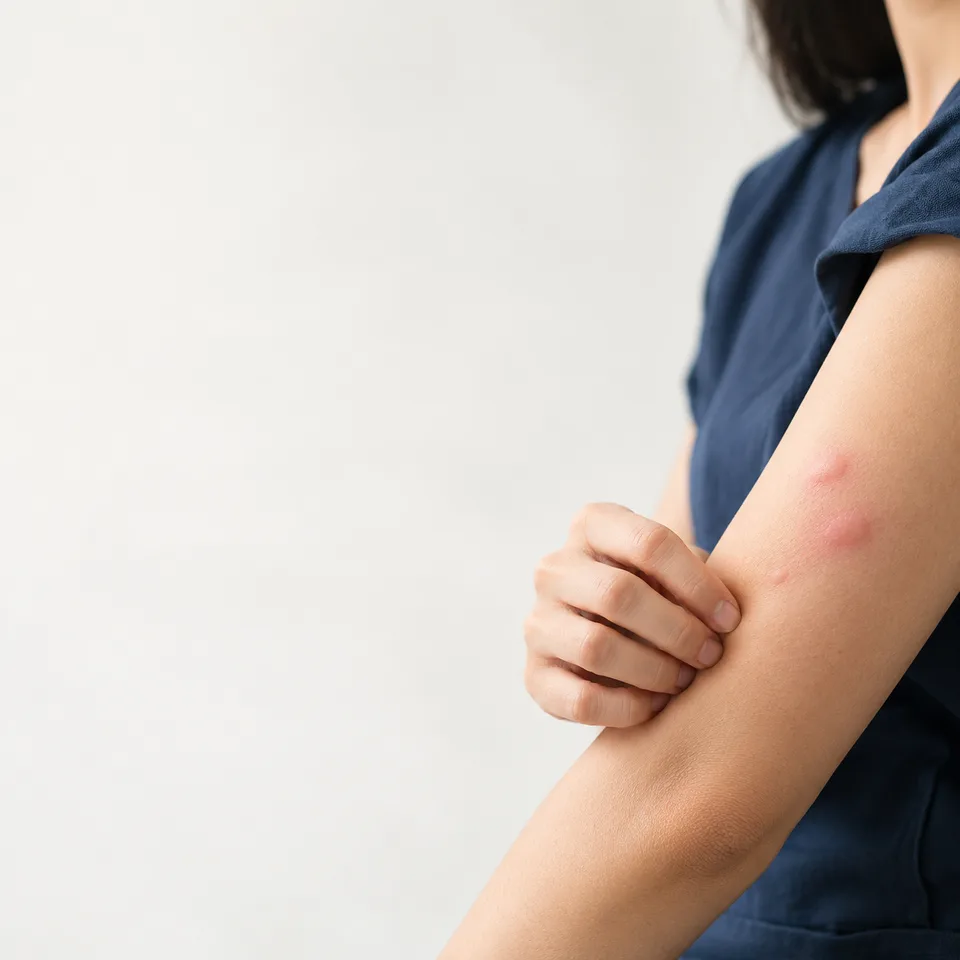
Individual hives typically last less than 24 hours, although new lesions may continue to appear elsewhere. Some people also develop angioedema, a deeper swelling that commonly affects the lips, eyelids, hands or feet.
Urticaria can be acute, lasting less than 6 weeks, or chronic, when hives continue or repeatedly recur for 6 weeks or longer. Chronic urticaria is often not caused by a traditional food or environmental allergy, and extensive allergy testing is usually unnecessary unless the patient’s history suggests a specific trigger.
Treatment usually begins with modern second-generation antihistamines. For chronic urticaria that remains uncontrolled, current international guidelines recommend a stepwise approach that may include increasing the antihistamine dose and considering additional therapies such as omalizumab in appropriate patients.
For patients in Bangkok—including Thai patients, expats, tourists and international visitors—the most important first step is determining whether the rash is truly urticaria, whether there is angioedema or anaphylaxis, and whether the condition is acute, chronic spontaneous or triggered by a physical stimulus.
What Is Urticaria?
Urticaria occurs when mast cells in the skin release histamine and other inflammatory mediators.
These chemicals cause small blood vessels in the skin to leak fluid, producing the characteristic raised swelling known as a wheal or hive.
A typical hive:
- Is raised above the surrounding skin
- Often itches intensely
- May be round, irregular or ring-shaped
- Can change shape
- May merge with nearby hives
- Often fades when pressed
- Usually disappears within 24 hours without leaving a permanent mark New hives can continue appearing after earlier ones disappear.
This changing pattern is one of the most useful clues that a rash is urticaria rather than eczema, contact dermatitis or another inflammatory skin disease.
What Do Hives Look Like?
In lighter skin tones, hives often appear pink or red with a raised pale or red center.
In Asian and darker skin tones, redness may be much less obvious. Hives may appear:
- Skin-colored
- Purple
- Gray
- Dark brown
- Slightly darker or lighter than surrounding skin
The raised swelling and sudden appearance may therefore be more helpful than color alone when identifying urticaria.
What Is Angioedema?
Angioedema is swelling deeper within the skin or mucous membranes.
Common locations include:
- Lips
- Eyelids
- Face
- Hands
- Feet
- Genital area
Unlike superficial hives, angioedema may feel:
- Tight
- Painful
- Burning
- Heavy
rather than intensely itchy.
A hive usually resolves within 24 hours, whereas angioedema may take longer—sometimes up to several days—to disappear.
When Are Hives an Emergency?
Most urticaria is uncomfortable rather than dangerous.
However, hives can occur as part of anaphylaxis, which is a medical emergency.
Seek emergency medical care immediately if hives or swelling occur with:
- Difficulty breathing
- Wheezing
- Throat tightness
- Tongue swelling
- Swelling inside the mouth or throat
- Difficulty swallowing
- Dizziness
- Fainting
- Rapid heartbeat
- Severe weakness
- Repeated vomiting associated with an allergic reaction
Facial swelling alone is not always anaphylaxis, but swelling involving the tongue or throat or causing breathing or swallowing difficulty requires urgent assessment.
Acute vs Chronic Urticaria
The duration of symptoms is clinically important.
Acute Urticaria
Acute urticaria lasts less than 6 weeks.
Possible triggers include:
- Viral infections
- Other infections
- Medicines
- Foods
- Insect stings
- Latex
- Occasionally another identifiable allergy
However, even in acute urticaria, the exact cause is not always found.
Chronic Urticaria
Chronic urticaria occurs when hives and/or angioedema continue or repeatedly recur for 6 weeks or longer.
It can be divided into:
- Chronic spontaneous urticaria
- Chronic inducible urticaria
This distinction helps guide both investigation and treatment.
What Is Chronic Spontaneous Urticaria?
Chronic spontaneous urticaria (CSU) means recurrent hives, angioedema or both for at least 6 weeks without one consistent external physical trigger explaining the episodes.
The term “spontaneous” does not mean the symptoms are imaginary or psychological.
It means the hives occur without a predictable external stimulus such as cold, pressure or heat.
In many patients, chronic spontaneous urticaria involves abnormal activation of mast cells and can have autoimmune mechanisms.
This is very different from assuming that the patient must be repeatedly eating something they are allergic to.
Is Chronic Urticaria Usually Caused by Food Allergy?
Usually not.
This is one of the most important misconceptions about chronic hives.
Food allergy is much more likely when:
- A specific food repeatedly causes symptoms
- Hives appear soon after eating it
- The same reaction occurs again with re-exposure
- Other allergy symptoms occur, such as lip swelling, vomiting, wheezing or anaphylaxis By contrast, someone who develops unpredictable hives on most days for months is less likely to have an undiagnosed food allergy as the explanation.
Modern urticaria guidelines therefore discourage indiscriminate allergy testing and very broad elimination diets in chronic spontaneous urticaria when the history does not suggest a specific allergy.
Do I Need to Avoid Seafood, Eggs, Milk or Other Foods?
Not automatically.
A common pattern is for patients with chronic hives to progressively eliminate:
- Seafood
- Eggs
- Milk
- Nuts
- Wheat
- Gluten
- Soy
- Chicken
- Beef
- Spicy food
without clear evidence that any of these foods are actually responsible.
This can make eating unnecessarily restrictive without controlling the urticaria.
A more useful question is:
Does the same food repeatedly cause hives within a consistent time period after eating it?
If not, routine long-term avoidance may not be helpful.
What Is Chronic Inducible Urticaria?
Chronic inducible urticaria occurs when hives are consistently triggered by a specific physical stimulus.
Examples include:
- Scratching or rubbing
- Pressure
- Heat
- Cold
- Exercise
- Sweating
- Sunlight
- Water
- Vibration
The trigger varies according to the subtype.
Dermographism
Dermographism means “skin writing.
”
In this type of inducible urticaria, rubbing or scratching the skin produces raised linear welts.
Patients may notice hives after:
- Scratching
- Tight clothing
- Toweling dry
- Carrying bags
- Friction from straps
A dermatologist can sometimes reproduce the reaction during examination by gently stroking the skin.
Cholinergic Urticaria
Cholinergic urticaria typically causes many small itchy hives after the body temperature rises.
Triggers may include:
- Exercise
- Sweating
- Hot showers
- Hot weather
- Emotional stress
This can be particularly relevant for people living in Bangkok, where heat and sweating are common.
Cholinergic urticaria should be distinguished from exercise-induced anaphylaxis, which can be more serious.
Cold Urticaria
Cold urticaria is triggered by exposure to low temperature.
Examples include:
- Cold air
- Cold objects
- Cold water
- Swimming in cold water
The reaction can sometimes be more significant when a large body surface is exposed suddenly, such as during swimming.
Patients with suspected cold urticaria should therefore be assessed rather than intentionally testing themselves by jumping into very cold water.
Delayed Pressure Urticaria
Pressure can cause deeper swelling several hours later.
Common triggers include:
- Heavy shoulder bags
- Tight belts
- Sitting for long periods
- Tight footwear
- Carrying heavy equipment
Lesions may be more painful than itchy and can persist longer than ordinary superficial hives.
Heat Urticaria
Local heat can trigger hives in some patients.
This differs from cholinergic urticaria, which is triggered by an increase in overall body temperature and sweating.
Solar Urticaria
Solar urticaria causes hives after exposure to sunlight.
It should be distinguished from:
- Sunburn
- Polymorphic light eruption
- Drug-induced photosensitivity
- Lupus-related photosensitivity
because these conditions require different approaches.
Aquagenic Urticaria
Aquagenic urticaria is a rare condition in which water exposure triggers hives.
It is different from simply having dry or itchy skin after showering.
What Causes Acute Hives?
Acute hives may be related to several factors.
Infection
Viral infection is a common association, particularly in children.
Hives can occur during or shortly after an infection even if the patient has never had urticaria before.
Medication
Possible medications include:
- Antibiotics
- NSAIDs such as ibuprofen or aspirin in susceptible patients
- Other prescription or over-the-counter medicines
However, a rash developing while taking an antibiotic does not automatically prove true antibiotic allergy.
The timing and clinical pattern matter.
Food Allergy
Food allergy can cause acute hives when the reaction is reproducible and occurs relatively soon after exposure.
Common accompanying symptoms may include:
- Lip swelling
- Vomiting
- Abdominal symptoms
- Wheezing
- Anaphylaxis
Insect Sting
Bee or wasp stings can cause generalized urticaria as part of an allergic reaction.
Unknown Cause
Sometimes no cause is identified even after careful history.
This is common and does not necessarily mean something serious has been missed.
What Causes Chronic Spontaneous Urticaria?
The biology is more complex than simple external allergy.
Mast cells become excessively activated and release histamine and other mediators.
In some patients, autoimmune mechanisms appear to contribute.
Chronic urticaria may also coexist with autoimmune thyroid disease or other conditions, but the presence of urticaria alone does not mean a patient has an autoimmune disease.
The 2026 international guideline emphasizes a focused diagnostic approach rather than performing large numbers of tests without clinical indication.
Can Stress Cause Hives?
Stress can worsen urticaria in some people.
It may increase:
- Itching
- Scratching
- Mast-cell activation
- Perception of symptoms
- Sleep disturbance
But chronic urticaria should not be dismissed as “just stress.
”
It is a real mast-cell-driven inflammatory disease.
Does Heat in Bangkok Make Urticaria Worse?
It can in some patients.
Heat and sweating may aggravate:
- Cholinergic urticaria
- Dermographism
- Existing chronic spontaneous urticaria in some people
Hot showers may also intensify itching and flushing.
Practical measures in Bangkok may include:
- Avoiding overheating when possible
- Taking lukewarm rather than very hot showers
- Wearing lightweight breathable clothing
- Cooling down gradually after exercise
- Avoiding excessive rubbing with towels
- Using air conditioning or fans appropriately when heat clearly triggers symptoms However, not every patient needs to avoid heat.
Trigger management should be individualized.
Can Alcohol Make Hives Worse?
Alcohol can worsen flushing and hives in some patients, partly through vascular and mast-cell effects.
This does not mean alcohol is the underlying cause of chronic urticaria.
Patients should assess whether there is a consistent relationship rather than assuming universal avoidance is necessary.
Can Painkillers Make Hives Worse?
NSAIDs such as aspirin or ibuprofen may aggravate urticaria in some people with chronic spontaneous urticaria.
Current guidance therefore recommends asking specifically about medication-related worsening.
If a medication appears to worsen hives, discuss alternatives with a doctor rather than stopping medically necessary treatment without advice.
Urticaria vs Contact Dermatitis
Contact dermatitis usually:
- Persists for days
- Causes dryness, scaling or blistering
- Stays in areas exposed to a product or chemical
- Does not migrate around the body within hours
Hives typically:
- Are raised
- Change shape
- Appear and disappear
- Move to different locations
- Resolve individually within 24 hours
Urticaria vs Eczema
Eczema usually produces:
- Dryness
- Scaling
- Cracking
- Chronic itchy patches
- Persistent inflammation
Individual eczema lesions do not normally disappear completely within several hours and reappear elsewhere.
Urticaria vs Insect Bites
Insect bites can produce itchy raised bumps, but individual lesions often remain for several days.
They may also show:
- A central bite mark
- Grouped distribution
- Exposure pattern
True hives generally fade within 24 hours.
Urticaria vs Scabies
Scabies typically causes:
- Severe nighttime itch
- Persistent small bumps
- Finger-web involvement
- Wrist involvement
- Genital or waist involvement
- Itching in household members
Unlike urticaria, scabies is contagious and requires antiparasitic treatment.
Urticaria vs Urticarial Vasculitis
Urticarial vasculitis can resemble ordinary hives but has important differences.
Warning clues include individual lesions that:
- Remain in the same place for more than 24 hours
- Hurt or burn more than itch
- Leave bruising or persistent pigmentation
- Occur with fever, joint pain or systemic symptoms
These features warrant medical evaluation and may require further testing or skin biopsy.
Chronic hives that leave bruises should not automatically be treated as ordinary urticaria.
How Is Urticaria Diagnosed?
Diagnosis is usually clinical.
A dermatologist will ask about:
- Appearance of the hives
- How long each individual lesion lasts
- Frequency
- Duration of the overall problem
- Angioedema
- Medication
- Food exposures
- Infection
- Exercise
- Heat
- Cold
- Pressure
- Sun exposure
- Stress
- Travel
- Occupational exposure
- Family history
One of the most useful questions is:
How long does each individual hive remain in exactly the same place?
If the answer is less than 24 hours, urticaria becomes more likely.
Photographs are extremely useful because patients often arrive at the clinic after the hives have disappeared.
Do I Need Blood Tests for Urticaria?
Not everyone.
For acute urticaria with an obvious short course, blood tests are often unnecessary.
For chronic spontaneous urticaria, international guidelines generally favor limited baseline investigation rather than a very broad screening panel.
Testing may be expanded if the history suggests:
- Thyroid disease
- Autoimmune disease
- Persistent infection
- Systemic inflammation
- Urticarial vasculitis
- Another systemic disorder
Extensive routine testing without a clinical clue is often low-yield.
Do I Need an Allergy Test?
Not automatically.
Allergy testing is more useful when the history suggests a specific trigger, such as:
- A particular food
- Latex
- Insect venom
- A medication
- Another immediate allergic exposure
Chronic spontaneous urticaria usually does not require broad food or environmental allergy panels.
Testing should answer a clinical question rather than simply produce a long list of results.
Is Patch Testing Useful for Hives?
Usually not.
Patch testing is used mainly for allergic contact dermatitis, which is a delayed skin allergy.
Urticaria is a different type of reaction.
If a patient develops raised hives that disappear within hours, ordinary patch testing is generally not the investigation used to identify the cause.
What About Thyroid Testing?
Autoimmune thyroid disease can coexist with chronic spontaneous urticaria.
Depending on the clinical history, thyroid testing may sometimes be considered.
However, thyroid disease is not the explanation for every patient with chronic hives, and discovering a thyroid antibody does not necessarily mean it is directly causing each hive.
How Is Inducible Urticaria Diagnosed?
Provocation testing may sometimes help confirm a specific subtype.
Examples include controlled:
- Skin stroking for dermographism
- Cold exposure for cold urticaria
- Pressure testing
- Exercise or heat-related testing in selected cases
Testing should be performed appropriately because some forms of inducible urticaria can cause more significant reactions.
How Is Urticaria Treated?
The goals are to:
- Control itching
- Prevent new hives
- Control angioedema
- Identify relevant triggers when possible
- Maintain normal daily activities
- Avoid unnecessary medication side effects
The current international treatment approach is stepwise.
Second-Generation Antihistamines
Modern second-generation H1 antihistamines are the foundation of urticaria treatment.
Examples include medications such as:
- Cetirizine
- Levocetirizine
- Loratadine
- Desloratadine
- Fexofenadine
- Bilastine
- Rupatadine
Availability varies by country.
These drugs block the effects of histamine released by mast cells.
Second-generation antihistamines are generally preferred over older sedating antihistamines for routine chronic treatment because they have fewer sedative and anticholinergic effects.
Should Antihistamines Be Taken Only When Hives Appear?
For occasional acute hives, treatment may be used according to clinical need.
For chronic urticaria, regular daily treatment is often more effective than repeatedly waiting for symptoms to become severe.
The goal is to prevent new hives, not simply respond after every outbreak.
What If One Antihistamine Tablet Is Not Enough?
Current international guidelines recommend that patients with chronic urticaria who remain symptomatic on a standard dose of a second-generation H1 antihistamine may have the dose increased up to fourfold under medical guidance.
Higher-than-fourfold dosing is not recommended.
Up-dosing above the standard licensed dose may be off-label depending on the medication and country, so patients should not simply increase medication themselves without appropriate medical advice.
Why Are Older Sedating Antihistamines Not Usually First Choice?
Older antihistamines can cause:
- Drowsiness
- Slower reaction time
- Impaired concentration
- Dry mouth
- Other anticholinergic effects
This can be particularly relevant for:
- Driving
- Working
- Studying
- Operating machinery
- Older adults
Sedating antihistamines may still be used in specific circumstances, but routine chronic treatment generally favors second-generation agents.
Do Steroid Creams Treat Hives?
Usually not very effectively.
Urticaria occurs through mast-cell mediator release throughout the skin rather than the type of localized inflammation seen in eczema.
Because each hive disappears spontaneously, topical corticosteroids are generally much less important for urticaria than they are for eczema or contact dermatitis.
What About Oral Steroids?
Short courses of systemic corticosteroids may sometimes be considered for severe acute exacerbations.
However, oral steroids are not a good long-term treatment for chronic urticaria.
Repeated or prolonged use can produce substantial side effects and does not address the underlying tendency to develop recurrent hives.
International guidance favors antihistamines and targeted treatment rather than long-term systemic corticosteroids.
Omalizumab for Chronic Spontaneous Urticaria
Omalizumab is a monoclonal antibody targeting IgE.
It is an established treatment for chronic spontaneous urticaria that remains inadequately controlled despite high-dose second-generation antihistamines.
The updated international guideline recommends adding omalizumab when chronic urticaria remains uncontrolled on high-dose second-generation H1 antihistamines.
It can reduce:
- Hives
- Itching
- Angioedema
- Disease burden
However, it does not work for everyone, and response can take time.
It is not a permanent cure; recurrence may occur after treatment is discontinued.
Availability, approval and insurance coverage vary between countries, so patients in Thailand should discuss locally available treatment options rather than assuming that every international indication applies automatically.
What If Omalizumab Does Not Fully Control the Hives?
Specialist management may involve reassessing:
- Diagnosis
- Adherence
- Antihistamine dosing
- Inducible urticaria
- Relevant triggers
- Other possible diseases
The updated international guideline discusses treatment adjustments for inadequate response to omalizumab, but some approaches are off-label and require specialist supervision.
Ciclosporin for Chronic Urticaria
Ciclosporin can reduce mast-cell activity and immune activation and may help selected patients with severe chronic urticaria that has not responded to licensed therapies.
However, it is not a routine first-line treatment.
Potential concerns include:
- Kidney effects
- High blood pressure
- Infection risk
- Drug interactions
It requires careful patient selection and monitoring.
The 2026 international guideline suggests ciclosporin for selected patients with chronic urticaria that remains uncontrolled despite other appropriate treatments, while emphasizing its greater adverse-effect burden.
Newer Treatments for Chronic Urticaria
Treatment options for chronic spontaneous urticaria are evolving.
The updated 2026 international guideline discusses newer targeted treatments, including biologic and small-molecule therapies for patients inadequately controlled with antihistamines.
For example, the guideline discusses:
- Dupilumab
- Remibrutinib
However, approval status, age indication, availability and prescribing requirements vary considerably between countries.
Patients in Bangkok should therefore discuss current Thailand-specific options with their treating physician rather than assuming that a recently approved treatment elsewhere is locally available or appropriate.
Can Urticaria Be Cured Permanently?
There is currently no treatment that guarantees permanent cure for chronic spontaneous urticaria.
Treatment aims for complete disease control while the disease is active.
Fortunately, chronic urticaria can eventually enter spontaneous remission.
The timing is unpredictable and varies considerably between individuals.
Some patients improve within months, while others continue to experience symptoms for years.
Does Stopping Treatment Make the Hives Come Back?
It can.
If the underlying urticaria is still active, symptoms may return when medication is reduced or stopped.
This does not necessarily mean the medication caused dependence.
It usually means the treatment was controlling a disease process that has not yet gone into remission.
Doctors may periodically reduce treatment when the patient has remained fully controlled to determine whether continued therapy is still necessary.
Can Antihistamines Be Taken Long Term?
Modern second-generation antihistamines are commonly used for long-term control of chronic urticaria when clinically indicated.
The specific medication, dose and patient’s medical history should be considered.
Older sedating antihistamines are generally less desirable for prolonged routine use because of their effects on alertness and cognition.
What Can I Do at Home During a Hives Flare?
For uncomplicated hives, practical measures can include:
- Use a cool compress
- Avoid scratching
- Avoid aggressive rubbing
- Wear loose clothing
- Avoid overheating if heat worsens symptoms
- Take prescribed antihistamine as directed
- Avoid a clearly identified trigger
AAD recommends cooling the skin and avoiding rubbing because friction can provoke additional hives in susceptible patients.
Should I Take a Hot Shower for Hives?
Very hot showers may intensify itching and vasodilation.
Lukewarm or cooler showers are usually better tolerated during an active flare.
This can be especially relevant in Bangkok when patients are already overheated.
Can I Exercise if I Have Urticaria?
Usually yes, but it depends on the type.
Someone with mild chronic spontaneous urticaria may continue normal exercise.
However, if exercise consistently causes:
- Widespread hives
- Breathing difficulty
- Dizziness
- Wheezing
- Abdominal symptoms
- Collapse
medical evaluation is important because exercise-induced anaphylaxis must be considered.
Can I Swim if I Have Cold Urticaria?
This requires caution.
Large-area cold-water exposure can produce a more extensive reaction than touching a small cold object.
Patients with confirmed or strongly suspected cold urticaria should discuss safe activity and emergency planning with their doctor before cold-water swimming.
Does Urticaria Leave Scars or Dark Marks?
Ordinary urticaria usually resolves without scarring.
Individual lesions should disappear without leaving a lasting mark.
If lesions consistently leave:
- Bruising
- Dark pigmentation
- Persistent redness
or remain in the same place longer than 24 hours, another diagnosis such as urticarial vasculitis should be considered.
When Should You See a Dermatologist for Hives?
Consider dermatology assessment when:
- Hives persist beyond 6 weeks
- Hives occur most days
- Antihistamines are not controlling symptoms
- Angioedema occurs repeatedly
- Hives interfere with sleep
- Symptoms interfere with work or school
- You are eliminating many foods without improvement
- You are unsure whether allergy testing is needed
- A physical trigger such as heat, cold or pressure is suspected
- Individual lesions last longer than 24 hours
- Hives leave bruises
- You need repeated systemic steroids
- The diagnosis is uncertain
- Advanced treatment may be required
AAD specifically recommends medical evaluation for persistent chronic hives and emphasizes that chronic spontaneous urticaria often does not have an identifiable external trigger despite being treatable.
When Should You Seek Urgent or Emergency Medical Care?
Seek emergency care immediately for:
- Difficulty breathing
- Throat swelling
- Tongue swelling
- Trouble swallowing
- Wheezing
- Fainting or near-fainting
- Severe dizziness
- Rapidly worsening generalized allergic reaction
Seek prompt medical assessment for:
- Hives with fever and significant illness
- Painful lesions lasting more than 24 hours
- Bruising after each lesion
- Significant unexplained angioedema
- Recurrent angioedema without hives
- Severe abdominal attacks associated with angioedema
Angioedema without hives can sometimes have mechanisms different from ordinary histamine-driven urticaria and may require a different diagnostic approach.
Angioedema Without Hives
Recurrent swelling without hives deserves particular attention.
Possible causes include:
- Medication-related angioedema
- ACE inhibitor-associated angioedema
- Hereditary angioedema
- Acquired C1 inhibitor deficiency
- Other forms of non-histaminergic angioedema
These conditions may not respond to ordinary antihistamine treatment in the same way as urticaria-associated angioedema.
Patients with recurrent unexplained angioedema—particularly involving the face, tongue or abdomen—should receive appropriate medical assessment.
What to Expect During an Urticaria Consultation in Bangkok
A useful urticaria consultation should establish the pattern before ordering numerous tests.
The dermatologist may ask:
- When did the hives start?
- How frequently do they occur?
- How long does each individual lesion last?
- Do they completely disappear?
- Do they leave bruising?
- Is there angioedema?
- Do you have breathing difficulty?
- Does scratching trigger welts?
- Does exercise trigger hives?
- Does heat or sweating trigger them?
- Does cold trigger symptoms?
- Does pressure cause swelling?
- Are medications involved?
- Are NSAIDs involved?
- Is there a consistent relationship with food?
- Have there been recent infections?
- Are there fever, joint symptoms or other systemic features?
The skin may be completely normal during the consultation.
Therefore, patients should ideally bring:
- Clear photographs of the hives
- Photographs showing swelling
- A list of current medications
- A timeline of when symptoms occur
- Previous allergy-test results
- Previous laboratory results
- Names and doses of antihistamines already tried
For tourists and international patients in Bangkok, photographs are particularly valuable when symptoms appeared before arriving in Thailand or fluctuate rapidly.
Successful Urticaria Treatment Starts With Classifying the Disease Correctly
When someone develops recurrent hives, the most useful question is often not simply:
“What am I allergic to?”
A better assessment asks:
Is this actually urticaria?
How long does each hive last?
Is there angioedema?
Is this acute or chronic?
If chronic, is it spontaneous or inducible?
Is there a reproducible trigger such as cold, pressure, scratching, exercise or heat?
Is there convincing evidence of food or drug allergy?
Do individual lesions persist longer than 24 hours or leave bruising?
Is the current antihistamine treatment being used appropriately?
Does the disease require escalation beyond standard-dose antihistamines?
Modern chronic urticaria management is therefore focused less on performing increasingly large allergy panels and more on accurate classification, symptom control and appropriate stepwise treatment.
The updated 2026 international EAACI/GA²LEN/EuroGuiDerm/APAAACI guideline supports second-generation H1 antihistamines as first-line therapy, up-dosing to a maximum of fourfold when needed, and escalation to therapies such as omalizumab for patients who remain uncontrolled.
For patients with chronic symptoms, the realistic treatment goal is complete or near-complete control while the disease is active, with periodic reassessment to determine when medication can safely be reduced.
Frequently asked questions
What is urticaria?
Urticaria is a condition causing raised, swollen, usually itchy welts that appear suddenly and generally disappear individually within 24 hours.
Are urticaria and hives the same thing?
Yes.
“Hives” is the common English term for urticaria.
Is urticaria contagious?
No.
Urticaria cannot spread from person to person.
How long does one hive last?
A typical individual hive usually lasts from minutes to less than 24 hours.
New lesions may continue to appear elsewhere.
What does it mean if a hive stays longer than 24 hours?
Persistent lesions, especially if painful or bruising, may indicate another diagnosis such as urticarial vasculitis and should be assessed.
What is the difference between acute and chronic urticaria?
Acute urticaria lasts less than 6 weeks.
Chronic urticaria persists or repeatedly occurs for 6 weeks or longer.
What is chronic spontaneous urticaria?
It is recurrent hives and/or angioedema lasting at least 6 weeks without one predictable external physical trigger.
Is chronic urticaria usually caused by food allergy?
Usually not.
A true food allergy is more likely when the same food repeatedly produces symptoms shortly after eating.
Should I get an allergy test for chronic hives?
Not routinely.
Testing is most useful when the history points to a specific allergic trigger.
Should I avoid seafood if I have chronic hives?
Not unless seafood consistently triggers your symptoms or a relevant allergy has been confirmed.
Can stress cause hives?
Stress can worsen hives in some people but is usually not the complete explanation for chronic spontaneous urticaria.
Can heat cause hives?
Yes.
Heat and sweating may trigger cholinergic urticaria and can worsen symptoms in some people with other types of urticaria.
Why do I get hives after exercise?
Exercise may trigger cholinergic urticaria, but more serious exercise-induced allergic reactions should be considered if symptoms include breathing problems, dizziness or systemic symptoms.
Why do I get hives after scratching?
This may be dermographism, a type of chronic inducible urticaria.
Can cold cause hives?
Yes.
Cold urticaria causes hives or swelling after cold exposure.
Can I swim if I have cold urticaria?
Cold-water swimming can provoke significant reactions in some patients, so medical assessment and safety advice are recommended.
What is angioedema?
Angioedema is deeper swelling beneath the skin, often affecting the lips, eyelids, hands or feet.
Is angioedema dangerous?
It can be.
Swelling of the tongue or throat or difficulty breathing or swallowing requires emergency medical care.
What is the best medicine for hives?
Modern second-generation H1 antihistamines are the usual first-line treatment.
The appropriate medication and dose depend on the type and severity of urticaria.
What if one antihistamine tablet does not work?
For chronic urticaria, international guidelines allow medical up-dosing of a second-generation antihistamine up to four times the standard dose in appropriate patients. This should be supervised because doses above the licensed dose may be off-label.
Can I take antihistamines every day?
Daily treatment is commonly used for chronic urticaria when needed to maintain control.
The medication and dose should be appropriate for the individual patient.
Do steroid creams help hives?
Usually very little compared with their role in eczema because urticaria is driven primarily by mast-cell mediators such as histamine.
Are oral steroids good for chronic hives?
Repeated or long-term systemic steroids are generally discouraged because of their side effects.
Short courses may occasionally be used for severe exacerbations under medical supervision.
What is omalizumab?
Omalizumab is an anti-IgE monoclonal antibody used for chronic spontaneous urticaria that remains inadequately controlled despite high-dose antihistamine treatment.
Is omalizumab a cure for urticaria?
No.
It can provide strong disease control in appropriate patients, but chronic urticaria may recur after treatment is stopped.
How long does chronic urticaria last?
The course varies greatly.
Some patients enter remission within months, while others continue having symptoms for years.
Can urticaria leave dark marks?
Ordinary hives normally disappear without persistent pigmentation.
Hives that leave bruises or dark marks repeatedly should be reassessed.
Does Bangkok's hot weather worsen hives?
Heat and sweating can aggravate symptoms in some patients, particularly those with cholinergic urticaria, but Bangkok's climate does not cause all chronic urticaria.
Related conditions
-
Contact Dermatitis Contact Dermatitis Contact dermatitis is a type of eczema caused by something that touches the skin. It can result from direct irritation or from a delayed allergic reaction to a substance such as fragrance, preservatives, metals, hair dye, rubber, cosmetics, cleaning products or workplace chemicals.

-
Atopic Dermatitis / Eczema Atopic Dermatitis / Eczema Atopic dermatitis, commonly called eczema or atopic eczema, is a chronic inflammatory skin condition that causes dry, itchy and easily irritated skin. It can affect children and adults and often goes through cycles of improvement and flare-ups.

-
Chronic Itch & Rashes Chronic Itch & Rashes Persistent itching or a rash that keeps coming back can be frustrating because “itch” is a symptom, not a diagnosis.