









Rejuran vs Plinest vs Vitara: Key Differences, Benefits, and Results
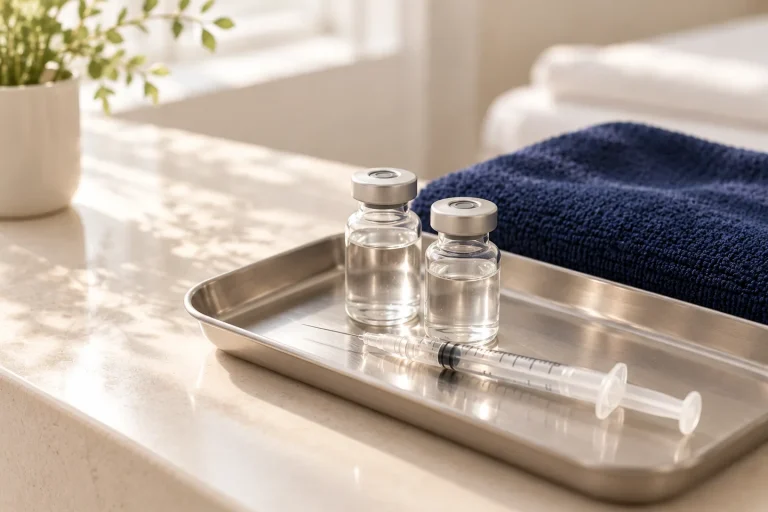
Polynucleotide (PN) injections have become increasingly popular for patients seeking improvements in skin texture, fine lines, and overall skin quality without adding significant facial volume.

Polynucleotide (PN) injections have become increasingly popular for patients seeking improvements in skin texture, fine lines, and overall skin quality without adding significant facial volume.
Three names you may encounter when researching PN skin boosters in Bangkok are Rejuran, Plinest, and Vitara (Vitaran).
All three belong to the broader category of polynucleotide-based injectable products, but they are not identical. They differ in manufacturing technology, product formulations, available variants, and intended treatment areas.
Which is better: Rejuran, Plinest, or Vitara?
There is currently insufficient high-quality head-to-head evidence to establish that one brand consistently delivers better skin rejuvenation results than the others.
The best choice depends on your skin concerns, the exact product formulation, treatment area, medical history, and the clinician’s assessment.
For patients considering PN injections in Bangkok, understanding these differences is more useful than choosing a product based on brand popularity alone.
Rejuran vs Plinest vs Vitara: Quick Comparison
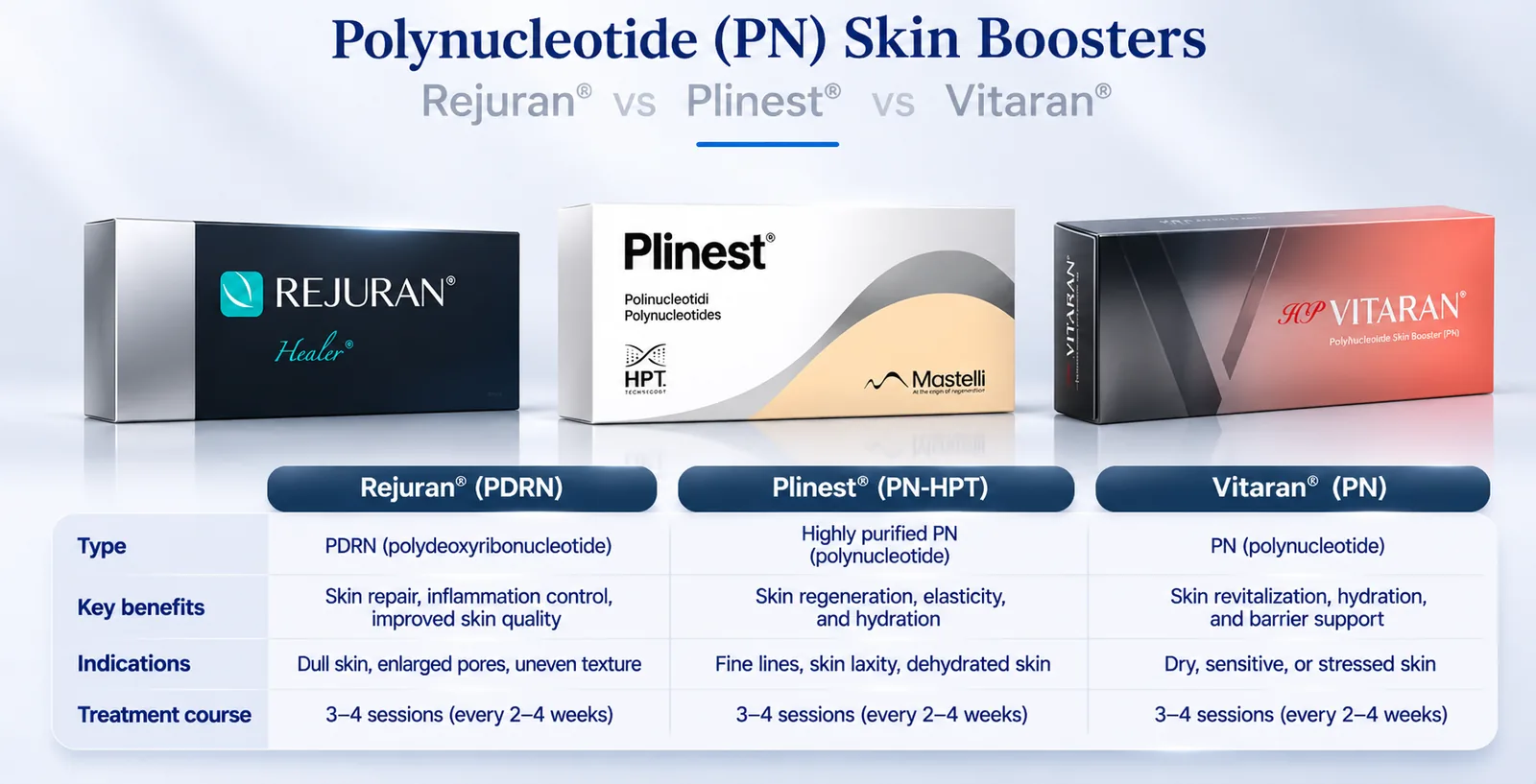
| Feature | Rejuran | Plinest | Vitara / Vitaran |
|---|---|---|---|
| Brand origin | South Korea | Italy | South Korea |
| Associated manufacturer | PharmaResearch | Mastelli | BR Pharm; introduced in Thailand through LG Chem |
| Main technology | Purified polynucleotides | Polynucleotides HPT | Polynucleotide formulations |
| Example product | Rejuran Healer | Plinest | HP VITARAN |
| Example PN concentration | 2% in Rejuran Healer | 2% (40 mg/2 mL) in standard Plinest | 20 mg/mL in documented HP VITARAN formulation |
| Available variants | Healer, I, S, HB and others | Standard, Eye, Fast, Hair and others | HP VITARAN, i, S and other variants |
| Common treatment interest | Skin texture, fine lines, skin quality | Skin elasticity, texture, selected scars | Skin quality, fine lines, selected treatment areas |
| Treatment frequency | Depends on product and clinical plan | Manufacturer protocols vary by formulation | Depends on exact product and clinical plan |
| Proven best brand | Not established | Not established | Not established |
Important: These specifications describe selected documented products, not every formulation sold under each brand. A 2% PN concentration does not prove equivalent performance between products, and a higher concentration does not automatically mean better clinical results.
Patients should ask to see the exact product name, packaging, and relevant regulatory information before treatment.
What Are Polynucleotide (PN) Skin Boosters?
Polynucleotides are chains of nucleotide units, the building blocks of DNA and RNA.
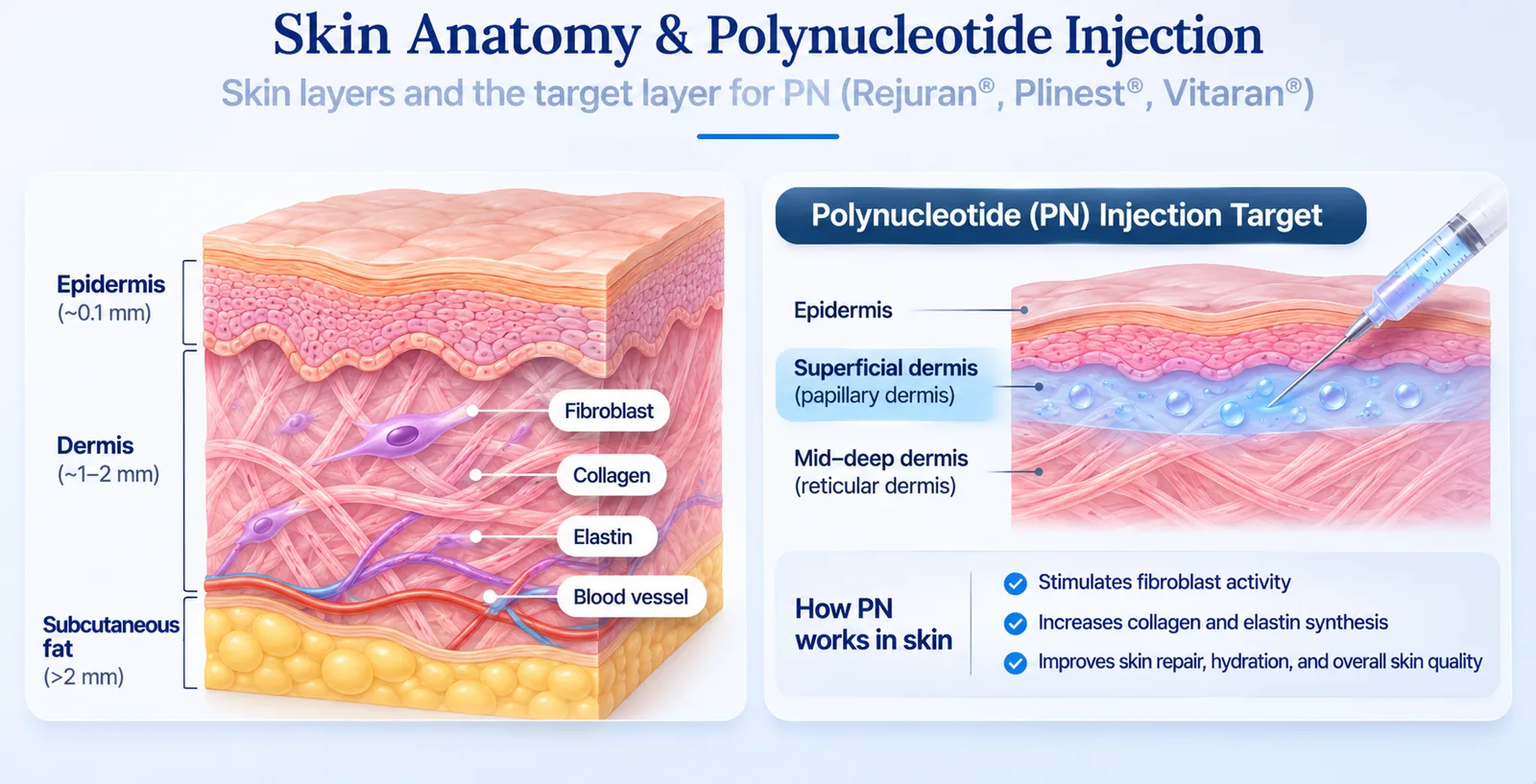
Injectable PN products generally contain purified DNA-derived fragments formulated for medical or aesthetic applications. Some products use materials derived from salmon or trout.
PN injections are being investigated for their potential effects on skin hydration, elasticity, texture, and tissue repair.
They are sometimes described as regenerative skin treatments. However, that term should not be interpreted as proof that the injections can completely repair damaged skin or reverse biological aging.
How Do PN Injections Work?
Laboratory and clinical research suggests that polynucleotides may influence tissue hydration, cellular signaling, and processes associated with tissue repair.
These mechanisms may contribute to gradual improvements in skin quality.
However, the exact mechanisms and clinical importance of these effects in human facial skin are not completely established.
PN injections should therefore be viewed as a potential skin-quality treatment rather than a guaranteed method of skin regeneration.
What Is Rejuran?
Rejuran is a South Korean product family associated with PharmaResearch.
Its injectable formulations use purified polynucleotides derived from fish DNA.
The brand includes different products designed for particular treatment goals and anatomical areas.
Rejuran Healer
Rejuran Healer is a commonly recognized formulation containing 2% polynucleotides.
It is generally discussed in the context of improving facial skin quality and the appearance of fine wrinkles.
Rejuran I
Rejuran I is a lower-viscosity formulation developed for delicate areas, particularly the skin around the eyes.
Lower viscosity may influence injection technique and tissue behavior, but it does not eliminate injection-related risks.
Rejuran S
Rejuran S is a higher-viscosity formulation associated with treatment of selected scars and depressed skin areas.
It should not be assumed that every type of acne scar will respond equally well.
Rejuran HB
Certain Rejuran HB formulations combine polynucleotides with hyaluronic acid and lidocaine.
Because these ingredients differ from standard PN-only formulations, the products should not be compared solely by brand name.
What Results Can Patients Expect from Rejuran?
Possible treatment goals include improvements in fine lines, skin texture, and the appearance of skin quality.
Some patients may notice gradual changes over several weeks following treatment.
However, results vary, and there is no guarantee that Rejuran will significantly improve deep wrinkles, prominent scars, or facial laxity.
What Is Plinest?
Plinest is an Italian polynucleotide product family manufactured by Mastelli.
Its formulations use the company’s polynucleotide HPT technology.
The standard Plinest product contains 40 mg of polynucleotides in a 2 mL syringe, equivalent to a 2% concentration.
The manufacturer describes its use for improving skin hydration, firmness, elasticity, and selected fibrous skin changes.
Plinest Standard
Standard Plinest is intended for selected facial skin concerns, including reduced skin elasticity and certain acne-scar concerns.
Plinest Eye
Plinest Eye is formulated for the delicate skin around the eyes.
Its documented PN concentration is 0.75%, or 15 mg per 2 mL.
Plinest Fast
Plinest Fast is another 0.75% formulation intended for selected delicate skin areas, including the forehead and neck.
Plinest Hair
Plinest Hair is a product variant intended for scalp and eyebrow applications.
Its existence does not establish that PN injections are a replacement for evidence-based treatment of androgenetic alopecia or other hair disorders.
What Results Can Patients Expect from Plinest?
Plinest may be considered for patients seeking improvements in skin firmness, elasticity, and texture.
The manufacturer provides different treatment protocols for different formulations and indications.
These protocols should not be treated as proof that the same schedule is necessary or optimal for every patient.
What Is Vitara (Vitaran)?
Vitara is a name patients may use when referring to VITARAN, a South Korean PN product family manufactured by BR Pharm.
The VITARAN product range has been introduced to the Thai aesthetic market through LG Chem.
Because similar names and multiple variants exist, patients should confirm the exact spelling and formulation on the packaging.
HP VITARAN
Documented HP VITARAN product materials describe a formulation containing 20 mg/mL of polynucleotides.
HP VITARAN i
This variant is presented for delicate skin areas, including the area around the eyes.
HP VITARAN S
This variant is positioned for selected scar-related concerns and differs in viscosity from other versions.
What Results Can Patients Expect from Vitara?
As with other PN products, the intended treatment goals may include improvements in skin texture, fine lines, and overall skin quality.
However, published clinical evidence specific to each VITARAN formulation is limited.
It would be inaccurate to claim that VITARAN produces faster results, longer-lasting results, or greater collagen stimulation than Rejuran or Plinest without direct comparative evidence.
Rejuran vs Plinest vs Vitara: What Actually Makes Them Different?
Although these products share the broad PN category, several differences matter clinically.
1. Manufacturing and Purification
The manufacturers use different proprietary processes to prepare their PN materials.
These processes may affect molecular characteristics, purity, and product behavior.
However, manufacturing differences alone do not establish superior clinical results.
2. PN Concentration
Some standard formulations from these brands contain approximately 20 mg/mL of PN.
Other variants contain different concentrations or additional ingredients.
Concentration is only one factor. Molecular characteristics, viscosity, formulation, injection depth, and treatment technique also matter.
3. Viscosity
Viscosity describes how easily a product flows.
Different viscosities may influence how a product is injected and which tissue areas it is designed for.
A thicker product is not necessarily better for skin rejuvenation, particularly in delicate areas.
4. Treatment Area
Some formulations are intended for general facial treatment, while others are designed for the eye area, scars, or other anatomical locations.
The specific product should be selected according to its intended use and applicable regulatory labeling.
5. Clinical Evidence
The amount and quality of published evidence vary.
Studies involving one PN formulation cannot automatically establish the same outcomes for every other product.
There is currently no sufficiently robust direct comparison proving that Rejuran, Plinest, or VITARAN is the best overall choice.
Which PN Injection Is Better for Fine Lines?
PN injections may provide modest improvements in certain fine lines and skin-quality measurements.
Patients with early superficial wrinkles may be more appropriate candidates than those with deep folds or pronounced skin laxity.
However, fine lines have different causes.
For example:
- Expression-related wrinkles may respond better to botulinum toxin.
- Lines associated with sun damage may require topical treatments or resurfacing procedures.
- Deep folds associated with volume loss may require a different approach.
- Crepey skin may benefit from a broader skin-quality treatment plan.
There is insufficient evidence to recommend one of the three PN brands as universally superior for fine lines.
Which Is Better for Under-Eye Skin?
The under-eye area is one of the most frequently discussed applications of PN injections.
Patients may seek treatment for fine lines, crepey skin, and reduced elasticity.
However, not all under-eye concerns have the same cause.
Fine Lines and Crepey Skin
Selected PN formulations intended for delicate skin may be considered.
Hollow Tear Troughs
PN injections are not a reliable substitute for treatments specifically intended to address significant volume loss.
Dark Circles
Dark circles may result from pigmentation, visible blood vessels, anatomical shadows, eczema, or other causes.
PN injections do not reliably correct every type of dark circle.
Under-Eye Bags
Prominent fat pads and structural under-eye bags are unlikely to be corrected by PN injections alone.
A dermatologist should assess the cause before recommending treatment.
Which Is Better for Acne Scars and Enlarged Pores?
Acne scars vary considerably in depth and structure.
They may include ice-pick, boxcar, and rolling scars.
PN products are sometimes considered as part of skin-quality or scar-treatment plans, but the evidence does not establish that PN injections alone reliably correct deep atrophic acne scars.
Other treatments may be more appropriate, including:
- Subcision for selected tethered scars
- TCA CROSS for suitable narrow, deep scars
- Fractional laser resurfacing
- Radiofrequency microneedling
- Selected combination treatments
For enlarged pores, PN injections may offer limited improvements in overall skin texture, but they do not permanently eliminate pores.
The most appropriate approach depends on the underlying skin condition.
Can PN Injections Improve Skin Hydration and Elasticity?
Some clinical studies report improvements in skin hydration, elasticity, and texture after PN treatment.
However, study methods, formulations, treatment schedules, and outcome measurements differ.
A systematic review published in the Journal of Cosmetic Dermatology included nine studies involving 219 patients and found encouraging results, while emphasizing that the evidence was limited by study quality and the lack of standardized protocols.
Therefore, patients should expect possible modest improvements rather than guaranteed or dramatic changes.
How Many Sessions of Rejuran, Plinest, or Vitara Are Needed?
There is no single scientifically established schedule suitable for every PN formulation.
Treatment schedules depend on the product, treatment area, skin condition, and clinical response.
Rejuran
Treatment courses may involve multiple sessions, but the appropriate number and interval should follow the specific formulation’s instructions and medical assessment.
Plinest
For standard Plinest, the manufacturer describes a protocol of three sessions approximately 14–21 days apart for selected skin-quality indications.
Other Plinest formulations have different protocols.
Vitara / Vitaran
The appropriate schedule depends on the exact VITARAN formulation and its locally applicable instructions.
Patients should not assume that a protocol used for Rejuran or Plinest automatically applies to VITARAN.
Are More Sessions Always Better?
No.
Additional injections may increase cost, discomfort, and cumulative exposure without providing proportionately greater benefits.
The response should be assessed before recommending further treatment.
When Will Results Become Visible?
Some patients notice temporary skin fullness or hydration changes soon after injection.
These early changes may partly reflect the injected fluid and local swelling.
More meaningful skin-quality changes, when they occur, may develop gradually over several weeks and after a course of treatment.
Clinical studies often evaluate results over weeks to months.
There is insufficient evidence to guarantee a particular timeline for all three brands.
How Long Do PN Injection Results Last?
The durability of PN injection results remains an area of ongoing research.
Published studies often have relatively short follow-up periods, and longer-term data are limited.
Results depend on the product, treatment area, skin condition, and individual response.
It would be misleading to guarantee that Rejuran, Plinest, or VITARAN lasts a specific number of months or years for every patient.
Maintenance treatment should be considered only after assessing the response and discussing the expected benefits and risks.
Are PN Injections Painful?
PN injections involve multiple injections into the skin and can cause discomfort.
Pain depends on the product formulation, injection technique, treatment area, and individual sensitivity.
Some formulations contain lidocaine, while others do not.
Topical anesthetic may be considered when appropriate.
Patients should not assume that a particular brand is always painless or consistently less painful than another.
Downtime and Aftercare
Common temporary reactions after PN injections include:
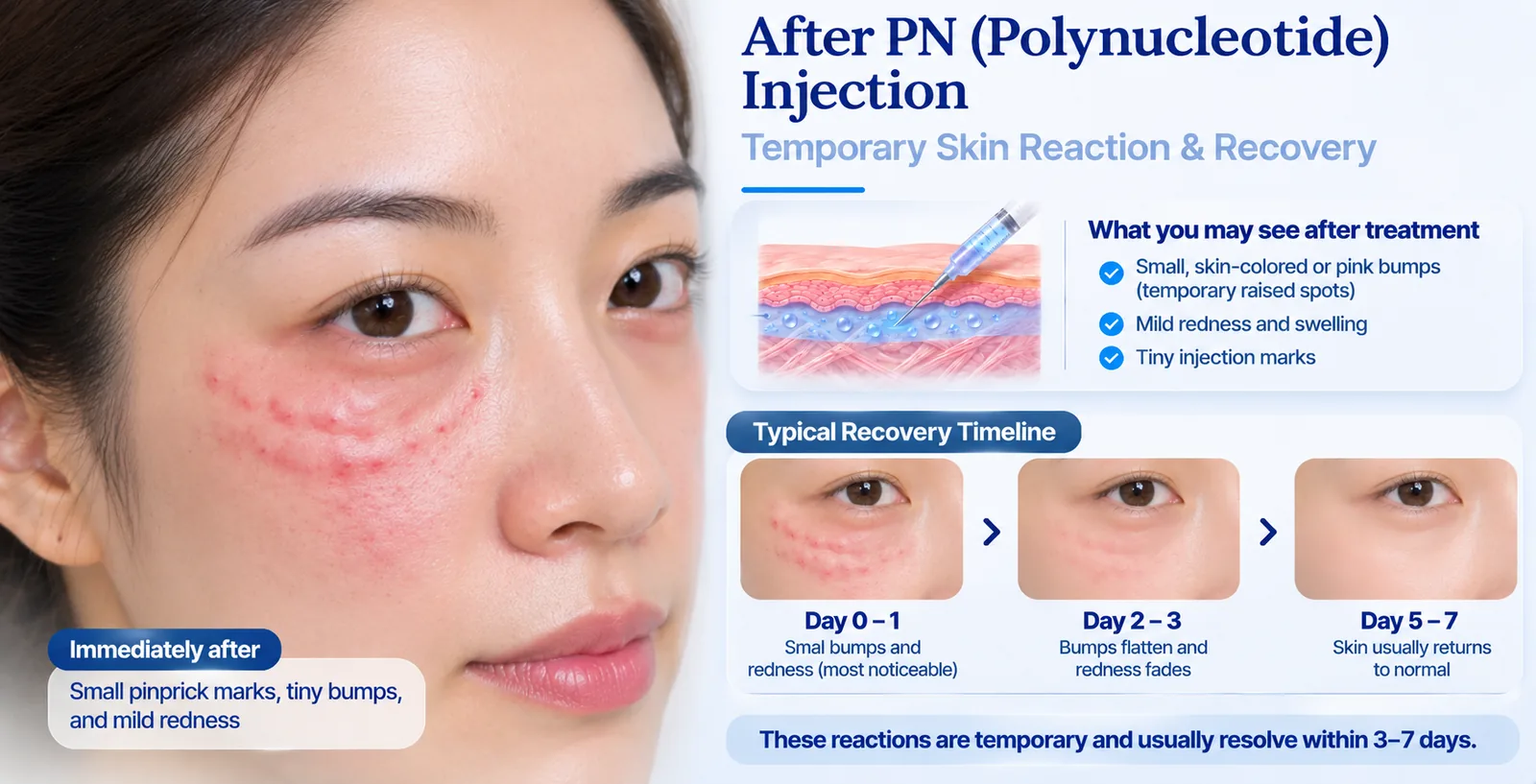
- Small raised injection bumps
- Redness
- Mild swelling
- Tenderness
- Bruising
Injection bumps may settle over the following hours or days, although recovery varies.
Aftercare Recommendations
Follow the treating clinician’s instructions.
In general:
- Avoid rubbing or massaging treated areas unless specifically instructed.
- Keep the skin clean.
- Avoid applying irritating products while the skin is inflamed.
- Avoid excessive heat and strenuous exercise until early swelling and redness settle.
- Use appropriate sun protection.
- Avoid additional cosmetic procedures until the skin has recovered or your clinician advises otherwise.
Patients traveling in Bangkok should allow sufficient time for recovery and follow-up, especially when treating the under-eye area.
Are Rejuran, Plinest, and Vitara Safe?
PN injections are generally associated with mild, temporary local reactions in the published small clinical studies.
However, this does not establish that they are risk-free.
Potential complications include:
- Bruising and swelling
- Infection
- Persistent inflammation
- Allergic or hypersensitivity reactions
- Nodules or irregularities
- Unwanted cosmetic results
- Injection-related vascular injury
Serious complications appear uncommon in the limited published literature, but their precise frequency is not well established.
When Should You Seek Medical Attention?
Contact the treating clinician promptly if you develop increasing redness, warmth, swelling, pain, discharge, or fever after treatment.
Seek urgent medical assessment immediately for severe or disproportionate pain, unusual blanching or dusky discoloration, rapidly worsening skin changes, or any visual disturbance following facial injections.
Sudden loss of vision or neurological symptoms require emergency medical care.
Who Should Avoid or Postpone PN Injections?
Treatment may need to be postponed or reconsidered for patients with:
- Active infection in the treatment area
- Significant active dermatitis or inflammation
- Known hypersensitivity to a product ingredient
- Relevant fish-derived material allergies requiring further assessment
- Pregnancy or breastfeeding, when adequate safety information is unavailable
- Certain bleeding disorders or medications affecting bleeding risk
- Previous unresolved complications from injectable treatments
Not every precaution is an absolute contraindication.
A dermatologist should review the exact product instructions and the patient’s medical history.
Patients taking prescribed anticoagulants should not stop their medication without advice from the prescribing clinician.
PN vs PDRN: Are They the Same?
PN stands for polynucleotide.
PDRN stands for polydeoxyribonucleotide.
The terms are related but not necessarily interchangeable.
Both refer to DNA-derived materials, but products may differ in molecular size, processing, formulation, and intended medical use.
The distinction matters because research involving a PDRN wound-healing product does not automatically establish the effectiveness of a PN skin booster for facial rejuvenation.
Patients should look beyond the terminology and ask which specific injectable product is being used.
PN Injections vs Hyaluronic Acid Fillers
PN skin boosters and hyaluronic acid fillers are not intended to achieve identical results.
| Treatment | Main purpose |
|---|---|
| PN skin booster | Potential improvement in skin texture, fine lines, and overall skin quality |
| Hyaluronic acid dermal filler | Restoring volume or changing facial contours, depending on the formulation |
| Botulinum toxin | Reducing selected expression-related wrinkles |
| Laser resurfacing | Improving selected pigmentation, texture, and scarring concerns |
| Skin tightening devices | Addressing selected degrees of skin laxity |
A patient with hollow cheeks, for example, may not benefit substantially from PN injections if the main concern is loss of facial volume.
Similarly, a patient with prominent acne scars may need scar-directed treatment rather than a skin booster alone.
Can PN Injections Be Combined with Laser or Other Treatments?
Combination treatment may be considered in selected patients.
However, adding PN injections to another procedure does not automatically improve outcomes.
The optimal sequence and treatment interval depend on the procedure, degree of skin injury, product instructions, and available clinical evidence.
Patients should disclose recent laser treatments, microneedling, chemical peels, fillers, and other injections before treatment.
There is no universal combination schedule that can be recommended for every patient.
How to Choose Between Rejuran, Plinest, and Vitara in Bangkok
Instead of choosing based only on brand name, consider the following questions.
What Is Your Main Skin Concern?
Fine lines, acne scars, under-eye hollowing, enlarged pores, and reduced elasticity require different assessments.
Which Exact Product Will Be Used?
Ask for the complete product name and formulation.
For example, standard Plinest is not the same as Plinest Eye, and Rejuran Healer is not identical to Rejuran HB.
Is the Product Appropriate for the Treatment Area?
Products intended for delicate under-eye skin may differ from those intended for general facial treatment or scars.
Is the Product Authentic and Appropriately Registered?
Ask the clinic to verify the product’s source, labeling, and applicable Thai regulatory status.
Do not assume that a product’s availability in another country establishes its approval for injection in Thailand.
What Is the Evidence for Your Particular Concern?
A product may be marketed for several indications, but the strength of supporting evidence can differ substantially.
Who Will Perform the Injection?
Choose an appropriately qualified medical professional familiar with facial anatomy, injection-related complications, and aftercare.
PN Skin Booster Consultation at Clear Skin Dermatology Bangkok
Clear Skin Dermatology is a medical dermatology and skin cancer clinic located in Asoke, Bangkok, Thailand.
Patients considering Rejuran, Plinest, VITARAN, or other PN skin boosters may benefit from a dermatologist consultation to determine whether injectable skin rejuvenation is appropriate for their concerns.
A consultation can include assessment of:
- Skin texture and fine lines
- Under-eye skin changes
- Acne scars and enlarged pores
- Skin hydration and elasticity
- Previous aesthetic procedures
- Medical history and treatment risks
- Alternative treatment options
Not every patient requires a PN injection.
Some concerns may be better addressed through prescription skin care, scar-directed procedures, laser treatments, or other dermatological approaches.
The goal is to choose a medically appropriate treatment rather than selecting a brand before understanding the underlying problem.
Patients interested in a specific PN product should contact the clinic to confirm current product availability and whether the requested treatment is offered.
Clear Skin Dermatology
Medical Dermatology & Skin Cancer Clinic
Asoke, Bangkok, Thailand
Frequently Asked Questions
1. Which is better: Rejuran, Plinest, or Vitara?
There is insufficient high-quality direct comparative evidence to establish one brand as consistently superior. The appropriate choice depends on the specific formulation, treatment area, and individual skin concerns.
2. Are Rejuran, Plinest, and Vitara the same?
No. They belong to the broader PN product category but differ in manufacturing processes, formulations, viscosity, and available variants.
3. Is Plinest stronger than Rejuran?
Not necessarily. Standard Plinest and Rejuran Healer both have documented 2% PN formulations. Equal concentration does not establish equal clinical performance or superiority.
4. Is Vitara the same as Vitaran?
Vitara may be used informally to refer to VITARAN, but patients should confirm the exact product name and manufacturer before treatment.
5. Which PN injection is best for under-eye wrinkles?
Certain formulations are intended for delicate skin around the eyes, but there is no convincing evidence that one of these brands is universally superior.
6. Which PN injection is best for acne scars?
Selected products are marketed for scar-related concerns, but deep acne scars often require other procedures. PN injections alone should not be expected to correct all scar types.
7. Can PN injections reduce enlarged pores?
Some studies suggest improvements in skin texture, but PN injections cannot permanently remove pores or guarantee a substantial reduction in their appearance.
8. How many PN injection sessions do I need?
The schedule depends on the exact product and treatment goal. Multiple sessions may be recommended, but no universal protocol applies to all three brands.
9. How soon will I see results?
Changes may develop gradually over several weeks. Immediate fullness may reflect temporary swelling rather than a lasting treatment effect.
10. How long do PN injection results last?
Long-term durability is not firmly established across all products. Results and maintenance requirements vary.
11. Do PN injections hurt?
They can cause discomfort, particularly when multiple small injections are performed. Pain varies with the product, treatment area, and technique.
12. How long do injection bumps last?
Small raised bumps often settle within hours to a few days, but recovery varies. Persistent or worsening bumps should be assessed.
13. Are PN injections suitable for sensitive skin?
Some patients with sensitive skin may be candidates, but active dermatitis, infection, and certain allergies require assessment before treatment.
14. Can PN injections replace dermal fillers?
No. PN injections are generally considered for skin-quality concerns, while dermal fillers are used for selected volume and contour changes.
15. Can I combine PN injections with laser treatment?
Sometimes, but the combination and timing should be individualized. Additional procedures do not guarantee better results.
16. Are PN injections approved in Thailand?
Regulatory status depends on the exact product and formulation. Patients should ask the clinic to verify the current Thai FDA registration and approved indications.
17. Which PN injection is safest?
There is insufficient comparative evidence to rank these brands reliably by safety. Authentic product selection, appropriate indications, qualified injection technique, and complication management are essential.
18. Where can I get advice about PN injections in Bangkok?
A dermatologist can assess your skin concerns, explain treatment options, and help determine whether PN injections or another approach is appropriate. Clear Skin Dermatology in Asoke provides a location for dermatology consultation; availability of specific injectable brands should be confirmed before booking.
Final Thoughts: Choosing the Right PN Injection
Rejuran, Plinest, and Vitara (VITARAN) are different product families within the broader category of polynucleotide-based injectable treatments.
They share some treatment goals but differ in their manufacturing technologies, formulations, and product variants.
Early research suggests that PN injections may provide modest improvements in selected aspects of skin quality, including fine lines, elasticity, and texture.
However, the evidence remains limited, and no brand has been conclusively established as the best choice for every patient.
The most important decision is not which brand is most popular, but whether a PN injection is appropriate for your particular skin concern.
For patients seeking skin rejuvenation advice in Bangkok, an individualized dermatologist consultation can help clarify realistic outcomes, product suitability, and safer treatment choices.
Clear Skin Dermatology — Asoke, Bangkok
Medical disclaimer: This article provides general educational information and does not replace an individualized medical consultation. Product indications, regulatory status, treatment schedules, and clinical outcomes vary by formulation and jurisdiction.
Medical References
- Rejuran: Product documentation identifies Healer, I, S and HB formulations with different characteristics and intended applications.
- Plinest: Mastelli specifies 2% PN for standard Plinest and 0.75% for certain delicate-area formulations.
- VITARAN: BR Pharm identifies the VITARAN product family, and product documentation describes 20 mg/mL PN for selected formulations. Its introduction into Thailand was reported in January 2025.
- Clinical effectiveness: A systematic review of nine studies involving 219 patients found promising results but emphasized the limited quality of evidence and lack of standardized protocols.
- Further clinical evidence: A more recent review of randomized trials also emphasizes small studies, heterogeneous treatment methods, and the need for longer follow-up.
Medically reviewed by
Reviewed on
Related articles
-
Aesthetic & Skin Rejuvenation Rejuran vs Plinest vs Vitaran for Acne Scars, Enlarged Pores, and Skin Texture Which is better for acne scars and enlarged pores: Rejuran, Plinest, or Vitaran?
-
Aesthetic & Skin Rejuvenation Rejuran vs Plinest vs Vitaran for Anti-Aging and Skin Rejuvenation: Which Is Better? Rejuran, Plinest, and Vitaran are polynucleotide-based injectable product families increasingly discussed for skin rejuvenation. They are often promoted for improving fine lines, skin texture, and elasticity.

-
Aesthetic & Skin Rejuvenation Rejuran vs Plinest vs Vitaran: Which PN Skin Booster Is Best in Bangkok? Rejuran, Plinest, and Vitaran are injectable skin rejuvenation products associated with polynucleotides (PN), a group of DNA-derived molecules being studied for their potential to improve skin quality.