






























How Often Should You Do HIFU (Ultraformer) or XERF? Treatment Intervals, Maintenance and Safety
How often should you repeat HIFU, Ultraformer, or XERF? For facial skin tightening, HIFU is often performed as a single treatment followed by reassessment after approximately three months. Maintenance may be considered around 12 months or later, depending on the response. XERF treatment schedules are more protocol-dependent: some patients may receive a short initial series, while others may need fewer sessions. There is no universally established maintenance interval for XERF.

How often should you repeat HIFU, Ultraformer, or XERF? For facial skin tightening, HIFU is often performed as a single treatment followed by reassessment after approximately three months. Maintenance may be considered around 12 months or later, depending on the response. XERF treatment schedules are more protocol-dependent: some patients may receive a short initial series, while others may need fewer sessions. There is no universally established maintenance interval for XERF.
The important point is that you do not need to repeat either treatment simply because a certain number of months has passed.
HIFU and XERF work by delivering controlled heat into tissue, with the aim of improving skin firmness through collagen remodeling. These changes develop gradually. Repeating treatment too early may expose tissue to additional heat before the full benefit of the previous treatment can be assessed.
At Clear Skin Dermatology in Asoke, Bangkok, we encourage patients to understand the expected treatment timeline, possible limitations, and safety considerations before planning repeated nonsurgical skin-tightening procedures.
How Often Should You Repeat HIFU or XERF? A Quick Comparison
| Question | HIFU / Ultraformer | XERF |
|---|---|---|
| Typical initial approach | Often one session, then reassessment | One or more sessions depending on the protocol |
| When to evaluate results | Approximately 2–3 months | Often around 1–3 months after the planned course |
| Initial repeat sessions | Not routinely required for everyone | Some studied protocols use two sessions about four weeks apart |
| Maintenance | Often discussed around 12–18 months, but individualized | No established universal maintenance interval |
| Can you repeat every month? | Not a routine maintenance schedule | Only when part of an appropriate planned treatment course |
| Is more frequent treatment better? | Not necessarily | Not necessarily |
These intervals are clinical considerations, not mandatory schedules. Different devices, applicators, treatment settings, and patient characteristics may require different approaches.
How Often Should You Do HIFU (Ultraformer)?
Is One HIFU Treatment Enough?
For many patients with mild to moderate facial skin laxity, a single HIFU treatment may be an appropriate starting point.
Focused ultrasound creates controlled thermal effects at selected tissue depths. The resulting collagen remodeling develops over time rather than ending immediately after the procedure.
Research on microfocused ultrasound has documented improvements after single-session treatment, with changes commonly evaluated at three, six, and twelve months.
However, these studies include different ultrasound devices and treatment protocols. Their findings cannot automatically establish the ideal schedule for every Ultraformer model.
One treatment may provide a modest improvement for some patients, while others may experience little visible change.
When Should You Assess HIFU Results?
A practical approach is to assess results at approximately three months.
Some patients notice early changes within several weeks, but the response can continue developing over subsequent months.
At the follow-up appointment, the dermatologist may compare standardized photographs and evaluate:
- Skin firmness
- Jawline definition
- Early jowls
- Loose skin beneath the chin
- Neck laxity
- Patient satisfaction
- Any unwanted facial contour changes
If the result is satisfactory, there may be no reason to repeat treatment immediately.
Should You Repeat HIFU Every 3 Months?
Routine full-face HIFU every three months is not an established maintenance recommendation for everyone.
Three months is often an appropriate time to assess the result, not automatically a time to repeat the procedure.
A further treatment might be considered for a specific clinical reason, but the decision should account for the previous treatment’s energy, anatomical areas, response, and adverse effects.
Should You Repeat HIFU Every 6 Months?
Some patients may be reassessed around six months, especially if the initial improvement was limited or their skin laxity has changed.
However, six-monthly treatment is not necessary for everyone.
Repeated treatment should not be based solely on a clinic package or a fixed promotional schedule.
Is Once a Year a Good HIFU Maintenance Schedule?
Annual reassessment is a reasonable approach for some patients.
Expert recommendations for certain microfocused ultrasound technologies have discussed maintenance intervals around 12–18 months, with longer intervals possible for some patients.
However, these recommendations are not a universal Ultraformer protocol.
A patient whose results remain satisfactory may not need another treatment at twelve months.
Conversely, someone with progressive laxity may need a different treatment approach rather than simply repeating HIFU.
How Often Should You Do XERF?
XERF uses dual-frequency monopolar radiofrequency to produce controlled heating in tissue.
Unlike focused ultrasound, which creates localized thermal zones, monopolar radiofrequency produces a more distributed pattern of tissue heating.
Both technologies may stimulate collagen remodeling, but their treatment schedules are not interchangeable.
Is One XERF Session Enough?
Some patients may undergo a single session, depending on the clinical plan.
However, one session should not be presented as the established ideal treatment course for every patient.
The appropriate number of treatments depends on the device instructions, treatment area, degree of laxity, and response.
Does XERF Require Two or Three Sessions?
A prospective multicenter study of dual-frequency noninvasive monopolar radiofrequency used two treatment sessions approximately four weeks apart.
The study reported short-term improvements in facial laxity, but its relatively small sample and limited follow-up mean it does not establish the best schedule for all patients or prove that repeated courses are superior.
A studied two-session protocol is different from a recommendation to repeat XERF every month indefinitely.
Can You Do XERF Every Month?
Monthly treatment may be appropriate when it forms part of a defined initial treatment course supported by the device protocol and clinician’s assessment.
However, monthly treatment should not automatically continue as long-term maintenance.
After the initial course, patients should allow time for tissue remodeling and follow-up assessment.
How Often Should XERF Be Repeated for Maintenance?
There is currently no well-established, evidence-based maintenance interval that applies to all XERF patients.
It would be premature to claim that everyone should repeat XERF every three, six, or twelve months.
The timing should depend on the observed response, degree of skin laxity, treatment history, and the clinician’s assessment.
HIFU vs XERF: Why Are the Treatment Schedules Different?
The difference comes partly from how energy is delivered and how individual treatment protocols have been studied.
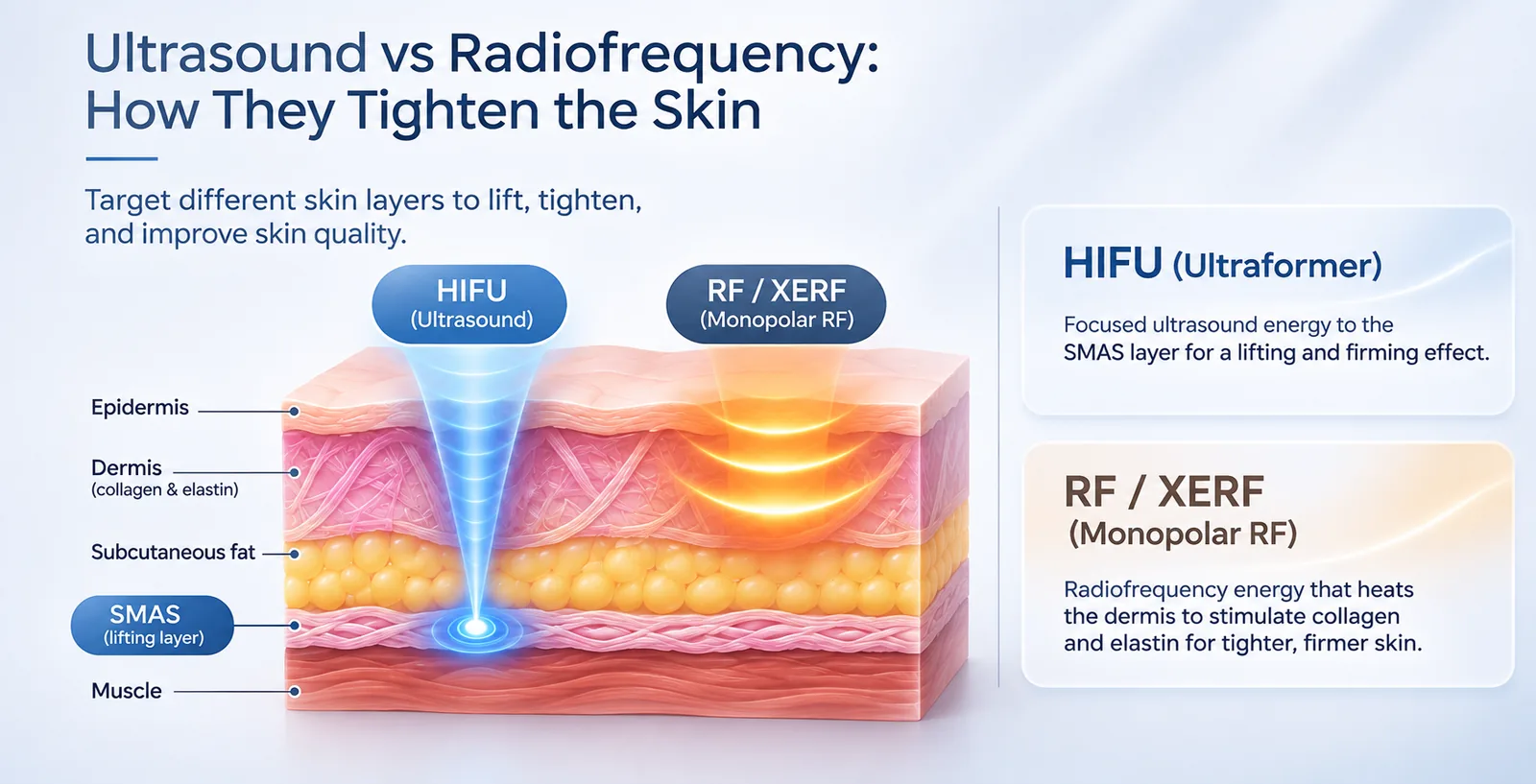
HIFU Uses Focused Ultrasound Energy
HIFU delivers energy into localized treatment zones at selected depths.
The treatment may stimulate tissue contraction and subsequent collagen remodeling.
Many facial microfocused ultrasound studies have evaluated the effects of a single treatment over several months.
XERF Uses Monopolar Radiofrequency
XERF uses two radiofrequency frequencies, 6.78 MHz and 2 MHz, to create controlled tissue heating.
Treatment settings can be adjusted according to the patient’s skin characteristics and treatment area.
Some dual-frequency radiofrequency research has evaluated an initial series of sessions.
However, the availability of a multi-session protocol does not mean XERF necessarily requires more treatments than HIFU in every case.
Neither technology has a universally superior treatment schedule.
How Long Does Collagen Remodeling Take?
Both HIFU and radiofrequency treatments rely partly on biological processes that occur after controlled tissue heating.
The immediate thermal effects occur during treatment, but tissue repair and collagen remodeling take longer.
Immediately After Treatment
Some patients notice temporary firmness or swelling.
This should not be mistaken for the final treatment result.
During the First Month
Early changes may become noticeable, although some patients will see little difference.
Temporary redness, swelling, or tenderness generally improves sooner.
Around 2–3 Months
This is a useful period for evaluating the developing result.
For focused ultrasound, several clinical studies have reported meaningful changes at approximately three months.
Around 3–6 Months
Collagen remodeling and changes in skin firmness may continue.
The degree and timing of improvement vary between patients and technologies.
Beyond 6 Months
Some improvements may persist for many months.
However, normal aging continues, and results are not permanent.
A longer-lasting result does not mean that repeat treatment is always necessary once a particular interval has passed.
Does Your Age Determine How Often You Need Treatment?
Age influences skin characteristics, but it should not dictate the schedule by itself.
In Your 30s
Many patients in their 30s have little clinically significant skin laxity.
They may not need HIFU or XERF at all.
For patients with early laxity, treatment should be based on an identifiable concern rather than a preventive schedule.
In Your 40s
Patients may begin to notice early jowls, reduced jawline definition, or mild neck laxity.
HIFU or XERF may be considered, but the need for maintenance should be determined by the actual response.
In Your 50s and Beyond
Some patients have more pronounced laxity, tissue descent, and facial volume loss.
They may experience less dramatic improvement from nonsurgical tightening.
Repeating treatments more frequently is not necessarily the solution.
In some cases, alternative procedures or a surgical consultation may be more appropriate.
What Determines the Best Treatment Interval?
A dermatologist should consider several factors before recommending another session.
1. Degree of Skin Laxity
Mild laxity may respond differently from more advanced sagging.
If the main problem is substantial tissue descent, repeating a tightening procedure may offer limited additional benefit.
2. Facial Fat Distribution
Patients with naturally thin faces or hollow cheeks may be particularly concerned about unwanted changes in facial volume.
The need for additional treatment should be assessed carefully.
3. Treatment Area
The cheeks, jawline, neck, and area beneath the chin have different anatomical characteristics.
The treatment plan may differ depending on the region.
4. Previous Treatment Settings
The type of applicator, treatment depth, energy, number of passes or lines, and treated areas can influence the cumulative exposure.
These details matter when planning another procedure.
5. Response to the Previous Session
Patients who achieved satisfactory improvement may not need another treatment.
Patients with limited improvement should be reassessed before assuming more energy is the answer.
6. Adverse Effects
Persistent tenderness, numbness, burns, or unexpected facial contour changes should be evaluated before further treatment.
7. Weight Changes and Facial Aging
Weight loss, changes in facial volume, and ongoing aging can influence appearance independently of treatment effectiveness.
Can You Do HIFU or XERF Too Often?
Yes. Unnecessarily frequent energy-based treatment may expose tissues to repeated heating without a clearly established additional benefit.
Potential concerns include:
- Increased cumulative thermal exposure
- Persistent tenderness or sensitivity
- Burns or blistering
- Changes in skin pigmentation
- Altered sensation
- Nerve-related symptoms
- Unwanted changes in facial contour
These complications are not inevitable, and the likelihood varies by device and technique.
However, repeated treatment should be justified by a clinical indication rather than the assumption that more sessions always produce greater lifting.
Can Repeated HIFU Cause Facial Fat Loss?
Focused ultrasound can produce thermal effects in fat-containing tissues, depending on treatment depth and settings.
Unwanted facial contour changes are possible, although the incidence of clinically significant fat loss is not established for every device.
Repeated treatments warrant particular caution in patients with thin faces or pre-existing hollow cheeks.
Can Repeated XERF Cause Facial Fat Loss?
Radiofrequency can heat tissue near or within the subcutaneous fat layer.
The clinical significance depends on the device and settings.
There is insufficient long-term XERF-specific evidence to quantify the risk of unwanted facial fat loss from repeated treatment courses.
Patients should not be promised that repeated RF treatments are completely risk-free.
Can You Alternate HIFU and XERF Every Few Months?
Alternating HIFU and XERF on a fixed schedule is not an established strategy for superior facial rejuvenation.
Both technologies deliver thermal energy, although in different patterns.
There is insufficient evidence to recommend a universal sequence or interval for combining them.
Before introducing a second technology, the clinician should assess the result of the first treatment and consider whether additional heating is necessary.
Combining treatments may be appropriate in selected circumstances, but it should not be treated as an automatic maintenance routine.
What If Your HIFU or XERF Results Have Worn Off?
If your face appears less firm months after treatment, it does not necessarily mean the treatment has failed.
Skin aging continues, and the original improvement may gradually become less noticeable.
Before repeating treatment, consider whether the current concern is caused by:
- New skin laxity
- Tissue descent
- Facial volume loss
- Weight changes
- Changes in jawline anatomy
- Unrealistic expectations of nonsurgical lifting
If the main issue has changed, the most appropriate treatment may also have changed.
What Happens During a Follow-Up Consultation?
A follow-up visit helps determine whether further treatment is necessary.

The dermatologist may:
- Review the date and type of previous treatment.
- Compare standardized photographs.
- Examine skin firmness and facial contours.
- Assess any adverse effects.
- Discuss the patient’s satisfaction and expectations.
- Recommend observation, another session, or an alternative approach.
Patients who previously received treatment at another clinic should bring any available information about the device, treatment areas, and settings.
When Should You See a Dermatologist Before Repeating Treatment?
Arrange an assessment before another session if you experience:
- Persistent pain or tenderness
- Numbness or unusual sensations that do not improve
- New facial asymmetry
- Unexpected hollowing or volume loss
- Burns, blisters, or skin discoloration
- A previous treatment with an unsatisfactory or unexpected result
New facial weakness, particularly difficulty moving part of the face, requires prompt medical assessment.
Do not repeat treatment over an area with unresolved complications.
Recovery and Aftercare Between Sessions
Most patients can return to normal daily activities relatively quickly after uncomplicated treatment.
Temporary redness, swelling, and tenderness may occur.
Aftercare instructions depend on the device and the patient’s skin response.
General considerations include:
- Follow the treating clinician’s aftercare instructions.
- Use gentle skin care if the treated area is sensitive.
- Protect the skin from excessive sun exposure.
- Avoid additional heat-based procedures until the treatment plan has been reviewed.
- Report persistent or worsening symptoms.
- Attend follow-up appointments before deciding on further sessions.
Patients visiting Bangkok for a short period should not feel pressured to complete multiple procedures simply because they have limited time in Thailand.
HIFU and XERF Treatment Planning at Clear Skin Dermatology Bangkok
Clear Skin Dermatology is a medical dermatology and skin cancer clinic in Asoke, Bangkok, Thailand.
For Thai residents, expatriates, tourists, and international patients considering facial skin tightening, an individualized consultation can help clarify whether treatment is appropriate and when reassessment should take place.
Patients may seek advice about:
- HIFU or Ultraformer treatment intervals
- XERF treatment schedules
- Jawline and lower-face tightening
- Early jowls
- Loose skin beneath the chin
- Neck skin laxity
- Facial volume loss
- Safety concerns after previous energy-based treatments
During consultation, a dermatologist can assess the degree of laxity, facial anatomy, previous procedures, and treatment goals.
The aim is to identify whether another session is likely to provide a worthwhile benefit—or whether waiting, observation, or a different approach would be more appropriate.
Patients specifically interested in Ultraformer III, Ultraformer MPT, or XERF should confirm the availability of the relevant device and treatment service before booking.
Clear Skin Dermatology
Medical Dermatology & Skin Cancer Clinic
Asoke, Bangkok, Thailand
Frequently Asked Questions
1. How often should you do HIFU?
Many patients begin with one treatment and reassess the result after approximately three months. Maintenance may be considered later, often around a year or more, depending on individual needs.
2. How often should you do Ultraformer?
There is no single interval appropriate for every Ultraformer patient. The schedule depends on the model, treatment protocol, skin laxity, and previous response.
3. How often should you do XERF?
XERF may be performed as part of an individualized treatment course. Some studied dual-frequency RF protocols used two sessions about four weeks apart. A universal maintenance interval has not been established.
4. Can I do HIFU every three months?
Routine full-face HIFU every three months is not necessary for most patients. Three months is commonly a time to assess results rather than automatically repeat treatment.
5. Can I do XERF every month?
Monthly sessions may be used in a defined initial protocol, but indefinite monthly maintenance is not supported by established evidence.
6. Is HIFU once a year enough?
Annual reassessment may be appropriate, but not everyone needs another treatment every year. Some patients may benefit from longer intervals or a different approach.
7. Is XERF once a year enough?
There is no established universal annual XERF schedule. The need for retreatment should be based on the clinical response.
8. Is doing HIFU twice a year too much?
Not necessarily in every situation, but twice-yearly treatment should not be automatic. The decision requires assessment of previous treatment exposure and results.
9. Can I repeat HIFU if I see no results after one month?
It is generally preferable to allow more time for the response to develop before deciding on retreatment, unless the treating clinician identifies a specific reason for an earlier intervention.
10. How long should I wait between HIFU and XERF?
There is no universally validated interval for combining these technologies. Timing should be individualized according to device instructions, previous energy exposure, tissue response, and treatment goals.
11. Does frequent HIFU or XERF make your skin tighter?
Not necessarily. More frequent sessions do not guarantee greater tightening and may increase unnecessary thermal exposure.
12. Can repeated HIFU or XERF make my face thinner?
Unwanted facial contour changes are possible with energy-based treatments, depending on the device, settings, and anatomy. Repeated treatment should be planned carefully, particularly in thin faces.
13. Should I do HIFU or XERF before an important event?
Both treatments may produce temporary swelling or tenderness, and collagen remodeling takes time. Avoid relying on a last-minute session for a major visible improvement.
14. Do people in their 50s need more frequent treatments?
Not automatically. More advanced sagging may respond less well to nonsurgical tightening, and increasing treatment frequency may not address the underlying problem.
Final Thoughts: Repeat HIFU or XERF When There Is a Reason, Not Just a Schedule
HIFU (Ultraformer) and XERF can be considered for selected patients with mild to moderate facial skin laxity.
However, they are not treatments that everyone needs every month, every six months, or every year.
For HIFU, a single treatment followed by assessment around three months is often a reasonable starting approach. Longer-term maintenance may be considered according to the clinical response.
For XERF, initial treatment protocols may vary, and there is no universally established maintenance interval.
The best time for another session is when a dermatologist identifies a clear reason for retreatment, the previous treatment has been adequately assessed, and the expected benefit outweighs the risks.
If you are considering HIFU, Ultraformer, or XERF in Bangkok—or are unsure whether it is time to repeat a previous treatment—a consultation at Clear Skin Dermatology in Asoke can help you make an informed decision.
Medical disclaimer: This article provides general medical information and does not replace an individualized consultation. Treatment intervals, suitability, outcomes, and risks vary by patient and device.
Medical References
- A systematic review of microfocused ultrasound studies supports the use of single-session treatment with outcomes assessed over subsequent months.
- An expert consensus on microfocused ultrasound with visualization discusses individualized maintenance, including intervals around 12–18 months. These recommendations are specific to the technologies and protocols reviewed and should not be applied automatically to Ultraformer.
- A prospective study of microfocused ultrasound followed participants for twelve months and observed changes in treatment response over time.
- A multicenter study of dual-frequency monopolar radiofrequency evaluated two sessions spaced approximately four weeks apart, with short-term follow-up. This supports the feasibility of that initial protocol, not a universal XERF maintenance schedule.
- The XERF manufacturer describes adjustable treatment settings and individualized treatment planning.
Medically reviewed by
Reviewed on
Related articles
-
Aesthetic & Skin Rejuvenation Rejuran vs Plinest vs Vitaran for Acne Scars, Enlarged Pores, and Skin Texture Which is better for acne scars and enlarged pores: Rejuran, Plinest, or Vitaran?

-
Aesthetic & Skin Rejuvenation Rejuran vs Plinest vs Vitaran for Anti-Aging and Skin Rejuvenation: Which Is Better? Rejuran, Plinest, and Vitaran are polynucleotide-based injectable product families increasingly discussed for skin rejuvenation. They are often promoted for improving fine lines, skin texture, and elasticity.

-
Aesthetic & Skin Rejuvenation Rejuran vs Plinest vs Vitaran: Which PN Skin Booster Is Best in Bangkok? Rejuran, Plinest, and Vitaran are injectable skin rejuvenation products associated with polynucleotides (PN), a group of DNA-derived molecules being studied for their potential to improve skin quality.