




















Which Botulinum Toxin Brand Is Best? Botox vs Dysport vs Xeomin vs Nabota in Thailand 2026
If you are considering wrinkle treatment with botulinum toxin in Bangkok, you may quickly run into a confusing question: which brand should you choose?

Botox, Dysport, Xeomin and Nabota are all botulinum toxin type A products, but they are not identical or directly interchangeable. They differ in formulation, manufacturing, unit measurement, approved indications and clinical experience.
The short answer is that there is no single “best” botulinum toxin brand for everyone.
For common expression lines, several established botulinum toxin type A products can produce effective results when the correct product-specific dose is injected into the appropriate muscles. Comparative research has not established one brand as universally superior for every patient or every facial area. (PubMed)
In practice, the result often depends as much on facial anatomy, muscle strength, dose, injection placement and the injector’s technique as it does on the brand itself.
This guide explains the differences between Botox, Dysport, Xeomin and Nabota, how their units differ, what matters when choosing a product, and what patients should check before receiving botulinum toxin treatment in Thailand.
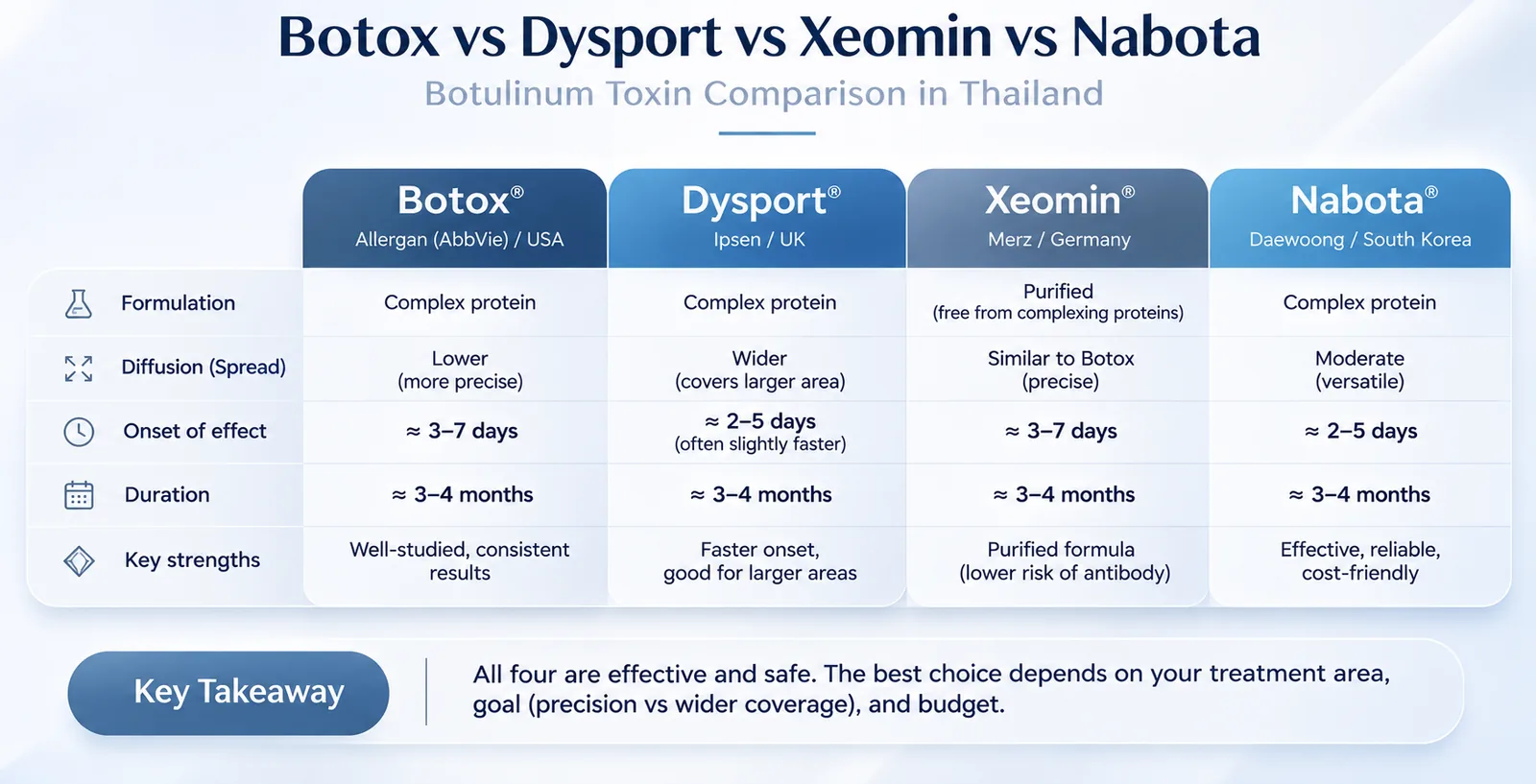
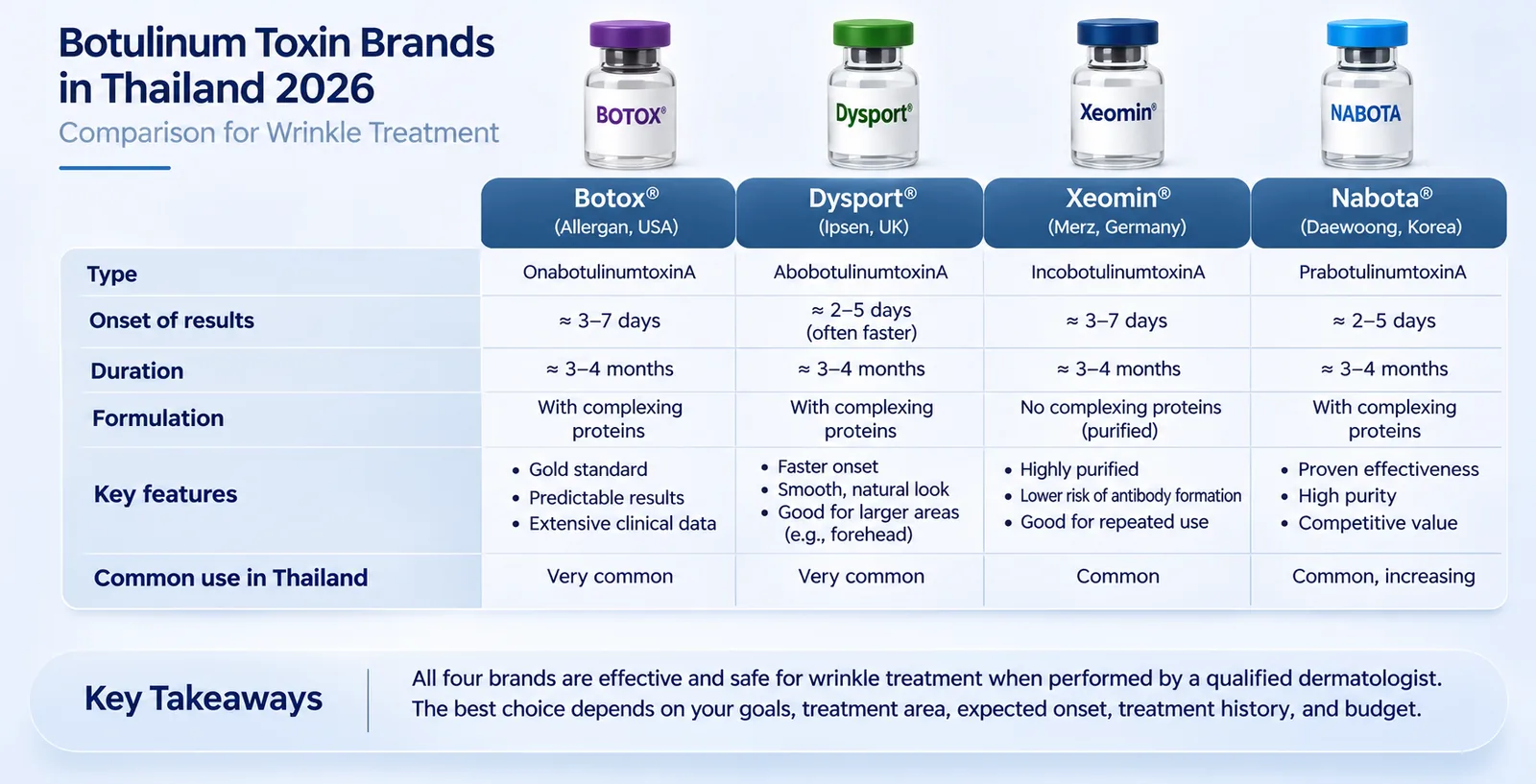
Quick Comparison: Botox vs Dysport vs Xeomin vs Nabota
| Brand | Active toxin | Origin of registered Thai product | Key practical point |
|---|---|---|---|
| Botox | onabotulinumtoxinA | Ireland | Long-established product with extensive clinical data |
| Dysport | abobotulinumtoxinA | United Kingdom | Uses its own product-specific unit system |
| Xeomin | incobotulinumtoxinA | Germany | Formulated without complexing proteins |
| Nabota | botulinum toxin type A | South Korea | Korean-manufactured botulinum toxin with clinical comparative data |
The Thai FDA drug database lists Botox 100 units, Dysport 500 units, Xeomin 50 and 100 units, and Nabota 100 units among registered botulinum toxin type A products. (National Drug Information)
Important: the number printed on a vial should not be used to decide which product is “stronger.” Botulinum toxin units are product-specific, and units from different formulations cannot simply be compared or converted as if they were the same measurement. The Xeomin prescribing information, for example, specifically states that its potency units are not interchangeable with those of other botulinum toxin preparations. (XEOMIN)
What Is Botulinum Toxin?
Botulinum toxin type A is a purified neurotoxin used medically to temporarily reduce muscle activity.
At the neuromuscular junction—the point where a nerve communicates with a muscle—botulinum toxin reduces the release of acetylcholine, a chemical signal that normally tells the muscle to contract.
When carefully injected into selected facial muscles, the treated muscle contracts less strongly.
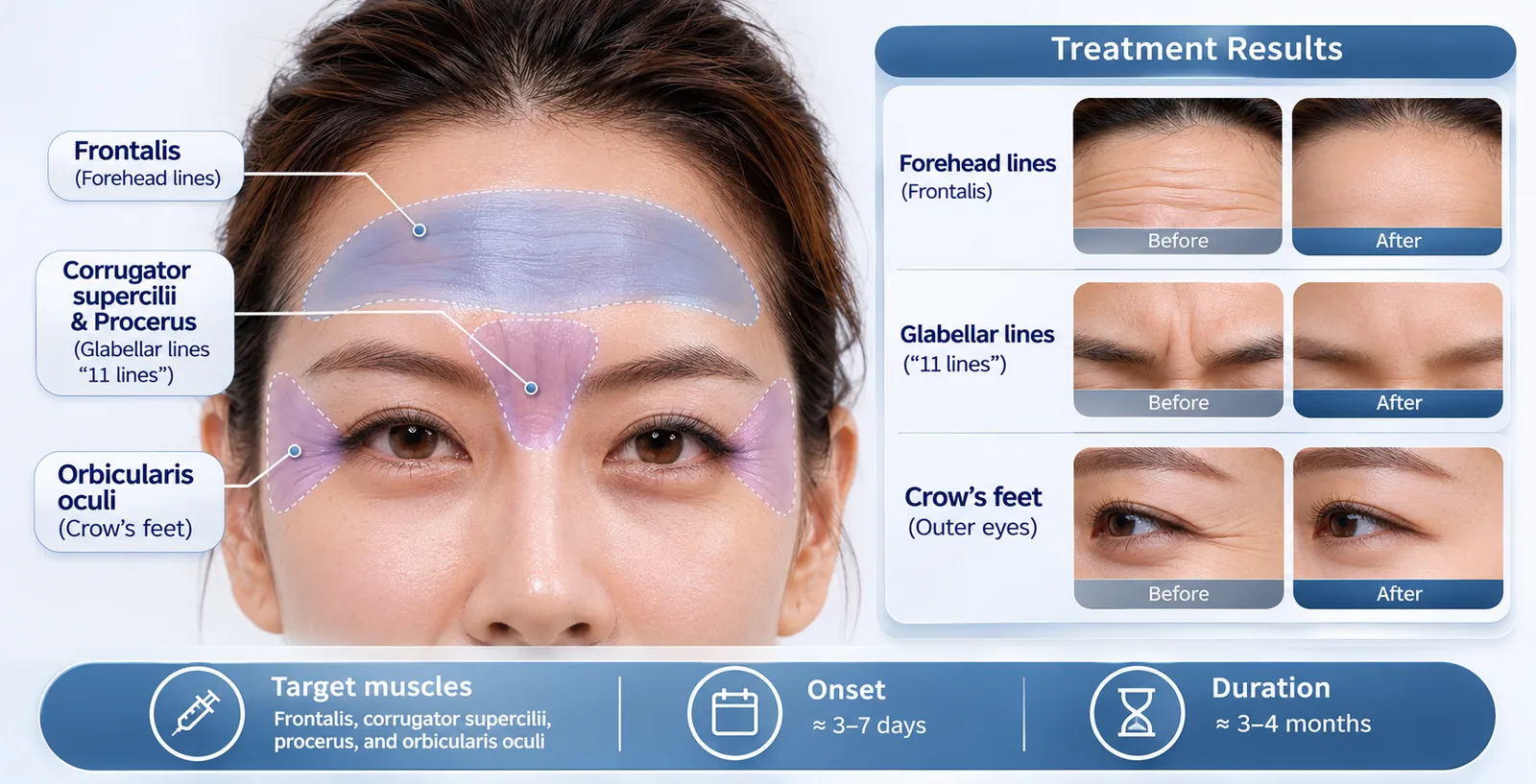
This can soften dynamic wrinkles, meaning lines produced or worsened by facial movement.
Common examples include:
- frown lines between the eyebrows
- horizontal forehead lines
- crow’s feet around the eyes
Botulinum toxin does not “fill” a wrinkle. That distinction is important.
It works by modifying muscle activity rather than adding volume underneath the skin.
What Types of Wrinkles Respond Best to Botulinum Toxin?
Botulinum toxin is particularly useful for dynamic wrinkles.
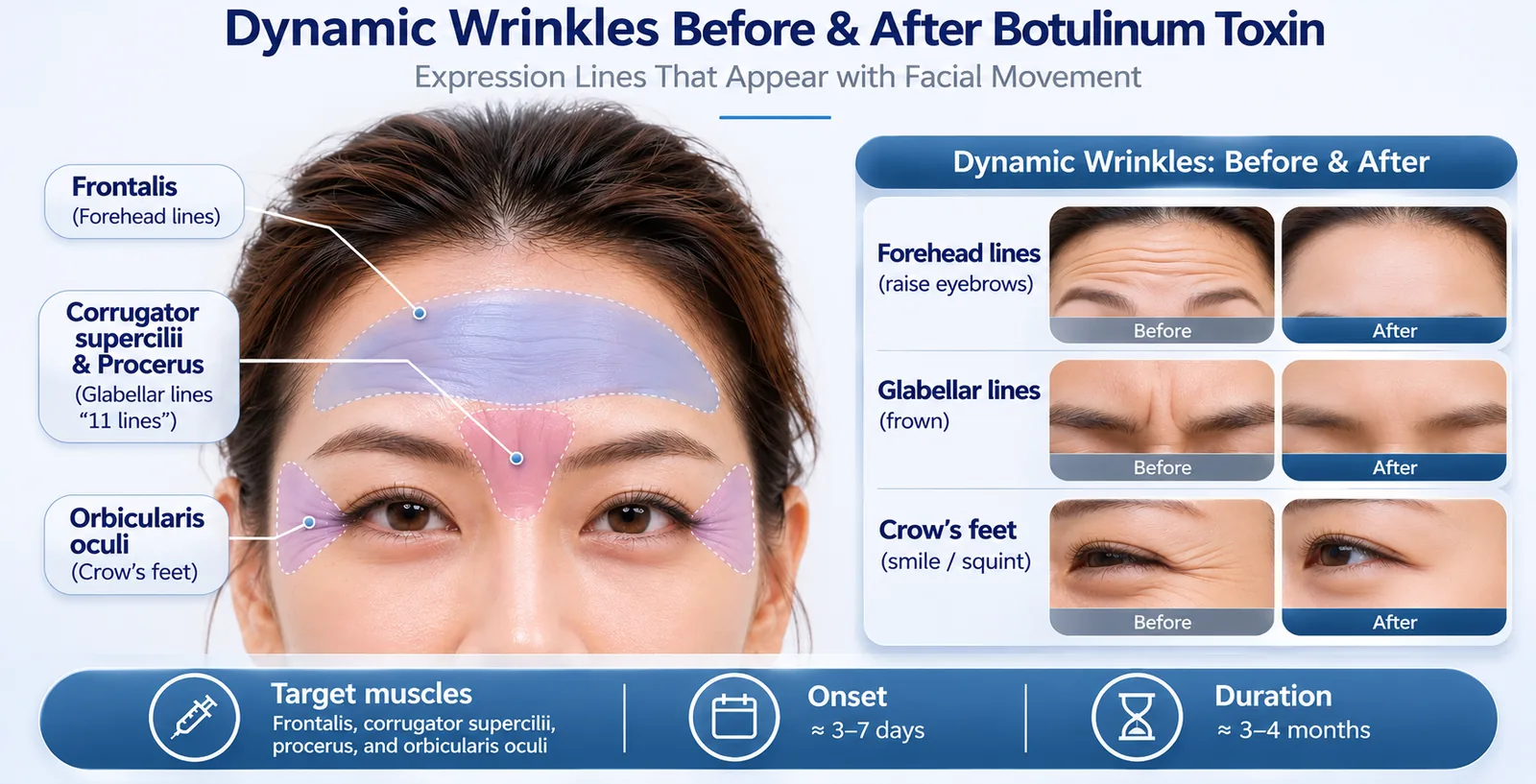
These are lines that become more visible when you smile, frown, squint or raise your eyebrows.
For example, a patient may have almost no forehead lines when the face is relaxed but develop prominent horizontal lines when raising the eyebrows. Reducing excessive contraction of the responsible muscles can soften these lines.
What about wrinkles that are visible even when the face is relaxed?
These are often called static wrinkles.
Long-standing expression lines can gradually become visible even without facial movement because of repeated folding of the skin combined with age-related changes in collagen, elasticity and skin quality.
Botulinum toxin may prevent the muscle from repeatedly deepening these creases and can sometimes make them less noticeable over time.
However, a deep static wrinkle may not disappear completely with botulinum toxin alone.
Depending on the problem, other treatments addressing skin texture, collagen or volume may be more appropriate.
This is one reason a proper facial assessment is more useful than simply choosing a toxin brand.
Botox: The Most Recognized Botulinum Toxin Brand
Botox is the trade name for onabotulinumtoxinA.
It has been extensively studied for both medical and aesthetic indications and has a large body of clinical evidence behind its use for facial expression lines.
The Thai FDA database lists Botox 100 units as a registered botulinum toxin type A product in Thailand. (National Drug Information)
What are the advantages of Botox?
One of its main advantages is the amount of clinical experience and research accumulated over many years.
OnabotulinumtoxinA has been studied extensively for upper facial lines, including glabellar lines, crow’s feet and forehead lines. A meta-analysis of randomized controlled trials found it effective for reducing moderate-to-severe upper facial expression lines at approved doses. (PubMed)
Does Botox last longer than other brands?
Not necessarily.
Duration depends on several variables, including:
- treatment area
- dose
- muscle strength
- individual response
- previous treatment history
- injection technique
Botox should therefore not automatically be considered longer-lasting simply because it is the most familiar brand.
Dysport: How Is It Different from Botox?
Dysport contains abobotulinumtoxinA.
The Thai FDA database lists Dysport 500 units as a registered botulinum toxin type A product manufactured in the United Kingdom. (National Drug Information)
Both Botox and Dysport reduce muscle contraction, but their formulations and potency assays differ.
This creates one of the most important points patients need to understand when comparing botulinum toxin treatments:
Dysport units are not the same as Botox units
A clinic may quote a larger number of Dysport units than Botox units for a treatment.
That does not mean the patient is receiving a dramatically larger amount of toxin.
The unit systems are product-specific.
For this reason, statements such as:
“100 units of this brand is stronger than 50 units of that brand”
can be misleading when comparing different botulinum toxin formulations.
The relevant question is whether the doctor is using an appropriate product-specific dose for your anatomy and treatment goal.
Xeomin: What Does “No Complexing Proteins” Mean?
Xeomin contains incobotulinumtoxinA.
Thai FDA records list both 50-unit and 100-unit Xeomin products registered in Thailand. (National Drug Information)
Xeomin differs from some other formulations because the final product contains the active neurotoxin without the accessory or complexing proteins found in some botulinum toxin preparations.
This characteristic is frequently used when explaining how Xeomin differs from other brands.
However, patients should be cautious about turning a formulation difference into an exaggerated clinical claim.
Does this make Xeomin better?
Not necessarily.
A systematic review of prospective comparative trials found that the overall evidence supported similar aesthetic efficacy between incobotulinumtoxinA, onabotulinumtoxinA and abobotulinumtoxinA when appropriately used. (PubMed)
A more recent systematic review and meta-analysis also supports the effectiveness of incobotulinumtoxinA for upper facial lines. (PubMed)
So while the formulation is different, this does not mean Xeomin is automatically better, stronger, safer or more natural-looking for every patient.
Nabota: A Korean Botulinum Toxin Available in Thailand
Nabota is a botulinum toxin type A manufactured by Daewoong Pharmaceutical in South Korea.
The Thai FDA database lists Nabota Injection 100 units as a registered product in Thailand. (National Drug Information)
Nabota is sometimes grouped casually with “Korean botox,” but patients should remember that Korea produces multiple botulinum toxin brands. They are not all the same product.
There is also published comparative clinical evidence for prabotulinumtoxinA. In a randomized, double-blind split-face study evaluating crow’s feet, prabotulinumtoxinA and onabotulinumtoxinA produced comparable efficacy and safety outcomes in the study population. (PubMed)
That does not mean every Korean toxin is equivalent to Botox, nor does it mean the results from one formulation can automatically be applied to another Korean product.
Each product should be evaluated individually.
So Which Botulinum Toxin Brand Is Best?
For most patients, this is the wrong question.
A better question is:
Which product, dose and injection pattern are most appropriate for my facial anatomy and treatment goal?
There is no convincing clinical evidence that Botox, Dysport, Xeomin or Nabota is universally the best option for every cosmetic indication.
Research comparing established botulinum toxin type A preparations generally shows that several formulations can effectively improve facial expression lines when used at appropriate product-specific doses. (PubMed)
The quality of the result depends on several factors beyond the brand.
1. Facial anatomy
Two people with similar wrinkles may have very different muscle anatomy and patterns of movement.
2. Muscle strength
A patient with strong glabellar or forehead muscles may require a different treatment plan from someone with weaker muscles.
3. Desired result
Some patients want maximum reduction of movement.
Others prefer to retain more facial expression.
4. Dose
Too little toxin may produce an inadequate or short-lived result.
Too much in an inappropriate location can create excessive weakness or an unnatural appearance.
5. Injection placement
A few millimeters can matter in certain anatomical areas.
This is particularly important around the eyebrows, forehead, eyelids and lower face.
Botox vs Dysport vs Xeomin vs Nabota: Which Lasts Longest?
This is one of the most common questions patients ask.
Unfortunately, there is no reliable rule that one of these brands will always last longer in every patient.
In general, cosmetic botulinum toxin treatment is temporary.
Earlier randomized-trial evidence found facial aesthetic effects commonly lasting several months, while duration varies according to the formulation, dose, treatment area and study design. (PubMed)
For an individual patient, duration can also vary between treatment sessions.
Factors that may influence how long a result lasts include:
- injected dose
- muscle strength
- treatment area
- individual biological response
- injection technique
- treatment interval
A claim that one toxin brand always lasts longer should therefore be viewed cautiously unless the comparison is based on appropriate head-to-head evidence using clinically comparable treatment protocols.
Which Botulinum Toxin Works Fastest?
Patients often hear claims such as:
- “This brand starts working in 24 hours.”
- “This toxin is faster.”
- “This one takes a week.”
Some differences in onset may occur between formulations and individuals, but onset should not be confused with the final result.
Patients may begin noticing reduced muscle movement within the first several days, while the effect continues to develop afterward.
A faster onset also does not necessarily mean a better or longer-lasting result.
For most patients, choosing a product based solely on whether it appears to start working a day or two earlier is less important than choosing an appropriate treatment plan.
How Many Units of Botulinum Toxin Do I Need?
There is no universal number.
The dose depends on:
- product used
- treatment area
- sex
- muscle size and strength
- facial anatomy
- previous treatment response
- desired degree of movement reduction
Most importantly:
Never compare units across brands as if they were identical
Botox, Dysport, Xeomin and other botulinum toxin formulations use product-specific potency units.
Official prescribing information for botulinum toxin products warns that potency units are specific to each formulation and assay and are not directly interchangeable. (XEOMIN)
This makes advertisements based only on “price per unit” potentially confusing.
A cheaper unit does not necessarily mean a cheaper treatment.
Instead, patients should compare the total treatment plan for a specific area using a specific product.
Should You Choose Botulinum Toxin Based on Price?
Price matters, but it should not be the only factor.
When comparing botulinum toxin treatment in Bangkok, consider:
- Which exact product is being used?
- Is the product registered in Thailand?
- Is the vial authentic and obtained through an appropriate supply chain?
- How much product is being used for the treatment area?
- Who is performing the injection?
- Has your facial anatomy been assessed before treatment?
- What follow-up is available if the result is asymmetric or a complication occurs?
A very low advertised price may not tell you the brand, total dose, dilution, treatment area or whether follow-up is included.
For this reason, comparing only the headline price can be misleading.
Other Botulinum Toxin Brands Registered in Thailand
Botox, Dysport, Xeomin and Nabota are not the only botulinum toxin type A products found in the Thai regulatory database.
Thai FDA records also list other products, including Neuronox, Letybo, Hugel toxin products and additional botulinum toxin type A formulations. (National Drug Information)
The number of products available is another reason patients should ask for the exact brand name, rather than simply asking whether a clinic offers “Botox.”
“Botox” is a specific brand name, although the word is often used informally to describe botulinum toxin injections in general.
Registration status, approved indications and available vial sizes can change, so patients and clinicians can verify current product information through the Thai FDA database.
Does a More Expensive Botulinum Toxin Give Better Results?
Not necessarily.
Price may reflect many factors, including manufacturing, importation, distribution, brand positioning and clinic pricing.
It does not provide a direct measurement of how good your result will be.
Likewise, a less expensive product should not automatically be assumed to be inferior if it is a legitimate registered product supported by appropriate evidence and used correctly.
The more clinically useful question is:
Can this product safely and predictably achieve the result I want when used appropriately for my anatomy?
What Makes Botulinum Toxin Look Natural?
Natural-looking treatment is usually more about planning and dose distribution than choosing a particular brand.
The goal does not necessarily have to be complete paralysis of every treated muscle.
For example, forehead wrinkles are produced by the frontalis muscle. This muscle also helps elevate the eyebrows.
Reducing its activity can soften horizontal forehead lines, but excessive weakening—particularly in a patient who relies heavily on the frontalis to maintain eyebrow position—can make the brows feel or appear heavy.
Similarly, treating the muscles between the eyebrows without understanding their relationship with the brow elevators can change eyebrow shape.
Good treatment therefore requires an understanding of both:
- where the wrinkle is located
- which muscle movement is creating it
The wrinkle itself is not always where the injection should go.
Can Botulinum Toxin Prevent Wrinkles?
Botulinum toxin reduces repeated muscle contraction, so regular treatment can reduce repeated folding of the overlying skin.
This may help prevent dynamic lines from becoming more deeply etched over time.
However, the term “preventive Botox” is sometimes overused.
There is no universal age at which everyone should start botulinum toxin.
A person in their twenties with minimal dynamic lines does not automatically need injections simply to prevent future aging.
Treatment should be based on facial movement, existing lines, patient preference and an appropriate risk-benefit discussion rather than age alone.
Can Botulinum Toxin Treat Deep Wrinkles?
Sometimes—but not always completely.
A useful way to assess a line is to look at it both during facial movement and at rest.
If the wrinkle disappears when the muscle relaxes, reducing muscle contraction may produce a substantial improvement.
If a deep crease remains visible even when the face is completely relaxed, part of the problem has become structural.
Botulinum toxin may prevent repeated folding and soften the line, but additional treatments aimed at skin quality, collagen or volume may sometimes be needed.
What Areas Can Be Treated with Botulinum Toxin?
For cosmetic facial treatment, commonly discussed areas include:
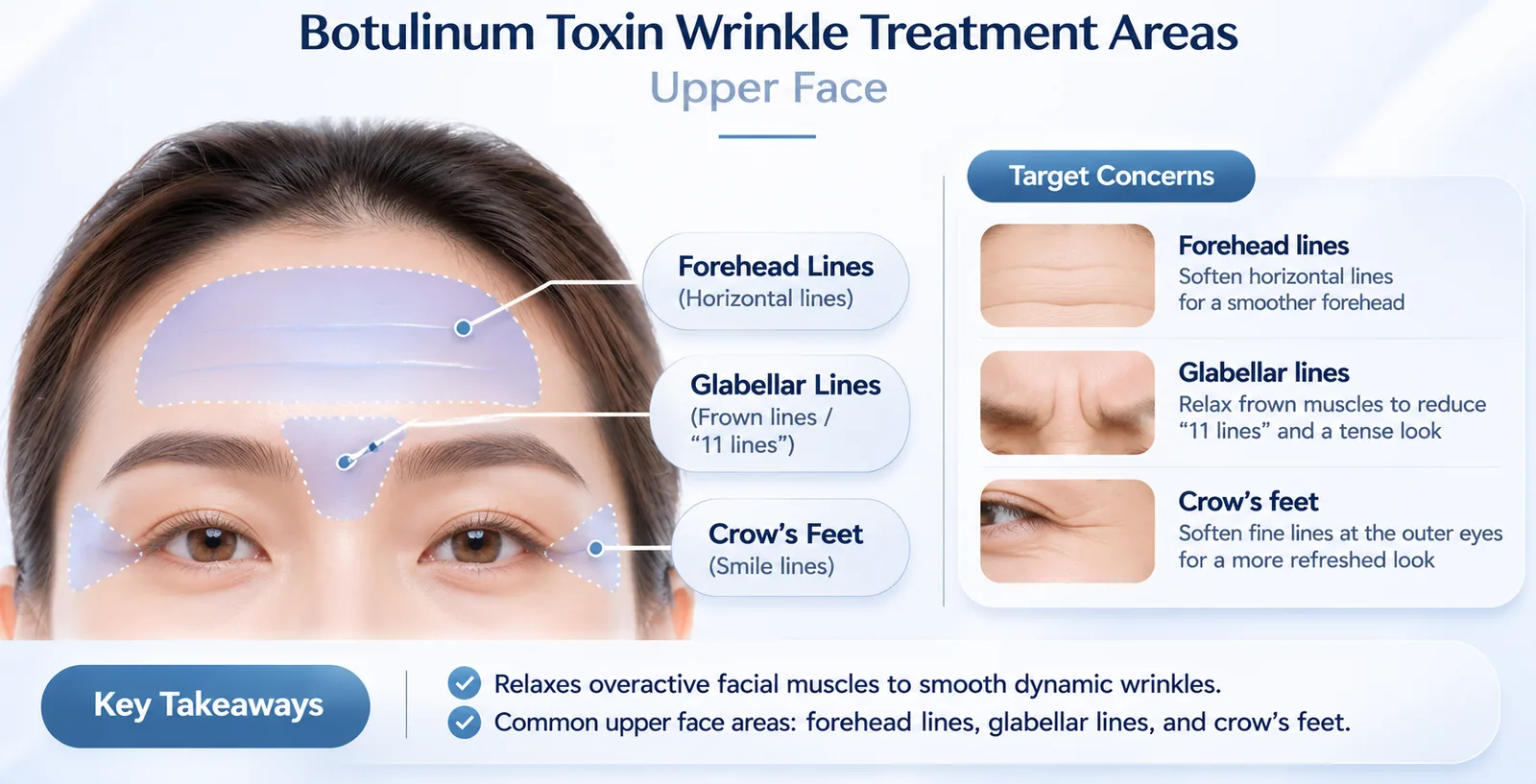
- frown lines between the eyebrows
- forehead lines
- crow’s feet
Botulinum toxin is also used by experienced physicians in selected patients for other facial or neck concerns, including:
- bunny lines
- gummy smile
- downturned mouth corners
- chin dimpling
- platysmal bands
- masseter muscle prominence
However, regulatory approval differs by product, indication and country.
Some commonly performed aesthetic uses may therefore be off-label.
Published evidence also varies substantially between upper-face indications and less-established lower-face or neck applications. A systematic review of abobotulinumtoxinA, for example, found positive studies for several middle- and lower-face uses but noted that many were unapproved indications and that the evidence base was more limited. (PubMed)
Botox for Jaw Slimming: Is It the Same Treatment as Wrinkles?
Not exactly.
Botulinum toxin can reduce the activity and, over time, the volume of the masseter muscle in appropriately selected patients.
This can create a slimmer lower-face appearance when facial width is primarily caused by large masseter muscles.
But not every wide jaw is caused by muscle.
Lower-face width can also result from:
- bone structure
- facial fat
- parotid gland prominence
- skin and soft-tissue distribution
Botulinum toxin cannot shrink the jawbone.
A patient considering masseter treatment should therefore be examined rather than assuming that more toxin will automatically produce a slimmer face.
Botulinum Toxin for Bruxism: Does It Work?
Botulinum toxin is also used in selected patients to reduce excessive masseter activity associated with jaw clenching or bruxism.
This is different from cosmetic wrinkle treatment and requires an appropriate assessment of the patient’s symptoms, muscle activity and other possible causes of jaw pain.
Not all bruxism requires botulinum toxin, and injections do not address every underlying cause of teeth grinding.
Patients with jaw pain, locking, significant dental wear or temporomandibular joint symptoms may require dental or other medical assessment as part of their management.
What Happens During a Botulinum Toxin Consultation?
A useful consultation should involve more than asking how many units you want.
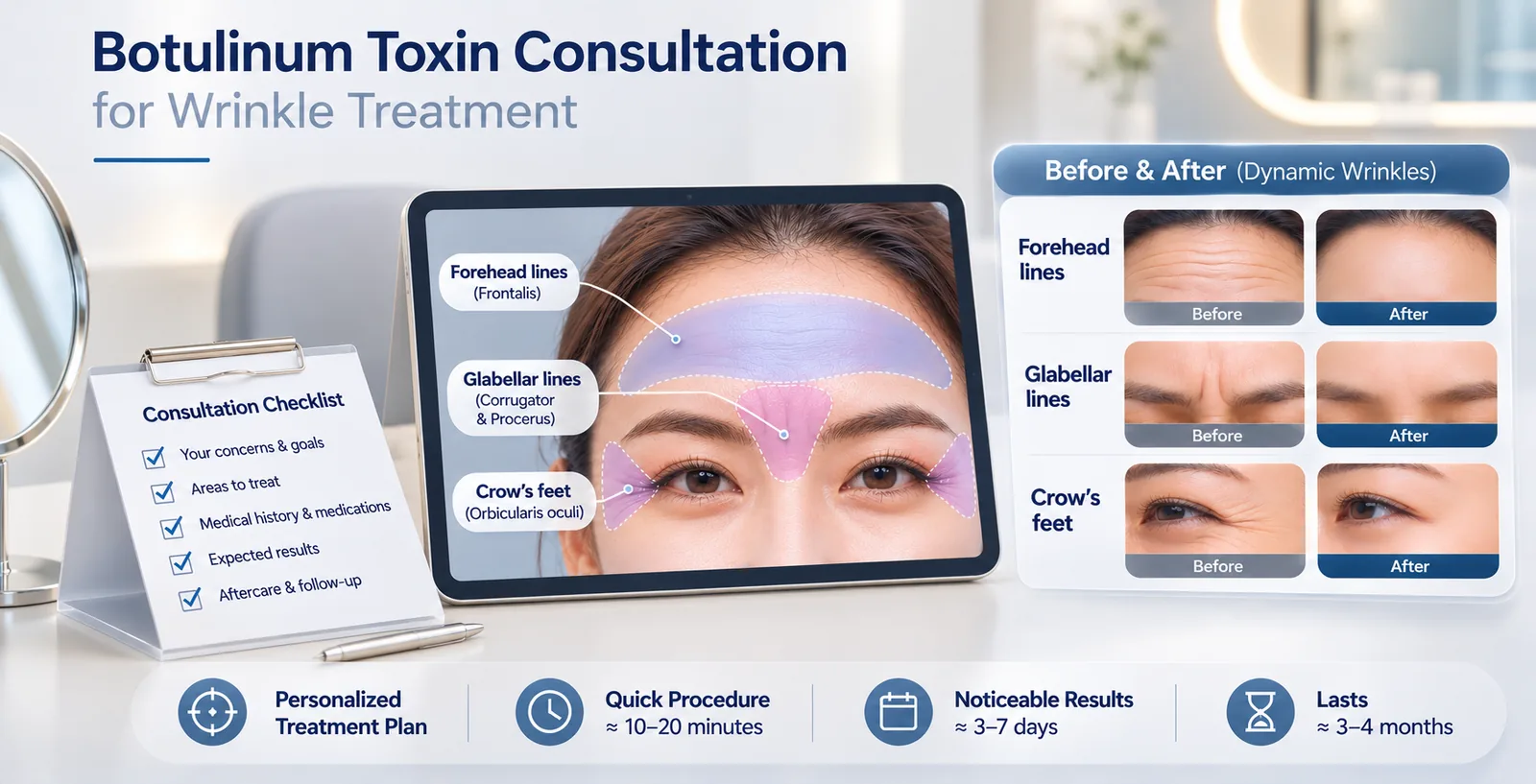
The doctor may assess your face both at rest and during movement.
You may be asked to:
- frown
- raise your eyebrows
- smile
- squint
- clench your jaw, when relevant
The assessment may include:
- facial symmetry
- eyebrow position
- eyelid position
- muscle strength
- existing static wrinkles
- previous toxin treatments
- previous complications
- desired degree of movement
The doctor should also review relevant medical history, medications and contraindications before treatment.
For international patients visiting Bangkok, it can be helpful to know the brand, approximate dose, treatment areas and date of your previous botulinum toxin treatment.
Who Should Not Have Botulinum Toxin Treatment?
Botulinum toxin is not appropriate for everyone.
Treatment may need to be avoided or postponed in situations such as:
- known hypersensitivity to the product or its components
- infection at the proposed injection site
- certain neuromuscular disorders
- medications that may affect neuromuscular transmission
- pregnancy or breastfeeding, depending on clinical circumstances and product guidance
Patients should provide their complete medical history and medication list before treatment.
What Are the Side Effects of Botulinum Toxin?
Most aesthetic botulinum toxin treatments are well tolerated when appropriately performed, but side effects are possible.
Temporary effects may include:
- pain or tenderness at injection sites
- redness
- swelling
- bruising
- headache
- temporary asymmetry
Effects related to weakening an unintended nearby muscle can include:
- eyelid drooping
- eyebrow drooping
- unwanted eyebrow shape
- smile asymmetry
- changes in facial expression
Systematic reviews of aesthetic botulinum toxin studies support an overall favorable short-term safety profile while confirming that local functional complications such as eyelid or brow ptosis can occur. (PubMed)
A large analysis of onabotulinumtoxinA registration studies also found that most treatment-related adverse events were mild to moderate and related either to injection or local pharmacological effects. (PubMed)
When Should You Seek Medical Attention After Botulinum Toxin?
Contact the treating doctor if you develop an unexpected or significant problem after treatment.
Seek urgent medical attention if you develop symptoms such as:
- difficulty swallowing
- difficulty speaking
- difficulty breathing
- generalized muscle weakness
- severe allergic symptoms
These are uncommon in routine cosmetic use, but symptoms consistent with spread of toxin effect are included in botulinum toxin product safety warnings. (XEOMIN)
What Should You Do After Botulinum Toxin Treatment?
Botulinum toxin treatment generally requires little downtime.
Small bumps or redness at injection sites usually settle quickly, and bruising is possible.
Your treating doctor should provide product- and procedure-specific instructions.
There are many rigid aftercare rules circulating online, some of which have limited evidence. Patients should therefore avoid assuming that every social-media rule—such as a precise number of hours for every activity—is medically necessary.
More important is to follow the instructions given for your individual treatment and contact the clinic if an unexpected problem develops.
Can You Become Resistant to Botulinum Toxin?
True secondary treatment failure can occur, although an apparent loss of effect does not automatically mean that a patient has developed neutralizing antibodies.
Other explanations include:
- inadequate dose
- incorrect muscle targeting
- changes in facial muscle activity
- inappropriate treatment intervals
- product handling or administration issues
- unrealistic expectations
Antibody formation has been studied with botulinum toxin products, but diagnosing true immunologic resistance requires more than noticing that one treatment “didn’t work as well.”
Patients experiencing repeated inadequate responses should be medically reassessed rather than simply increasing the dose or changing brands without determining the cause.
Is Xeomin Less Likely to Cause Resistance Because It Has No Complexing Proteins?
This is often presented online as a simple fact, but the clinical question is more complicated.
Xeomin’s formulation does differ because it does not contain accessory complexing proteins.
However, it is not appropriate to promise an individual patient that this automatically means they will never develop resistance or that Xeomin is universally superior for patients receiving repeated cosmetic treatment.
Formulation is one factor among many, and clinically meaningful antibody-mediated treatment failure at aesthetic doses is a more nuanced issue.
How to Choose a Botulinum Toxin Clinic in Bangkok
For patients comparing wrinkle treatment in Bangkok, choosing the clinic and injector is at least as important as choosing the brand.
Before treatment, consider asking:
- What exact botulinum toxin brand will be used?
- Is it registered in Thailand?
- Can I see the original vial or packaging?
- What treatment areas are recommended for my facial anatomy?
- What result are we trying to achieve?
- What are the possible side effects for these specific injection sites?
- What happens if I develop asymmetry or another complication?
- When should the result be reviewed?
A good consultation should not pressure every patient toward the most expensive product or the highest number of units.
Botox vs Dysport vs Xeomin vs Nabota: Final Comparison
| Question | Practical answer |
|---|---|
| Which is the best brand? | There is no universally best brand |
| Which has the most established clinical history? | Botox has extensive long-term clinical use and published evidence |
| Which contains no complexing proteins? | Xeomin |
| Which is manufactured in South Korea? | Nabota |
| Is Dysport weaker because it uses more units? | No. Its units cannot be directly compared with Botox units |
| Which lasts longest? | No brand reliably lasts longest in every patient |
| Which looks most natural? | Natural results depend heavily on anatomy, dose and injection technique |
| Is the most expensive toxin necessarily best? | No |
| Can I compare prices per unit between brands? | Not reliably without considering product-specific dosing |
| Should I choose by brand alone? | No. Product, anatomy, dose, indication and injector experience all matter |
The Bottom Line
If you are looking for the best botulinum toxin for wrinkle treatment in Bangkok, Botox, Dysport, Xeomin and Nabota are not simply different versions of the same product with interchangeable units.
They are distinct botulinum toxin type A formulations.
Clinical evidence supports the effectiveness of several established formulations for facial expression lines, and comparative research does not justify declaring one brand universally superior for every patient. (PubMed)
For most patients, the better question is not:
“Which botulinum toxin brand is best?”
but:
“Which product, dose and injection pattern are best suited to my facial anatomy and the result I want?”
Brand matters—but correct diagnosis of the wrinkle pattern, understanding facial muscle anatomy, appropriate product-specific dosing and careful injection technique matter just as much.
Frequently Asked Questions
Is Botox better than Dysport?
Not universally. Both are established botulinum toxin type A products with evidence supporting aesthetic use. They have different formulations and unit systems, so their units should not be directly compared.
Is Xeomin better than Botox?
Xeomin has a different formulation and does not contain accessory complexing proteins. Comparative studies have generally found similar aesthetic effectiveness when the products are appropriately dosed. (PubMed)
Is Nabota as effective as Botox?
Clinical research on prabotulinumtoxinA has shown comparable outcomes to onabotulinumtoxinA in specific aesthetic studies, including a randomized split-face study for crow’s feet. This does not mean the products are identical or that their findings apply to every treatment area. (PubMed)
Which botulinum toxin lasts the longest?
There is no brand that reliably lasts longest in every patient. Duration depends on the product, dose, treatment area, muscle strength, individual response and injection technique.
Which botulinum toxin looks the most natural?
No specific brand guarantees a more natural result. Natural-looking treatment depends heavily on facial assessment, appropriate dosing and injection placement.
Is Dysport stronger than Botox?
This is not a useful direct comparison because the potency units are product-specific. A larger number of Dysport units does not automatically mean a stronger treatment.
Can I compare botulinum toxin prices per unit?
Be careful. Price-per-unit comparisons between different brands can be misleading because the units are not interchangeable. Comparing the total cost of treating the same anatomical area is more useful.
How long does botulinum toxin last for wrinkles?
Results are temporary and commonly persist for several months, but duration varies by patient, product, dose and treatment area. (PubMed)
How soon will I see results?
Some reduction in muscle activity may become noticeable within several days, with the result developing further afterward. Exact onset varies.
Can Botox completely remove deep forehead wrinkles?
Not always. Botulinum toxin works particularly well for wrinkles caused by muscle movement. Deep static wrinkles that remain visible at rest may improve but may not disappear completely.
Can botulinum toxin make my eyebrows or eyelids droop?
Yes, temporary brow or eyelid ptosis is a recognized potential complication, although it is uncommon when treatment is appropriately planned and performed. (PubMed)
Is Korean botulinum toxin safe?
“Korean botulinum toxin” is not a single product. Korea manufactures multiple formulations. Safety should be assessed for the specific product, its regulatory status, evidence, authenticity and appropriate medical use.
Is Nabota registered in Thailand?
The Thai FDA drug database lists Nabota Injection 100 units as a registered botulinum toxin type A product. (National Drug Information)
Are Botox, Dysport and Xeomin registered in Thailand?
Thai FDA records list Botox, Dysport and Xeomin botulinum toxin type A products. (National Drug Information)
Should I choose the cheapest botulinum toxin?
Price can be considered, but product authenticity, regulatory status, appropriate dose, treatment planning and injector experience are more important for safety and predictable results.
How often should I have botulinum toxin?
Treatment intervals should be individualized according to the product, treatment indication, previous response and clinical assessment rather than following a fixed schedule for everyone.
Can I switch from Botox to Dysport or Xeomin?
It is possible to use a different formulation at a future treatment, but the doctor must use product-specific dosing rather than simply copying the number of units used with another brand.
Can botulinum toxin permanently remove wrinkles?
No. Botulinum toxin temporarily reduces muscle activity. The effect gradually wears off as neuromuscular function recovers.
Medically reviewed by
Reviewed on
Related articles
-
Aesthetic & Skin Rejuvenation Skin Tightening in Bangkok: How to Choose Between HIFU (Ultraformer) and Monopolar RF (XERF) If you are considering nonsurgical skin tightening in Bangkok, two technologies you may encounter are HIFU (Ultraformer) and monopolar radiofrequency (XERF).
-
Aesthetic & Skin Rejuvenation Ultraformer for Face Lifting: Who Is It Best For and When Will You See Results? Facial sagging is one of the most common concerns associated with aging. As collagen and elastin change over time, the skin gradually loses firmness. Changes in facial fat, connective tissue, and bone support can also contribute to sagging cheeks, early jowls, and reduced jawline definition.

-
Aesthetic & Skin Rejuvenation Ultraformer vs XERF: What’s the Difference and Which One Should You Choose? If you are considering facial lifting or skin tightening without surgery, you may have heard of Ultraformer and XERF. Both are energy-based treatments designed to improve skin firmness and reduce the appearance of mild to moderate sagging, but they use different technologies.