






















Monopolar Radiofrequency
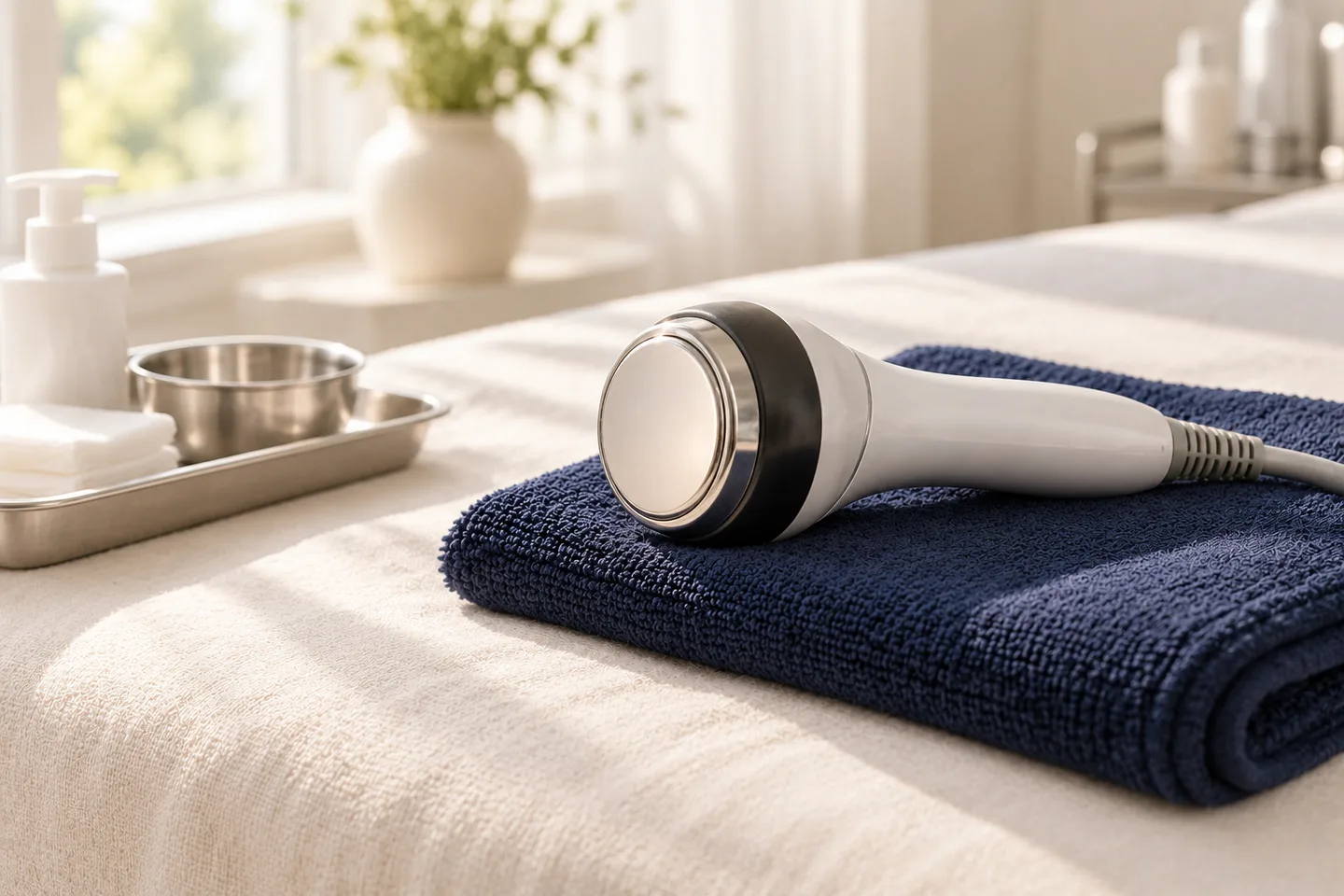
XERF is a non-invasive monopolar radiofrequency (RF) technology designed to deliver controlled heat into tissues beneath the skin. It uses two radiofrequency frequencies—6.78 MHz and 2 MHz—to create different patterns and depths of thermal energy delivery.
The treatment is primarily intended for people looking for improvement in mild to moderate skin laxity, facial firmness and contour without surgery or needles.
Radiofrequency skin tightening works differently from fillers, Botulinum toxin, lasers and ultrasound. Rather than adding facial volume or treating pigmentation, RF creates controlled heating within tissue, triggering collagen contraction and a longer remodeling response. Published evidence for monopolar RF supports modest improvement in facial laxity in appropriately selected patients, but it should not be expected to reproduce the lifting effect of surgery.
What Is XERF?
XERF is a non-invasive monopolar radiofrequency system developed by Cynosure Lutronic.
Unlike conventional monopolar RF systems that operate at a single frequency, XERF incorporates 6.78 MHz and 2 MHz radiofrequency energy. The manufacturer describes the system as a multifrequency monopolar RF platform capable of producing different thermal profiles across superficial, middle and deeper tissue levels.
The treatment is performed from the surface of the skin and does not require needles to deliver RF energy into the tissue.
Its main purpose in aesthetic treatment is to create controlled tissue heating that may improve:
- mild facial skin laxity
- reduced skin firmness
- early loss of jawline definition
- mild lower-face laxity
- selected areas of neck laxity
- overall skin tightness and quality
It is important to distinguish skin tightening from surgical lifting.
XERF may improve firmness and produce a modest tightening effect, but it does not surgically reposition significantly descended facial tissues.
How Does Monopolar Radiofrequency Tighten the Skin?
Radiofrequency is electromagnetic energy.
When RF energy passes through tissue, resistance within the tissue converts part of that energy into heat.
The goal is not to burn the skin. Instead, treatment aims to produce a controlled thermal effect beneath the skin while protecting the surface.
This thermal response can affect collagen in two main ways.
Immediate Collagen Contraction
Heating collagen-containing tissue can cause structural changes and contraction of existing collagen fibers.
This may contribute to some early feeling or appearance of tightening after treatment.
Gradual Collagen Remodeling
The more important changes occur over time.
Controlled thermal stimulation initiates biological repair and remodeling processes that can include new collagen formation and reorganization of existing collagen.
For this reason, radiofrequency tightening should not be judged only by what the face looks like immediately after treatment.
Clinical studies of monopolar RF have demonstrated continued improvement in skin laxity during follow-up after treatment.
How Is XERF Different From Conventional Monopolar RF?
The distinguishing feature of XERF is its use of two RF frequencies: 6.78 MHz and 2 MHz.
Different frequencies interact differently with tissue.
In general, higher-frequency RF tends to concentrate its thermal effect more superficially, while lower-frequency RF can create a deeper and broader pattern of energy deposition.
XERF uses these properties to provide different treatment-depth settings.
The system can use 6.78 MHz alone for shallower thermal profiles and sequential 6.78 MHz and 2 MHz energy for its deeper treatment mode. Experimental modeling and histologic research has demonstrated different thermal patterns produced by these frequency configurations.
This does not mean that “deeper” is automatically better.
The appropriate depth depends on:
- facial anatomy
- skin thickness
- degree of laxity
- amount of facial fat
- treatment area
- desired result
- tolerance of treatment
- previous procedures
A properly planned treatment should therefore be individualized rather than automatically using the deepest or highest-energy setting.
XERF: 6.78 MHz and 2 MHz Explained
6.78 MHz
The 6.78 MHz frequency is used to create thermal effects in relatively shallower tissue levels.
Depending on the selected treatment mode and parameters, it may be used when the treatment goal is focused more toward the skin and collagen-rich supporting tissues.
2 MHz
The lower 2 MHz frequency allows a different, deeper distribution of RF energy.
In XERF’s deeper mode, 6.78 MHz and 2 MHz are delivered sequentially within the treatment pulse.
The practical significance is that treatment can be adapted to different tissue depths rather than relying on one fixed RF frequency.
What Problems Can XERF Treat?
XERF is primarily a skin-tightening treatment.
It may be considered for patients concerned about:
- early facial sagging
- mild to moderate skin laxity
- reduced firmness
- early jawline blurring
- mild lower-face laxity
- selected neck laxity
- age-related reduction in skin elasticity
- subtle changes in facial contour associated with tissue laxity
It may also produce secondary improvements in aspects of skin quality, but patients should not assume that it replaces treatments specifically designed for pigmentation, scars, vascular problems or significant wrinkles.
XERF for the Lower Face and Jawline
The lower face is one of the most common areas where age-related laxity becomes noticeable.
Patients may describe:
- a less defined jawline
- early jowling
- mild sagging around the mouth
- softer facial contours
- reduced firmness of the lower cheeks
Monopolar RF has been specifically studied for lower facial laxity.
A prospective study in Asian patients with Fitzpatrick skin types III–V found improvement following monopolar RF treatment for mild-to-moderate lower facial laxity, with changes continuing during six months of follow-up.
However, RF cannot physically remove excess skin or reposition significantly descended tissues.
Patients with prominent jowls or advanced laxity may therefore obtain only limited improvement from non-invasive tightening.
XERF for the Neck
Radiofrequency can also be used for selected patients with mild neck laxity.
Good candidates are generally those whose main problem is early loss of skin firmness, rather than substantial excess skin.
A neck that appears loose can result from several different anatomical problems:
- skin laxity
- submental fat
- platysma muscle changes
- loss of jawline support
- significant excess skin
These problems are not interchangeable.
RF may help skin laxity but cannot correct every cause of an aging neck.
Can XERF Reduce Jowls?
It may improve the appearance of early or mild jowling when skin and soft-tissue laxity are contributing factors.
However, jowls can result from a combination of:
- skin laxity
- changes in facial fat compartments
- loss of midface support
- skeletal aging
- retaining ligament changes
- tissue descent
Heating the skin cannot completely reverse all of these anatomical changes.
For this reason, a patient with mild early jowling may be a better candidate for non-invasive RF than someone with substantial lower-face tissue descent.
Can XERF Make the Jawline Sharper?
A tightening treatment may make the jawline appear somewhat more defined if laxity is the reason the contour has become less distinct.
But a poorly defined jawline may also result from:
- facial anatomy
- chin projection
- mandibular structure
- submental fat
- jowls
- facial volume distribution
RF does not change bone structure and is not equivalent to facial contouring with filler, fat reduction or surgery.
The cause should therefore be assessed before deciding which treatment is appropriate.
Does XERF Melt Facial Fat?
Radiofrequency can influence subcutaneous tissue depending on the device, frequency, temperature, treatment depth and energy delivered.
A systematic review of facial and neck RF treatments found evidence of volumetric changes in facial fat in some studies.
This deserves particular attention in patients who already have:
- a thin face
- hollow cheeks
- temple hollowing
- significant age-related volume loss
- previous facial fat reduction
More heating or deeper treatment is not automatically desirable in these patients.
Treatment planning should consider whether the goal is tightening, contouring, preserving facial volume, or some combination of these.
Who Is a Good Candidate for XERF?
XERF may be suitable for an adult who:
- has mild to moderate skin laxity
- wants non-surgical treatment
- prefers to avoid needles
- wants relatively little interruption to daily activities
- understands that improvement is generally gradual
- has realistic expectations
- does not require surgical repositioning of facial tissues
It may be particularly relevant to patients beginning to notice early laxity rather than those with advanced sagging.
Who May Not Get the Result They Want From XERF?
XERF may not be the best stand-alone treatment when the primary concern is:
- severe facial sagging
- substantial jowling
- large amounts of excess skin
- prominent neck laxity
- major facial volume loss
- deep dynamic wrinkles
- significant pigmentation
- melasma
- acne scars
- prominent surface texture abnormalities
- facial asymmetry caused by skeletal structure
These concerns may require a different treatment or combination approach.
XERF vs HIFU or Focused Ultrasound
Both treatments can be used for non-surgical tightening, but they deliver energy differently.
XERF
Uses monopolar radiofrequency to generate controlled tissue heating across selected tissue depths.
Focused Ultrasound
Uses focused acoustic energy to create discrete thermal treatment zones at predetermined depths.
Neither technology is universally superior.
Treatment selection should depend on:
- anatomy
- skin thickness
- facial fat
- degree of laxity
- treatment area
- pain tolerance
- previous procedures
- expected result
A patient should therefore be assessed based on anatomy rather than choosing treatment simply because one device is marketed as newer or deeper.
XERF vs Thermage
Both XERF and Thermage belong to the broad category of non-invasive monopolar radiofrequency skin-tightening treatments.
One technological difference is frequency.
Thermage FLX operates at 6.78 MHz, whereas XERF incorporates both 6.78 MHz and 2 MHz RF. FDA documentation comparing the devices confirms these frequency characteristics.
This technological difference does not by itself prove that one device will produce better clinical results for every patient.
Outcome depends on multiple factors including:
- patient selection
- anatomy
- treatment parameters
- energy delivery
- treatment technique
- tissue response
Patients should therefore be cautious about simplistic claims that one technology is universally “stronger” or “better.
”
XERF vs Radiofrequency Microneedling
Although both use RF energy, they are very different treatments.
XERF
Delivers monopolar RF energy non-invasively through the skin surface.
Its principal role is tissue heating and tightening.
Radiofrequency Microneedling
Uses needles that penetrate the skin and deliver RF energy at selected depths.
It may be particularly useful when the treatment goal includes:
- acne scars
- enlarged pores
- uneven texture
- fine wrinkles
- skin remodeling
RF microneedling creates controlled needle injuries, so it generally involves more direct disruption of the skin than non-invasive monopolar RF.
If the main concern is skin laxity, XERF may be considered.
If acne scarring and texture are dominant concerns, RF microneedling may be more relevant.
Some patients have both problems and require an individualized plan.
XERF vs Dermal Filler
These treatments solve fundamentally different problems.
XERF → tissue tightening
Filler → volume and structural support
Filler may be appropriate when the aging appearance results from:
- cheek volume loss
- chin deficiency
- selected facial hollows
- certain folds
- loss of structural support
XERF may be more appropriate when the primary problem is tissue laxity.
Adding filler to a face that primarily needs tightening can sometimes create unnecessary heaviness or fullness.
Conversely, tightening alone cannot replace significant volume that has been lost.
XERF vs Botulinum Toxin
Botulinum toxin reduces the activity of selected facial muscles.
It is commonly used for dynamic wrinkles such as:
- forehead lines
- frown lines
- crow’s feet
XERF does not work by relaxing facial muscles.
Therefore, a patient whose primary concern is a deep frown line caused by repeated muscle movement should not expect RF tightening to provide the same effect as Botulinum toxin.
XERF vs Laser Skin Resurfacing
Laser resurfacing primarily targets skin quality and surface remodeling.
Depending on the type of laser, it may be used for:
- fine lines
- acne scars
- rough texture
- photodamage
- selected pigmentation
XERF primarily targets tissue firmness and laxity.
A patient with excellent facial contour but significant acne scarring may benefit much more from a scar-directed treatment than from skin tightening.
Likewise, a patient with relatively smooth skin but early lower-face laxity may not need resurfacing.
What Happens During a XERF Treatment?
Treatment begins with an assessment of the face and the areas of concern.
The skin is prepared and a return electrode is used because XERF is a monopolar RF system.
The treatment handpiece is then applied systematically over the selected areas.
Each pulse delivers controlled RF energy while the system’s integrated cooling helps protect the skin surface and improve comfort.
XERF also incorporates monitoring of treatment conditions including skin-surface temperature. Published technical descriptions report automatic RF termination if the treatment-tip surface temperature exceeds 43°C.
The exact treatment pattern, depth, energy and number of pulses should be individualized.
There is no medically appropriate universal number of “shots” for every face.
Does XERF Require Numbing Cream?
The manufacturer describes XERF as designed to be performed without routine numbing.
However, comfort varies between individuals and depends on:
- treatment area
- energy settings
- tissue thickness
- number of passes
- individual pain sensitivity
Patients commonly describe RF treatment as repeated warmth or brief deeper heating sensations.
“No numbing required” should not be interpreted as a guarantee that treatment will be completely painless.
How Painful Is XERF?
Pain perception is highly individual.
The system uses integrated cooling to help manage skin-surface temperature and comfort.
XERF-specific clinical research has used treatment settings adjusted according to patient tolerance, reinforcing an important principle: energy should be individualized rather than increased simply to reach the highest possible setting.
A patient should tell the treating clinician if heat becomes unexpectedly intense, sharply painful or markedly different in one area.
Is There Downtime After XERF?
Because XERF is non-invasive and does not intentionally remove the epidermis, recovery is generally much shorter than after ablative laser resurfacing or surgery.
Patients may experience temporary:
- redness
- warmth
- tenderness
- mild swelling
Many patients can return to normal daily activities quickly.
However,
“no downtime” should be interpreted as no planned wound-healing period, rather than a promise that the skin will look completely unchanged immediately after treatment.
When Will I See Results?
Radiofrequency tightening can involve both an early tissue response and gradual collagen remodeling.
Some patients notice subtle firmness soon after treatment.
More meaningful changes may develop gradually over the following weeks and months as tissue remodeling occurs.
Research on monopolar RF in Asian patients has demonstrated continued improvement during follow-up, including several months after treatment.
XERF-specific clinical research is also emerging. A 2026 retrospective study evaluated patients after a single dual-frequency XERF treatment and reported objective and subjective improvement in facial laxity and skin quality.
Individual results nevertheless vary.
How Much Tightening Should I Expect?
This is one of the most important questions to answer realistically.
Non-invasive RF generally produces modest rather than surgical-level tightening.
Dermatological guidelines describe non-invasive RF as capable of producing tightening that develops as collagen is produced, while emphasizing that non-invasive procedures do not produce the same results as surgical lifting.
Patients with mild laxity are therefore usually more appropriate candidates than patients seeking dramatic repositioning of facial tissues.
How Many XERF Treatments Are Needed?
There is no universal treatment number appropriate for everyone.
Published monopolar RF studies include single-treatment protocols, while other RF approaches use repeated treatments.
The appropriate plan depends on:
- degree of laxity
- treatment area
- age
- tissue characteristics
- treatment intensity
- response to the first treatment
- desired degree of improvement
XERF-specific studies have demonstrated measurable outcomes after a single treatment, but this should not be interpreted as a guarantee that one treatment is optimal for every patient.
A sensible approach is to evaluate the clinical response before automatically scheduling repeated treatments.
How Long Do XERF Results Last?
There is not yet enough long-term XERF-specific evidence to give every patient a precise duration.
Collagen remodeling may persist after treatment, but the natural aging process continues.
Factors that can influence durability include:
- age
- degree of baseline laxity
- sun exposure
- smoking
- weight fluctuations
- genetics
- skin quality
- future facial aging
Patients should be cautious about any claim that guarantees an exact number of years for an individual treatment.
Is XERF Suitable for Asian Skin?
Radiofrequency does not depend on selectively targeting melanin in the same way that many pigment-targeting lasers do.
This makes RF an important option for patients across a wide range of skin colors.
Monopolar RF has specifically been studied in Asian patients, including Fitzpatrick skin types III–V, with favorable safety findings when appropriate treatment protocols were used.
However, darker skin can still develop post-inflammatory hyperpigmentation after significant inflammation, burns or other complications.
Appropriate energy delivery and skin-surface protection therefore remain important.
Can XERF Cause Facial Fat Loss?
This is an important concern, particularly in thin faces.
Radiofrequency produces thermal effects that vary according to frequency, depth, energy and tissue characteristics.
Published reviews of facial RF have reported changes in facial fat volume in some treatment settings.
Therefore, patients who already have substantial facial volume loss should be assessed carefully.
The goal should not automatically be to deliver the deepest or highest amount of energy possible.
In facial rejuvenation, preserving appropriate volume can be just as important as tightening tissue.
Possible Side Effects of Monopolar RF
Common temporary effects may include:
- redness
- swelling
- warmth
- tenderness
- temporary sensitivity
Published experience with monopolar RF generally supports an acceptable safety profile when treatments are appropriately performed.
Less common complications reported with RF treatments can include:
- prolonged swelling
- burns
- crusting
- changes in pigmentation
- contour irregularity
- unwanted tissue-volume changes
- prolonged tenderness
- nodules
- scarring
The exact risk profile varies between devices and treatment protocols.
Warning Signs After Radiofrequency Treatment
Patients should contact their treating clinician if they develop:
- severe or increasing pain
- blistering
- significant crusting
- rapidly increasing swelling
- persistent marked redness
- unusual skin discoloration
- an open wound
- signs of infection
- new contour depression
- symptoms that are progressively worsening rather than improving
Severe burns, persistent skin changes or suspected infection require medical evaluation.
Who Should Tell Their Doctor Before XERF Treatment?
Before monopolar RF treatment, patients should provide a complete medical and procedural history.
Important information may include:
- implanted electronic medical devices
- previous facial surgery
- facial implants
- previous threads
- previous filler injections
- previous energy-based treatments
- active skin infection
- significant inflammatory skin disease
- history of abnormal scarring
- altered facial sensation
- pregnancy or breastfeeding
- medications and relevant medical conditions
Whether treatment is appropriate depends on the device’s contraindications as well as the individual’s medical history.
XERF After Dermal Filler
Patients should tell their clinician if they have previously received filler, including:
- what product was used
- where it was injected
- approximately when it was injected
- whether complications occurred
Energy-based treatment and filler do not automatically have to be avoided in the same patient, but the sequence and timing should be planned deliberately.
This is particularly important if the filler type or injection plane is unknown.
XERF After Thread Lift or Facial Surgery
Previous threads, implants or facial surgery can alter anatomy.
Patients should disclose:
- thread lifting
- facelift surgery
- facial implants
- fat grafting
- previous liposuction
- other energy-based treatments
Treatment should not simply be performed over altered anatomy without considering what lies beneath the skin.
XERF for Thin Faces
A thin face should be approached differently from a fuller face.
A patient may have both:
- mild skin laxity
- significant facial volume loss
Aggressive tightening or deep heating is not necessarily desirable if further volume reduction would make the face appear more hollow.
In these patients, the clinician should distinguish between loose skin and insufficient facial volume before treatment.
XERF for Fuller Faces
Patients with fuller lower faces may have a combination of:
- skin laxity
- thicker subcutaneous tissue
- jowling
- submental fullness
- underlying skeletal anatomy
Skin tightening may improve one component without completely changing the overall facial shape.
This is why facial contouring should be based on anatomy rather than assuming that one RF treatment will create a universally “V-shaped” face.
Is XERF Preventive?
The concept of treating early tissue laxity before more advanced aging develops is sometimes called prejuvenation.
There is a biological rationale for collagen remodeling with monopolar RF, and recent literature has discussed its possible preventive role. However, long-term prospective evidence showing that regular RF treatment actually prevents future facial aging remains limited.
Therefore, there is no medical requirement for every young adult to undergo RF treatment simply to prevent aging.
Treatment should be based on an actual concern, appropriate anatomy and realistic goals.
XERF for Tourists and International Patients in Bangkok
Non-invasive treatments can be attractive to international patients because they generally require less recovery than surgery.
However, treatment should still be coordinated with travel plans.
Tell your doctor if you will:
- fly shortly after treatment
- leave Bangkok immediately afterward
- travel to the beach
- spend prolonged periods outdoors
- have another cosmetic procedure during the same trip
- attend an important event soon after treatment
Even when significant downtime is not expected, allowing time for temporary swelling, redness and follow-up can make treatment planning easier.
What to Expect During a Skin-Tightening Consultation
A useful consultation should determine why the face appears loose or less defined, rather than immediately deciding on a device.
Assessment may include:
Skin laxity
How much looseness is actually present?
Facial volume
Is the face sagging, hollow, or both?
Fat distribution
Would deeper tissue heating be appropriate or undesirable?
Jawline anatomy
Is poor definition caused by laxity, jowls, submental fat or skeletal structure?
Skin quality
Are wrinkles, pores, pigmentation or scars actually the dominant problem?
Previous treatment
Has the patient had filler, threads, surgery, ultrasound or other RF treatments?
Expectations
Is the patient looking for subtle tightening or expecting a surgical-level lift?
This assessment is particularly important because the same complaint—such as “my face is sagging”
—can have very different anatomical causes.
How to Choose a XERF Treatment Provider in Bangkok
Useful questions include:
- Who will assess my facial anatomy before treatment?
- Why is XERF appropriate for my specific problem?
- Is my problem actually skin laxity?
- What degree of improvement is realistic?
- Could deeper heating be undesirable for my facial volume?
- How will the treatment depth and energy be selected?
- What side effects are expected?
- What complications are possible?
- What should I do if I develop unusual pain or skin changes?
- How is follow-up handled?
- Would another treatment be more appropriate for my concern?
A consultation that concludes XERF is not the right treatment can be just as valuable as one that recommends it.
Bottom Line
XERF is a newer dual-frequency monopolar radiofrequency technology designed for non-invasive tissue tightening.
Its 6.78 MHz and 2 MHz frequencies allow different patterns of energy delivery across tissue depths, while controlled heating is intended to produce collagen contraction followed by gradual tissue remodeling.
The most appropriate candidates are generally people with mild to moderate skin laxity who want modest tightening without surgery.
The key word is modest.
XERF should not be presented as a substitute for a facelift in someone with substantial sagging, nor should it automatically be used for every patient who wants a sharper jawline.
A less-defined face may be caused by laxity, facial fat, volume loss, skeletal anatomy or several factors together.
The most useful consultation therefore starts with:
“What is causing the facial change?”
—not—
“Which machine should we use?”
For patients considering XERF or monopolar radiofrequency skin tightening in Bangkok, treatment should be based on facial anatomy, degree of laxity, existing facial volume, previous procedures and realistic expectations.
Frequently asked questions
What is XERF?
XERF is a non-invasive monopolar radiofrequency system that uses 6.78 MHz and 2 MHz RF energy to create controlled heating at different tissue depths.
Is XERF a laser?
No.
XERF uses radiofrequency electromagnetic energy rather than laser light.
What is monopolar radiofrequency?
Monopolar RF delivers RF energy between a treatment electrode and a return electrode placed elsewhere on the body, allowing electrical energy to pass through tissue and generate controlled heat.
How does XERF tighten the skin?
Controlled heating can cause an early contraction response in collagen-containing tissue and stimulate longer-term collagen remodeling.
What is special about XERF?
Its main technological distinction is the incorporation of two RF frequencies—6.78 MHz and 2 MHz—with selectable treatment-depth profiles.
Does XERF lift the face?
It may produce modest tightening and improve the appearance of mild laxity. It does not provide the same degree of tissue repositioning as a surgical facelift.
Can XERF improve the jawline?
It may improve jawline definition when mild skin and soft-tissue laxity are contributing to the problem.
Does XERF treat jowls?
Mild early jowling may improve, but substantial jowls caused by significant tissue descent are unlikely to be completely corrected by non-invasive RF.
Can XERF tighten the neck?
It may be considered for mild neck laxity. Significant excess skin may require a different approach.
Does XERF melt fat?
RF can affect subcutaneous tissue under some treatment conditions. The clinical goal and treatment depth should therefore be individualized, particularly in patients with thin faces or existing volume loss.
Can XERF make my face look hollow?
Unwanted volume change is a relevant consideration with energy-based facial treatments. Patients with naturally thin faces or significant volume loss should be assessed carefully before deep heating treatments.
Is XERF painful?
Patients generally experience heat during treatment. Comfort varies with energy, area treated and individual sensitivity.
Does XERF require numbing?
The system is designed to be used without routine numbing, although individual treatment decisions may vary.
Is there downtime?
There is generally no planned wound-healing period because the skin surface is not intentionally removed. Temporary redness, warmth, tenderness or swelling can still occur.
When will I see results?
Some early tightening may be noticed, while collagen remodeling develops more gradually over the following weeks and months.
How many treatments do I need?
There is no universal number. Some studies have demonstrated improvement after one monopolar RF treatment, but treatment planning should be individualized.
How long do the results last?
There is not enough long-term XERF-specific evidence to promise a precise duration for every patient. Aging continues after treatment.
Is XERF suitable for Asian skin?
Monopolar RF can be used across a wide range of skin colors and has been studied specifically in Asian patients.
Can XERF cause hyperpigmentation?
RF does not target melanin in the same manner as pigment lasers, but burns or significant inflammation can still lead to pigmentation changes.
XERF or HIFU—which is better?
Neither is universally better. They use different forms of energy and create different patterns of tissue heating. The appropriate choice depends on anatomy and treatment goals.
XERF or Thermage—which is better?
Both are monopolar RF technologies. XERF incorporates 6.78 MHz and 2 MHz frequencies, whereas Thermage FLX operates at 6.78 MHz. This technical difference does not guarantee that one treatment will be superior for every patient.
XERF or RF microneedling?
XERF is non-invasive and focuses primarily on tightening. RF microneedling uses needles and is often considered when acne scars, pores and texture are major concerns.
XERF or filler?
XERF addresses tissue laxity, while filler replaces or adds volume. The correct treatment depends on the cause of the facial change.
Can XERF replace a facelift?
No. Non-invasive RF can improve mild to moderate laxity but cannot reproduce the degree of lifting and tissue repositioning possible with surgery.
Can I have XERF if I already have filler?
Possibly, but the treating clinician should know the filler type, location and timing before planning energy-based treatment.
Can I have XERF after a thread lift?
Previous threads should be disclosed before treatment so the clinician can assess altered anatomy and determine whether RF is appropriate.
Can tourists have XERF while visiting Bangkok?
Potentially, yes. Travel dates, expected temporary swelling and access to follow-up should be considered before treatment.
Is XERF suitable for young patients?
Age alone is not an indication. Treatment should be based on actual skin laxity, anatomy and goals rather than the idea that everyone should begin RF at a particular age.
Related conditions
-
Face & Neck Tightening Face & Neck Tightening Loose skin around the cheeks, jawline and neck is one of the most common age-related aesthetic concerns. However,
-
Facial Contouring Facial Contouring Facial contouring is not one treatment. It is an approach to improving facial proportion, definition and balance by identifying which anatomical structures are responsible for the appearance a patient wants to change.
-
Non-Surgical Facial Rejuvenation Non-Surgical Facial Rejuvenation Non-surgical facial rejuvenation is not a single procedure. It is a treatment approach that combines different non-surgical methods to address the specific changes responsible for an aged or tired appearance.