
























Cyst Excision
A skin cyst is a lump that develops beneath or within the skin. One of the most common types seen in dermatology is the Epidermoid Cyst, sometimes incorrectly called a “sebaceous cyst.
”
Most Epidermoid Cysts are benign, slow-growing, and painless, and many do not require treatment. Removal may be considered when a cyst becomes repeatedly inflamed, painful, ruptures, drains, interferes with daily activities, or causes cosmetic concern.
For patients considering Cyst Removal in Bangkok, the important question is not simply how to empty the lump. The dermatologist first needs to determine what type of cyst or skin lump is present, whether it is inflamed or infected, and whether definitive removal of the cyst wall is appropriate.
A practical treatment pathway is:
Skin lump assessment → diagnosis → control inflammation or infection if present → Surgical Excision when appropriate → Histopathology if indicated → wound care and follow-up
What Is a Skin Cyst?
A skin cyst is a sac-like structure that develops within or beneath the skin and contains material such as keratin, fluid, or other tissue products.
Several different conditions are commonly described as “cysts,
” and they should not all be treated in the same way.
Common examples include:
- Epidermoid Cyst
- Pilar Cyst
- Dermoid Cyst
- Digital Myxoid Cyst
- Acne Pseudocyst
- Hidrocystoma
- other cystic or subcutaneous lesions
For general dermatology patients seeking Cyst Removal, Epidermoid Cyst and Pilar Cyst are among the most relevant diagnoses.
What Is an Epidermoid Cyst?
An Epidermoid Cyst is a benign cyst lined by epidermal-type cells and filled primarily with keratin.
It commonly appears as a round, firm or slightly soft lump beneath the skin.
Typical locations include:
- face;
- neck;
- chest;
- back;
- trunk.
A small central opening, called a punctum, may sometimes be visible.
The cyst may remain small for years or slowly enlarge over time.Is an Epidermoid Cyst the Same as a Sebaceous Cyst?
Not exactly.
The term “sebaceous cyst” is widely used by patients, but many lumps called sebaceous cysts are actually Epidermoid Cysts or Pilar Cysts.
True sebaceous cysts arise from sebaceous glands and are much less common.
Epidermoid Cysts arise from epidermal or follicular structures, while Pilar Cysts arise from the hair follicle and occur particularly commonly on the scalp.
For accurate treatment planning, it is better to identify the actual lesion rather than relying only on the general term “sebaceous cyst.
”
What Is a Pilar Cyst?
A Pilar Cyst, also called a Trichilemmal Cyst, usually develops on the scalp.
It often presents as a smooth, firm, mobile lump under the skin and typically does not have the obvious central punctum seen in some Epidermoid Cysts.
Pilar Cysts are generally benign but can become large, uncomfortable, or bothersome when brushing or washing the hair.What Causes an Epidermoid Cyst?
Epidermoid Cysts form when keratin-producing cells become trapped beneath the skin and continue producing keratin inside a cyst wall.
They may develop in association with:
- blocked or disrupted hair follicles;
- acne;
- previous skin injury;
- surgical or traumatic implantation of epidermal cells beneath the skin.
However, in many patients there is no obvious trigger.
They are not caused by poor hygiene and are not contagious.
What Does a Skin Cyst Look and Feel Like?
A typical Epidermoid Cyst may be:
- round;
- smooth;
- mobile beneath the skin;
- skin-colored or slightly yellowish;
- slowly enlarging;
- painless.
A small central punctum may be visible.
If the cyst opens, it may release thick white, gray, or yellow keratinous material that patients sometimes describe as “cheesy.
” The material can have an unpleasant smell.What Happens When a Cyst Becomes Inflamed?
A previously quiet cyst can suddenly become:
- red;
- swollen;
- tender;
- painful;
- warm;
- rapidly larger.
This commonly occurs when the cyst wall ruptures and keratin leaks into the surrounding skin, causing a strong inflammatory reaction.
Importantly, an inflamed Epidermoid Cyst is not always infected.
Routinely prescribing antibiotics for every red, swollen epidermal cyst is generally not advised because many are inflamed rather than bacterially infected.
Inflamed Cyst vs Infected Cyst
The distinction matters because treatment may be different.
An inflamed cyst may become red, swollen, and painful after rupture of the cyst wall even without bacterial infection.
An infected cyst or abscess may have features such as:
- increasing tenderness;
- pus;
- spreading redness;
- significant warmth;
- systemic symptoms such as fever in more significant infections.
Clinical examination is usually needed to decide which situation is present.
Can a Cyst Turn Into an Abscess?
Yes.
An Epidermoid Cyst may become infected and form a painful abscess.
When significant pus has accumulated, Incision and Drainage may be required to relieve pressure and control the acute problem.
However, drainage and definitive cyst removal are not the same procedure.
How Does a Dermatologist Diagnose a Cyst?
Many Epidermoid Cysts can be diagnosed from history and physical examination.
A dermatologist may assess:
- location;
- size;
- consistency;
- whether the lesion moves beneath the skin;
- presence of a punctum;
- history of drainage;
- previous inflammation;
- how quickly the lump is growing.
Most straightforward cysts do not require imaging.
However, additional investigation may be appropriate when the diagnosis is uncertain, the lesion is unusually deep, or another type of mass is suspected.
Not Every Lump Is a Cyst
One reason dermatologic assessment matters is that many skin and subcutaneous lesions can resemble cysts.
Possible alternatives include:
- Lipoma
- Abscess
- Enlarged lymph node
- Dermatofibroma
- Pilomatricoma
- Acne Nodule
- benign skin tumor
- basal cell carcinoma
- Squamous Cell Carcinoma
- other soft-tissue tumors
A new unexplained lump should not automatically be assumed to be a cyst. Medical assessment is advised for an unexplained skin lump, as some tumors can resemble cystic nodules.
When Might Imaging Be Needed?
Imaging is not routinely required for a typical superficial Epidermoid Cyst.
However, Ultrasound or other imaging may be useful when:
- the lesion is deep;
- the diagnosis is unclear;
- it appears fixed to deeper tissue;
- a congenital Dermoid Cyst is suspected;
- the lesion is near an anatomically sensitive structure.
For example, some Dermoid Cysts may require Ultrasound before surgery to assess deeper extension.
Does Every Cyst Need to Be Removed?
No.
Most small, uncomplicated Epidermoid Cysts can simply be observed if they are not causing problems.
Removal may be considered if the cyst:
- is painful;
- repeatedly becomes inflamed;
- repeatedly drains;
- ruptures;
- interferes with shaving, brushing hair, clothing, or daily activities;
- progressively enlarges;
- is cosmetically bothersome;
- has an uncertain diagnosis.
A stable, asymptomatic cyst does not necessarily require surgery.
What Is the Best Treatment for a Cyst?
Treatment depends largely on whether the cyst is:
- quiet and non-inflamed;
- acutely inflamed;
- infected or abscessed;
- recurrent;
- diagnostically uncertain.
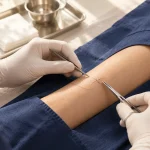
For a straightforward non-inflamed Epidermoid Cyst, complete Surgical Excision of the cyst and its wall is generally the most definitive treatment and reduces the chance of recurrence.Surgical Excision for Cyst Removal
Surgical Excision aims to remove:
- the cyst contents;
- the cyst lining;
- the cyst capsule or wall.
Removing the cyst wall is important because the lining can continue producing keratin if it remains behind.
Complete excision with an intact cyst capsule is considered the most effective treatment for an Epidermoid Cyst.
What Happens During Cyst Removal?
A typical minor Cyst Removal procedure may involve:
1. Confirming the lesion
The dermatologist assesses whether the lump is consistent with a cyst and whether it is currently inflamed.
2. Local Anesthesia
Local Anesthetic is injected around the cyst.
The injection may sting briefly, but once the area is numb the procedure should not feel sharply painful.
3. Skin incision
A small incision is made over or around the cyst.
4. Cyst dissection
The cyst is carefully separated from surrounding tissue.
5. Removal of the cyst wall
The aim is to remove the cyst lining as completely as possible.
6. Wound closure
Depending on the cyst size, location, and technique, the wound may be closed with sutures.
7. Histopathology when appropriate
The specimen may be sent for microscopic examination when clinically indicated.
Why Is Removing the Cyst Wall Important?
A cyst is not simply a pocket of material.
The wall of an Epidermoid Cyst contains cells that continue producing keratin.
If the contents are squeezed out but the wall remains, the cyst can refill.
This is why emptying a cyst and completely excising a cyst are fundamentally different treatments.
Complete removal of the cyst lining lowers the likelihood of recurrence.Incision and Drainage
Incision and Drainage involves making an opening into the cyst or abscess and allowing the contents to drain.
It is especially useful when a cyst is:
- acutely infected;
- abscessed;
- extremely swollen;
- very painful.
The main advantage is rapid relief of pressure and inflammation.
The main limitation is that the cyst wall usually remains.
Therefore, Incision and Drainage has a higher chance of recurrence than complete Surgical Excision.
Drainage vs Cyst Removal
This is one of the most important distinctions for patients.
| Procedure | What it does | Main limitation |
|---|---|---|
| Incision and Drainage | Opens the cyst and removes accumulated contents | Cyst wall remains, so recurrence can occur |
| Surgical Excision | Removes the cyst and cyst lining | Requires surgery and leaves a scar |
| Intralesional Steroid | Reduces inflammation in selected inflamed cysts | Does not remove the cyst |
| Antibiotics | Treat bacterial infection when present | Do not remove the cyst wall |
Why Might Surgery Be Delayed if a Cyst Is Inflamed?
Removing an acutely inflamed cyst can be more difficult because:
- the cyst wall may have ruptured;
- tissue planes become less distinct;
- the capsule may be fragile;
- separating the cyst wall from surrounding inflamed tissue may be more difficult.
For this reason, definitive excision is sometimes postponed until inflammation has improved, and surgery may be delayed when a cyst is inflamed.
Does an Inflamed Cyst Need Antibiotics?
Not always.
Many red and swollen Epidermoid Cysts are caused by inflammation after rupture rather than infection.
It is recommended to not routinely prescribe antibiotics for inflamed epidermal cysts unless infection is actually present.
Treatment for an inflamed cyst may instead include:
- observation;
- Intralesional Corticosteroid in selected cases;
- Incision and Drainage when appropriate;
- delayed Surgical Excision.
If bacterial infection is suspected, antibiotics may be appropriate.
Intralesional Steroid Injection
An Intralesional Corticosteroid Injection can sometimes be used to decrease inflammation in a swollen Epidermoid Cyst.
This can help settle:
- redness;
- swelling;
- tenderness.
However, it does not remove the cyst wall, so it is not considered definitive Cyst Removal.
Should a Removed Cyst Be Sent for Histopathology?
Histopathology may be recommended when:
- the diagnosis is uncertain;
- the lesion appears atypical;
- it is recurrent;
- there are unusual findings during surgery;
- confirmation of the diagnosis is clinically important.
Histological examination of surgically removed Epidermoid Cysts is recommended because misdiagnosis can occur and malignant change, although rare, has been reported.
Can a Skin Cyst Be Cancer?
A typical Epidermoid Cyst is benign.
Malignant transformation is rare.
The more practical concern is that another tumor can sometimes be mistaken for a cyst.
This is why a lump that behaves unusually should be reassessed rather than repeatedly squeezed or drained.
Warning Signs That a Lump Needs Medical Evaluation
See a dermatologist or another appropriate clinician if a lump:
- grows rapidly;
- becomes persistently painful;
- repeatedly bleeds;
- ulcerates;
- becomes fixed to deeper tissue;
- has an unusual color;
- keeps returning after treatment;
- does not behave like a typical cyst;
- develops in an unusual anatomical location.
A rapidly growing or unexplained lump should not automatically be treated as a simple cyst.
Cyst Removal on the Face
Facial Cyst Removal requires balancing complete removal with scar placement and cosmetic outcome.
Common locations include:
- cheek;
- forehead;
- jawline;
- chin;
- around the ear.
A small cyst may still require an incision longer than patients expect because the cyst wall needs to be removed without excessive tearing.
Trying to create the smallest possible opening is not always the same as achieving the best long-term result.
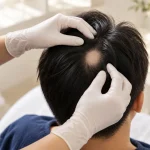
Cyst Removal on the Scalp
A scalp lump may be a Pilar Cyst rather than an Epidermoid Cyst.
Pilar Cysts can occur as solitary or multiple firm lumps on the scalp.
Patients often seek removal because the lump:
- catches during hair brushing;
- is painful when lying on it;
- progressively enlarges;
- becomes cosmetically noticeable.
The treatment principle is still removal of the cyst wall when definitive treatment is desired.
Cyst Removal on the Back
The back is a common location for Epidermoid Cysts.
Back cysts may become quite large before patients notice them and may be prone to repeated inflammation because of pressure, sweating, or friction.
Larger cysts often require a larger incision and may leave a more noticeable surgical scar.
Cyst Removal on the Neck
Neck lumps require particularly careful diagnosis because not every neck lump is a superficial skin cyst.
A lesion that is deep, fixed, associated with lymph nodes, or not clearly located within the skin should be assessed appropriately before minor skin surgery is considered.
Can a Cyst Be Removed Through a Tiny Incision?
Several surgical techniques can use smaller incisions in selected cysts.
However, the main goal remains removal of the entire cyst wall.
A small opening can improve cosmetic appearance in some cases, but if the cyst capsule tears and portions remain behind, recurrence becomes more likely.
Therefore, the smallest incision is not automatically the best procedure for every cyst.
Does Cyst Removal Leave a Scar?
Yes.
Any Surgical Excision through the skin leaves some degree of scar.
The appearance depends on:
- cyst size;
- incision length;
- location;
- skin tension;
- wound closure;
- infection or inflammation;
- individual healing tendency.
The scar may initially appear pink or red and then gradually mature.
There is no completely scar-free method of removing a true encapsulated cyst surgically.
Can a Cyst Come Back After Removal?
Yes, although recurrence is less likely when the entire cyst wall has been successfully removed.
Recurrence is more likely when:
- only the contents were drained;
- the cyst wall ruptured during inflammation;
- part of the capsule remained;
- the lesion was difficult to dissect;
- the original lump was not actually a simple Epidermoid Cyst.
Complete Surgical Excision is therefore preferred when definitive removal is the goal.
Can New Cysts Develop Elsewhere?
Yes.
Removal of one cyst does not prevent a person from developing a new cyst elsewhere.
Some patients, particularly those with multiple Pilar Cysts or a family tendency, may develop new lesions over time.
What Happens if a Cyst Ruptures?
When an Epidermoid Cyst ruptures, keratin leaks into surrounding tissue and can trigger significant inflammation.
The area may suddenly become:
- painful;
- swollen;
- red;
- warm.
Rupture can also make future complete excision more technically difficult because the cyst wall may become fragmented and scarred into surrounding tissue.
Should You Squeeze a Cyst?
No.
Squeezing may force cyst contents into surrounding tissue, increase inflammation, cause rupture, introduce infection, and make the cyst more difficult to remove later.
It also usually fails to remove the cyst wall.
Squeezing or attempting to drain Epidermoid Cysts yourself is strongly advised against.
Can Cyst Removal Be Done Under Local Anesthesia?
Many uncomplicated superficial skin cysts can be removed under Local Anesthesia.
The patient remains awake while the treatment area is numbed.
Larger, deeper, unusually located, or more complex lesions may require a different surgical setting or specialist evaluation.
How Long Does Cyst Removal Take?
Procedure time varies considerably depending on:
- size;
- location;
- previous inflammation;
- whether the cyst has ruptured;
- whether it is recurrent;
- how easily the cyst wall separates from surrounding tissue.
A small uncomplicated cyst is usually much simpler to remove than a large cyst with repeated episodes of rupture and inflammation.
Recovery After Cyst Removal
Recovery depends mainly on the wound size and location.
After Surgical Excision, patients may experience:
- mild soreness;
- swelling;
- bruising;
- tightness around sutures.
The wound should be cared for according to the instructions provided after the procedure.
Wound Care After Cyst Removal
General wound-care principles may include:
- keeping the wound clean;
- following dressing instructions;
- avoiding unnecessary rubbing or pressure;
- avoiding picking at the wound;
- monitoring for bleeding or infection;
- returning for wound review or suture removal when required.
Specific instructions depend on where the cyst was removed and how the wound was closed.
When Are Stitches Removed?
Timing varies according to anatomical location and wound characteristics.
Facial sutures are often managed differently from sutures on the trunk, scalp, or extremities.
Patients should follow the specific postoperative plan rather than applying one standard timeframe to every wound.
Can I Shower After Cyst Removal?
Many surgical wounds can be showered after an appropriate period according to the surgeon’s instructions.
However, prolonged soaking is usually different from brief showering.
The patient should receive specific advice regarding:
- showering;
- dressings;
- swimming;
- wound cleaning.
Can I Exercise After Cyst Removal?
Exercise can increase tension on a sutured wound.
Activities involving stretching, heavy lifting, repetitive movement, or sweating may increase the risk of:
- bleeding;
- wound separation;
- widened scars.
Restrictions depend greatly on the location of the cyst.
For example, an incision on the back or shoulder may be affected significantly by upper-body exercise.
Can I Swim After Cyst Removal?
Swimming is generally postponed until the wound has healed sufficiently.
This includes:
- swimming pools;
- sea water;
- hot tubs;
- lakes.
This consideration can be particularly important for tourists planning Cyst Removal in Bangkok before traveling to beach destinations elsewhere in Thailand.
Can I Fly After Cyst Removal?
Minor skin surgery does not automatically prevent air travel.
For international patients, more practical considerations include:
- wound care;
- bleeding;
- suture removal;
- Histopathology results;
- what to do if infection develops after leaving Thailand.
Patients planning to leave Bangkok shortly after surgery should discuss follow-up before the procedure.
Possible Side Effects and Complications
Potential complications of Cyst Removal include:
- bleeding;
- bruising;
- infection;
- pain;
- swelling;
- wound separation;
- delayed healing;
- scarring;
- Hypertrophic Scar;
- Keloid;
- temporary or persistent numbness;
- recurrence;
- incomplete removal.
Risk depends on the cyst size, location, previous inflammation, and individual healing.
When Should You Contact a Doctor After Surgery?
Seek medical review if there is:
- increasing pain;
- rapidly worsening swelling;
- spreading redness;
- pus;
- fever;
- persistent bleeding;
- wound separation;
- increasing tenderness after initially improving.
These may indicate infection, bleeding, or another postoperative complication.
Cyst Removal for Darker and Asian Skin
In patients with darker skin tones, postoperative considerations include:
- Post-Inflammatory Hyperpigmentation;
- Hypopigmentation;
- Hypertrophic Scarring;
- Keloid formation in susceptible individuals.
The risk varies by patient and anatomical site.
For cosmetic Cyst Removal, patients should understand that removing a lump means replacing it with a surgical wound and eventually a scar.
Cyst Removal for Tourists and International Patients in Bangkok
International patients often want to know whether Cyst Removal can be fitted into a short stay in Bangkok.
The procedure itself may be straightforward, but planning should include:
Consultation → diagnosis → procedure if appropriate → wound care → possible Histopathology → suture removal or follow-up
Before surgery, international patients should discuss:
- departure date from Thailand;
- where stitches will be removed;
- how pathology results will be delivered;
- wound care during travel;
- whether the planned trip involves swimming or strenuous activity.
An acutely inflamed cyst may not be suitable for immediate definitive excision, so patients should not assume every cyst can be completely removed at the first visit.
What to Expect During a Dermatology Consultation in Bangkok
A useful consultation should determine:
Is the lump actually a cyst?
The first step is diagnosis.
What type of cyst is most likely?
Epidermoid Cyst, Pilar Cyst, Dermoid Cyst, and other lesions behave differently.
Is it inflamed or infected?
This may determine whether immediate excision is appropriate.
Does it require drainage first?
An abscess may require Incision and Drainage.
Can definitive excision be performed?
If inflammation is controlled and the lesion is suitable, Surgical Excision may be considered.
Should tissue be sent for Histopathology?
This depends on the diagnosis and clinical features.
What scar should be expected?
Scar location and length should be discussed before elective removal.
Frequently asked questions
What is the most common type of skin cyst?
Epidermoid Cyst is one of the most common cutaneous cysts encountered in dermatology.
Is an Epidermoid Cyst dangerous?
Usually not. It is typically benign and slow growing.
Is a sebaceous cyst the same as an Epidermoid Cyst?
The terms are often used interchangeably by patients, but true sebaceous cysts are different and less common.
Does every cyst need removal?
No. Small, uncomplicated, asymptomatic cysts can often be observed.
When should a cyst be removed?
Removal may be considered when it becomes painful, repeatedly inflamed, ruptures, drains, enlarges, interferes with activities, or causes cosmetic concern.
What is the best way to remove an Epidermoid Cyst?
Complete Surgical Excision with removal of the cyst lining is generally the most definitive treatment.
Can a cyst be drained instead of removed?
Yes, particularly during acute infection or abscess formation. However, drainage usually leaves the cyst wall behind.
Will a drained cyst come back?
It can. Recurrence is more likely after Incision and Drainage than after complete excision.
Why does my cyst keep coming back?
The cyst lining may still be present and continue producing keratin.
Can an inflamed cyst be removed immediately?
Sometimes, but definitive surgery may be delayed because inflammation makes complete removal more difficult.
Does every inflamed cyst need antibiotics?
No. Many inflamed epidermal cysts are inflamed but not infected.
Can steroid injection treat an inflamed cyst?
Intralesional Corticosteroid may reduce inflammation in selected cases, but it does not remove the cyst wall.
Does Cyst Removal hurt?
Local Anesthesia is usually used for uncomplicated superficial cyst surgery.
Does Cyst Removal leave a scar?
Yes. Surgical removal creates an incision and therefore leaves some degree of scar.
Can a cyst return after complete removal?
Yes, but recurrence is less likely when the entire cyst wall has been removed.
Can I squeeze a cyst myself?
No. Squeezing can cause rupture, inflammation, infection, and scarring.
What is the white material inside a cyst?
It is usually keratin rather than sebum.
Why does cyst material smell?
Keratinous material inside an Epidermoid Cyst can develop a characteristic unpleasant odor.
What is a Pilar Cyst?
A Pilar Cyst is a cyst arising from a hair follicle and is particularly common on the scalp.
Can scalp cysts be removed?
Yes, after appropriate diagnosis. Many scalp cysts are Pilar Cysts.
Can facial cysts be removed?
Yes, but scar placement and the diagnosis should be considered carefully.
Can a cyst turn into cancer?
Typical Epidermoid Cysts are benign and malignant transformation is rare, but some tumors can mimic cysts.
Does a removed cyst need Histopathology?
It may be recommended, particularly when the diagnosis is uncertain or the lesion has unusual features.
Can I exercise after Cyst Removal?
It depends on wound location and size. Activity that places tension on the wound may need to be restricted temporarily.
Can I swim after Cyst Removal?
Usually not until the wound has healed sufficiently.
Can I fly after Cyst Removal?
Many patients can fly after minor surgery, but wound care, suture removal, and pathology follow-up should be planned.
Can tourists have Cyst Removal in Bangkok?
Yes, but the timing of surgery, wound care, stitches, and possible Histopathology should be considered before departure.
Related conditions
-
Mole Removal Mole Removal Many growths that patients call “moles” are benign and can be removed because they catch on clothing, become repeatedly irritated, or are cosmetically unwanted. Others may actually be Seborrheic Keratosis, Skin Tag, Wart, Actinic Keratosis, or another skin condition. Occasionally, a lesion that looks like an ordinary mole or growth can represent Melanoma, Basal Cell Carcinoma, SCC, or another skin cancer.

-
Skin Biopsy (การวินิจฉัย / Diagnosis) Skin Biopsy (การวินิจฉัย / Diagnosis) A skin biopsy is a minor medical procedure in which a dermatologist removes a small sample of skin so it can be examined under a microscope. It is one of the most important diagnostic tools in dermatology because many skin conditions cannot be confirmed by appearance alone.

-
Histopathology Histopathology Histopathology is the microscopic examination of tissue to identify disease. In dermatology, this usually means examining a piece of skin removed during a skin biopsy or surgical excision.

-
Surgical Excision Surgical Excision Surgical excision is one of the main treatments for skin cancer. During the procedure, the doctor removes the cancer together with a planned amount of normal-looking skin around it. The removed tissue is then examined under a microscope to determine whether cancer cells extend to the surgical edges, known as the margins.