





























Can HIFU or RF Cause Facial Fat Loss? What You Should Know Before Treatment
HIFU and radiofrequency (RF) treatments have become popular nonsurgical options for improving skin firmness, reducing mild facial sagging, and enhancing jawline definition.


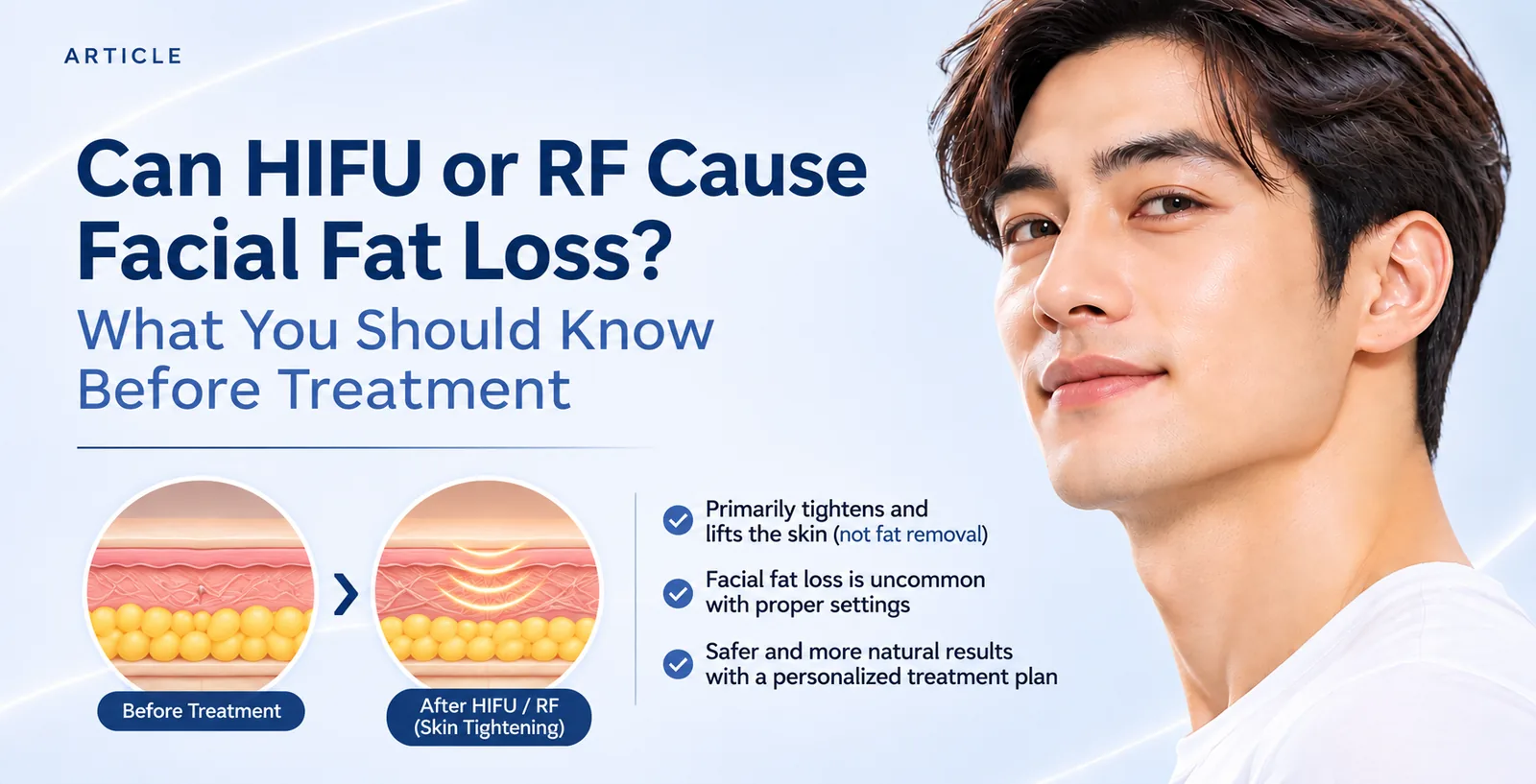
HIFU and radiofrequency (RF) treatments have become popular nonsurgical options for improving skin firmness, reducing mild facial sagging, and enhancing jawline definition.
Devices such as Ultraformer, which uses focused ultrasound energy, and XERF, which uses monopolar radiofrequency, are designed to deliver controlled thermal energy into tissue.
These treatments may stimulate collagen remodeling and gradually improve skin tightness.
However, one concern increasingly discussed among patients is whether HIFU or RF can cause unwanted facial fat loss.
Some patients worry that skin-tightening procedures could make their cheeks appear hollow, reduce facial volume, or cause the face to look older rather than younger.
Others specifically want a slimmer lower face and wonder whether these treatments can reduce facial fat.
So, can HIFU or RF really cause facial fat loss? Is the risk the same for everyone? And how can patients reduce the likelihood of unwanted changes?
At Clear Skin Dermatology in Asoke, Bangkok, we believe that facial rejuvenation should begin with a careful assessment of skin laxity, facial fat distribution, and individual anatomy.
Understanding the potential effects of energy-based treatments on facial fat is an important part of making an informed decision.
Why Is Facial Fat Important for a Youthful Appearance?
Facial fat is not simply excess tissue that should be removed.
Fat compartments in the cheeks, temples, around the eyes, and lower face help support facial contours and contribute to a youthful appearance.
Healthy facial volume can help maintain:
- Fullness of the cheeks
- Smooth transitions between facial regions
- Support around the eyes
- Balanced facial proportions
- Natural facial contours
As people age, facial fat compartments may lose volume, change shape, or shift in position.
These changes occur alongside alterations in collagen, connective tissue, and bone structure.
Consequently, facial aging is not caused by loose skin alone.
A person with sagging skin and adequate facial volume may benefit from tightening, while someone with significant facial volume loss may need a different approach.
Removing or damaging facial fat in someone who already has a thin face can potentially make facial aging more noticeable.
What Is Facial Fat Loss or Facial Fat Atrophy?
Facial fat loss refers to a reduction in the volume of fat beneath the skin.
Facial fat atrophy describes a more pronounced loss of fatty tissue that may produce visible changes in facial contour.
Possible signs include:
- Hollow cheeks
- More prominent cheekbones
- Sunken temples
- Deeper shadows beneath the eyes
- Reduced facial fullness
- Uneven facial contours
- A thinner or more gaunt appearance
However, not every change in facial contour after an aesthetic procedure represents true fat atrophy.
Temporary swelling, changes in skin tension, weight loss, lighting, and normal facial aging may also affect appearance.
Confirming genuine fat loss may require examination, standardized photographs, and occasionally imaging when clinically appropriate.
How Do HIFU and RF Skin-Tightening Treatments Work?
Although HIFU and RF both use thermal energy, they generate heat differently.
HIFU: Focused Ultrasound
HIFU stands for High-Intensity Focused Ultrasound.
Devices such as Ultraformer use focused ultrasound energy to create localized thermal effects at selected depths within tissue.
Depending on the device, applicator, and settings, ultrasound energy may affect different anatomical layers.
The resulting thermal effects may cause collagen contraction and stimulate tissue remodeling.
RF: Radiofrequency Skin Tightening
Radiofrequency devices generate heat through electrical energy interacting with tissue.
Monopolar RF devices, including XERF, produce distributed tissue heating rather than the same pattern of focused thermal zones used by HIFU.
XERF uses dual-frequency monopolar RF technology at 6.78 MHz and 2 MHz, with adjustable settings and surface cooling.
Different RF devices have different electrode configurations, treatment depths, and energy-delivery characteristics.
The term RF includes several distinct technologies, and safety findings from one RF device cannot automatically be applied to every other device.
Can HIFU Cause Facial Fat Loss?
Yes, unwanted facial fat or contour changes are biologically plausible with focused ultrasound treatments, particularly when energy reaches fat-containing tissue.
Focused ultrasound can produce thermal effects at different depths.
Some ultrasound-based technologies are specifically developed to affect adipose tissue.
However, facial skin-tightening protocols are not necessarily intended to reduce facial fat.
The risk depends on several factors, including:
- Treatment depth
- Energy settings
- Number and distribution of treatment lines
- Anatomical location
- Facial fat thickness
- Device design
- Treatment technique
For patients with limited facial fat, unintended effects on deeper tissue may be particularly concerning.
Nevertheless, the frequency of clinically significant facial fat loss following individual HIFU skin-tightening devices is not well established.
Published reports and patient experiences do not provide a reliable incidence rate for every device or protocol.
Does Ultraformer Specifically Cause Facial Fat Loss?
Ultraformer devices deliver focused ultrasound energy using different treatment applicators and settings.
Because focused ultrasound can produce heat near or within fat-containing tissue, unwanted contour changes are possible.
However, the available evidence does not establish that Ultraformer routinely causes facial fat atrophy or that all patients face the same risk.
The risk should be assessed according to the specific device, applicator, treatment plan, and patient anatomy.
Can Radiofrequency Cause Facial Fat Loss?
Radiofrequency energy can heat tissues beneath the skin, including tissue near or within the subcutaneous fat layer.
Whether this results in clinically meaningful fat reduction depends on the RF technology, treatment parameters, tissue characteristics, and intended treatment target.
Some RF-based devices are specifically designed for fat reduction or body contouring.
Other devices are primarily intended for skin tightening.
These uses should not be confused.
For facial skin-tightening treatments, unwanted changes in facial fat or contour are possible, but the frequency and magnitude of risk vary by device and protocol.
It would be inaccurate to claim that all RF treatments destroy facial fat or that RF skin tightening is completely incapable of affecting fat.
Can XERF Cause Facial Fat Loss?
XERF uses monopolar RF energy to produce controlled tissue heating.
Because heat can extend into tissues containing fat, potential effects on facial fat should be considered when planning treatment.
However, long-term, XERF-specific clinical evidence is currently insufficient to establish a reliable incidence of unwanted facial fat loss.
It is therefore inappropriate to claim either that XERF always reduces facial fat or that it carries absolutely no risk of facial contour changes.
Patients with thin faces or pre-existing hollow cheeks should receive particular attention during treatment planning.
HIFU vs RF: Which Has a Higher Risk of Facial Fat Loss?
There is no reliable, universal answer.
The technologies deliver energy differently, but risk cannot be determined from the energy type alone.
| Factor | HIFU / Ultraformer | Monopolar RF / XERF |
|---|---|---|
| Energy type | Focused ultrasound | Radiofrequency |
| Heating pattern | Localized thermal zones | Distributed tissue heating |
| Potential interaction with facial fat | Possible, depending on depth and settings | Possible, depending on tissue heating and settings |
| Risk in thin faces | Requires careful assessment | Requires careful assessment |
| Reliable device-specific fat-loss incidence | Not established for every device | Not established for every device |
| Proven universally safer option | No | No |
There are insufficient high-quality head-to-head studies to conclude that Ultraformer or XERF consistently carries a lower risk of facial fat loss.
The safest approach is individualized treatment planning rather than assuming one technology is inherently risk-free.
Who May Be More Vulnerable to Unwanted Facial Volume Loss?
Certain patients may be more concerned about even small changes in facial volume.
1. People With Naturally Thin Faces
Patients with little facial fat may notice contour changes more readily.
Even a modest reduction in volume can make the cheeks appear more hollow.
2. People With Pre-existing Hollow Cheeks
If the cheeks are already hollow, further volume loss may exaggerate shadows and facial contours.
3. People With Significant Age-related Facial Volume Loss
Facial aging often involves both skin laxity and volume loss.
Treating only the skin without considering the underlying volume deficit may produce an unsatisfactory result.
4. People Who Have Recently Lost Weight
Significant weight loss can reduce facial fullness.
Patients may mistakenly attribute ongoing changes in facial volume to an aesthetic procedure when weight changes are also contributing.
5. People Receiving Repeated or Aggressive Treatments
Repeated treatment, excessive energy, or poorly planned overlapping treatment areas may increase cumulative thermal exposure.
However, the precise relationship between treatment intensity and clinically significant facial fat loss has not been quantified for every device.
6. People Undergoing Multiple Energy-based Procedures
Combining HIFU, RF, or other heat-based treatments without adequate planning may increase thermal exposure in the same anatomical region.
Combination treatment is not automatically safer or more effective.
Which Areas of the Face Require Particular Caution?
Facial anatomy varies considerably.
Areas that may deserve particular attention include:
Cheeks
The cheeks contain important fat compartments that contribute to facial fullness.
Patients with naturally hollow cheeks may be concerned about additional volume loss.
Temples
The temples may become hollow with age.
Unwanted volume reduction in this area can make facial contours appear more pronounced.
Lower Face
The lower face contains fat compartments and soft tissues that influence jawline definition.
Treatment should distinguish between loose skin, fat accumulation, and volume loss.
Under the Chin
Some patients have excess submental fat, while others have loose skin or a recessed chin.
The treatment target should be identified before deciding whether tightening or fat reduction is appropriate.
Around the Eyes
The tissues around the eyes are anatomically delicate.
Energy-based treatment in this region requires appropriate device indications, applicators, and safety precautions.
Not every HIFU or RF device is intended for use around the eyes.
Can HIFU or RF Make Your Face Look Older?
Potentially, if treatment produces an unwanted reduction in facial volume or changes facial contours in an unfavorable way.
A youthful appearance depends on a balance between:
- Skin firmness
- Facial volume
- Tissue position
- Bone support
- Skin quality
Tightening the skin does not necessarily improve appearance if the underlying problem is substantial volume loss.
For example, a patient with hollow cheeks and mild skin laxity may not benefit from aggressive heating in areas where facial volume is already limited.
However, it is also important not to assume that every patient who looks thinner after treatment has experienced procedure-related fat atrophy.
Natural aging, weight changes, swelling resolution, and photographic differences can influence perceived results.
How Can You Reduce the Risk of Facial Fat Loss?
No treatment can be guaranteed completely risk-free.
However, careful patient selection and appropriate treatment planning may help reduce avoidable complications.
1. Have Your Facial Anatomy Assessed
A qualified clinician should evaluate:
- Facial fat distribution
- Skin thickness
- Degree of laxity
- Facial volume loss
- Treatment goals
- Previous aesthetic procedures
2. Choose the Treatment Based on the Actual Problem
If the main concern is volume loss rather than skin laxity, a tightening procedure may not be the most appropriate first treatment.
3. Use Appropriate Device Settings
Treatment depth, energy, and technique should follow the device’s instructions and be adapted to the patient.
Higher energy is not automatically better.
4. Avoid Unnecessary Treatment
Patients without clinically meaningful skin laxity may not need energy-based tightening.
Routine treatment solely for preventive purposes is not supported by strong evidence for every age group.
5. Be Cautious With Repeated Procedures
Repeated treatments should be based on documented response and an appropriate interval rather than automatically scheduling frequent sessions.
6. Discuss Combination Treatments Carefully
Combining HIFU and RF may be considered in selected cases, but there is insufficient evidence to establish an ideal combination for everyone.
7. Document the Baseline Appearance
Standardized photographs before treatment may help distinguish treatment-related changes from natural variations over time.
Is Facial Fat Loss After HIFU or RF Permanent?
The answer depends on what has actually happened.
Temporary swelling, changes in skin tension, or short-term contour differences may resolve over time.
If true adipose tissue loss has occurred, spontaneous recovery may be limited and unpredictable.
The extent of recovery depends on the mechanism and severity of tissue injury.
There is insufficient evidence to predict recovery reliably for every HIFU or RF device.
Patients should avoid assuming that every apparent hollow area is permanent fat loss without a proper assessment.
What Should You Do if Your Face Looks Hollow After Treatment?
If you notice new facial hollowing, asymmetry, or an unexpected change in facial contour after HIFU or RF, arrange a clinical assessment.
A dermatologist or appropriately qualified clinician may review:
- The timing of the change
- Pre-treatment photographs
- Recent weight changes
- Treatment areas
- Device type and settings, if available
- Swelling or tenderness
- Other possible causes of facial volume change
In selected cases, imaging may help evaluate the soft tissues.
Should You Immediately Have Another Tightening Treatment?
Generally, it is sensible to avoid additional heat-based treatment in the affected area until the cause has been assessed.
Repeated energy exposure may be inappropriate when unintended contour changes are suspected.
Can Lost Facial Volume Be Restored?
Depending on the cause and severity, treatment options may include:
- Observation when changes may be temporary
- Addressing relevant weight or medical factors
- Hyaluronic acid fillers in appropriately selected patients
- Autologous fat grafting in selected cases
- Other individualized reconstructive or aesthetic approaches
These options have their own risks and should not be considered automatic solutions.
Is HIFU or RF Safe for People in Their 30s, 40s, and 50s?
Age alone does not determine safety.
In Your 30s
Some patients have minimal skin laxity and may not need treatment.
Those with naturally thin faces should be cautious about unnecessary procedures.
In Your 40s
Patients may have a combination of early laxity and changing facial volume.
Treatment should distinguish between these different problems.
In Your 50s
Facial aging may involve significant volume loss, tissue descent, and skin laxity.
Aggressive tightening may not address all of these changes and may be unsuitable for some patients.
The key question is not how old you are, but whether your facial anatomy and concerns make you a suitable candidate.
Can HIFU or RF Be Used to Intentionally Slim the Face?
Some patients want a slimmer face or reduced fullness beneath the chin.
However, intentional fat reduction and skin tightening are different treatment goals.
Certain energy-based devices and protocols are specifically intended to affect fat tissue.
Standard facial HIFU or monopolar RF skin-tightening treatments should not automatically be presented as reliable facial fat-reduction procedures.
For patients with a double chin, it is important to determine whether the main cause is:
- Excess submental fat
- Loose skin
- Chin or jaw anatomy
- A combination of factors
A targeted treatment plan may be more appropriate than trying to achieve both fat reduction and skin tightening with a single device.
HIFU and RF Safety Consultation at Clear Skin Dermatology Bangkok
Clear Skin Dermatology is a medical dermatology clinic located in Asoke, Bangkok, Thailand.
Patients considering nonsurgical facial tightening can consult a dermatologist to discuss their concerns, facial anatomy, and treatment suitability.
This is particularly important for people who:
- Have naturally thin faces
- Already have hollow cheeks
- Have experienced significant weight loss
- Are concerned about facial fat atrophy
- Have previously undergone HIFU or RF treatment
- Have noticed unexpected facial contour changes
- Are considering repeated or combination energy-based treatments
During consultation, the dermatologist can assess:
- Skin laxity
- Facial fat distribution
- Facial volume loss
- Tissue descent
- Skin thickness
- Previous treatment history
- Individual treatment goals
The dermatologist can then explain whether focused ultrasound, monopolar radiofrequency, or another treatment approach may be appropriate.
Patients interested in Ultraformer III, Ultraformer MPT, or XERF should confirm specific device availability and treatment indications with the clinic before booking.
Clear Skin Dermatology
Medical Dermatology & Skin Cancer Clinic
Asoke, Bangkok, Thailand
Frequently Asked Questions
1. Can HIFU cause facial fat loss?
Focused ultrasound can create thermal effects in fat-containing tissue. Unwanted contour changes are possible, although the incidence of clinically significant fat loss varies and is not well established for every device.
2. Can Ultraformer make cheeks hollow?
Unwanted facial contour changes are possible, particularly when treatment affects fat-containing tissue. However, Ultraformer does not routinely cause hollow cheeks in every patient.
3. Can RF cause facial fat loss?
RF can heat tissues near or within the fat layer. Whether this causes meaningful fat reduction depends on the technology, settings, and treatment technique.
4. Can XERF cause facial fat loss?
Potential effects on fat-containing tissue should be considered. However, XERF-specific long-term evidence is insufficient to establish a reliable rate of unwanted facial fat loss.
5. Is HIFU more likely than RF to cause fat loss?
There is insufficient direct comparative evidence to establish that one technology consistently carries a higher risk.
6. Is facial fat loss after HIFU permanent?
Temporary contour changes may resolve, while true fat loss may persist. A clinical assessment is needed to determine the likely cause.
7. Can facial fat grow back after RF treatment?
Recovery depends on whether genuine fat loss occurred and its underlying mechanism. Spontaneous recovery cannot be guaranteed.
8. Should people with thin faces avoid HIFU?
Not necessarily, but they require careful assessment. Some may be better served by other treatments or no energy-based treatment.
9. Is XERF safer for thin faces than Ultraformer?
There is insufficient evidence to claim that XERF is universally safer for thin faces.
10. Can repeated HIFU treatments increase the risk?
Repeated treatments can increase cumulative energy exposure. The appropriate interval and number of sessions should follow clinical assessment and device guidance.
11. What should I do if my cheeks look hollow after HIFU?
Arrange an assessment, review baseline photographs, and avoid further treatment in the affected area until the cause is clarified.
12. Can facial fat loss be treated?
Depending on the cause and severity, options may include observation, fillers, or fat grafting in selected patients.
Final Thoughts: Skin Tightening Should Not Come at the Expense of Facial Volume
HIFU and radiofrequency treatments may improve mild facial skin laxity through controlled thermal effects and collagen remodeling.
However, facial rejuvenation is not simply about making the skin tighter.
Facial fat compartments play an important role in maintaining natural contours and a youthful appearance.
Both focused ultrasound and radiofrequency can generate heat in tissues beneath the skin, and unwanted facial contour changes are possible under certain circumstances.
At the same time, current evidence does not justify claiming that all HIFU or RF treatments routinely cause facial fat loss.
The most important step is identifying whether the patient needs skin tightening, volume restoration, fat reduction, or a different approach altogether.
For patients concerned about facial fat loss or considering HIFU or RF skin tightening in Bangkok, a consultation at Clear Skin Dermatology in Asoke can help evaluate facial anatomy, discuss potential risks, and determine the most appropriate treatment approach.
Medical disclaimer: This article is for general educational purposes and does not replace individualized medical advice. Treatment outcomes, risks, and suitability vary between patients.
Medical References
Medically reviewed by
Reviewed on
Related articles
-
Aesthetic & Skin Rejuvenation Rejuran vs Plinest vs Vitaran: Pain, Downtime, and Side Effects Rejuran, Plinest, and Vitaran are polynucleotide (PN) injectable treatments used or marketed for improving skin quality. But how painful are the injections, how long does recovery take, and which product causes fewer side effects?

-
Aesthetic & Skin Rejuvenation Skin Tightening in Bangkok: How to Choose Between HIFU (Ultraformer) and Monopolar RF (XERF) If you are considering nonsurgical skin tightening in Bangkok, two technologies you may encounter are HIFU (Ultraformer) and monopolar radiofrequency (XERF).
-
Aesthetic & Skin Rejuvenation Ultraformer for Face Lifting: Who Is It Best For and When Will You See Results? Facial sagging is one of the most common concerns associated with aging. As collagen and elastin change over time, the skin gradually loses firmness. Changes in facial fat, connective tissue, and bone support can also contribute to sagging cheeks, early jowls, and reduced jawline definition.