
































Can You Combine HIFU (Ultraformer) and Monopolar RF (XERF)? When Does Combination Treatment Make Sense?
Can HIFU and XERF be combined? Yes, focused ultrasound and monopolar radiofrequency may be considered together in selected patients. However, combining them is not automatically more effective than using either treatment alone, and there is no universally established schedule for performing Ultraformer and XERF together.

Can HIFU and XERF be combined? Yes, focused ultrasound and monopolar radiofrequency may be considered together in selected patients. However, combining them is not automatically more effective than using either treatment alone, and there is no universally established schedule for performing Ultraformer and XERF together.
Both technologies deliver controlled thermal energy into tissue, but they use different mechanisms. HIFU creates localized thermal effects at selected depths, while monopolar radiofrequency produces a more distributed pattern of tissue heating.
This difference provides a theoretical reason why the treatments might complement one another. It does not, by itself, prove that combining them produces better facial lifting, longer-lasting results, or fewer side effects.
For patients considering nonsurgical facial rejuvenation in Bangkok, the decision should begin with a simple question: What is causing the face to look less firm—skin laxity, tissue descent, loss of facial volume, excess fat, or a combination of these factors?
At Clear Skin Dermatology in Asoke, Bangkok, an individualized dermatology consultation can help patients understand which concerns may respond to energy-based skin tightening and when additional treatment may be unnecessary.
HIFU and XERF Combination Treatment: Quick Answers
| Common question | What patients should know |
|---|---|
| Can HIFU and XERF be combined? | Potentially, in selected patients after clinical assessment |
| Do the technologies work differently? | Yes. HIFU uses focused ultrasound; XERF uses monopolar radiofrequency |
| Is combining them proven to work better? | Not conclusively for the specific Ultraformer–XERF combination |
| Can they be performed on the same day? | A universal safe same-day protocol has not been established |
| How long should you wait between treatments? | No validated interval applies to every patient |
| Can combination treatment cause facial fat loss? | Unwanted contour changes are possible; risk depends on anatomy, devices, settings, and cumulative exposure |
| Does everyone need both? | No. One treatment—or no energy-based treatment—may be more appropriate |
| Is combination treatment a replacement for a facelift? | No |
What Is HIFU (Ultraformer)?
HIFU stands for High-Intensity Focused Ultrasound.
It uses focused ultrasound energy to create controlled thermal effects within tissue at selected depths.
Ultraformer is a family of devices that use focused ultrasound technology. Different models, including Ultraformer III and Ultraformer MPT, have different applicators and energy-delivery options.
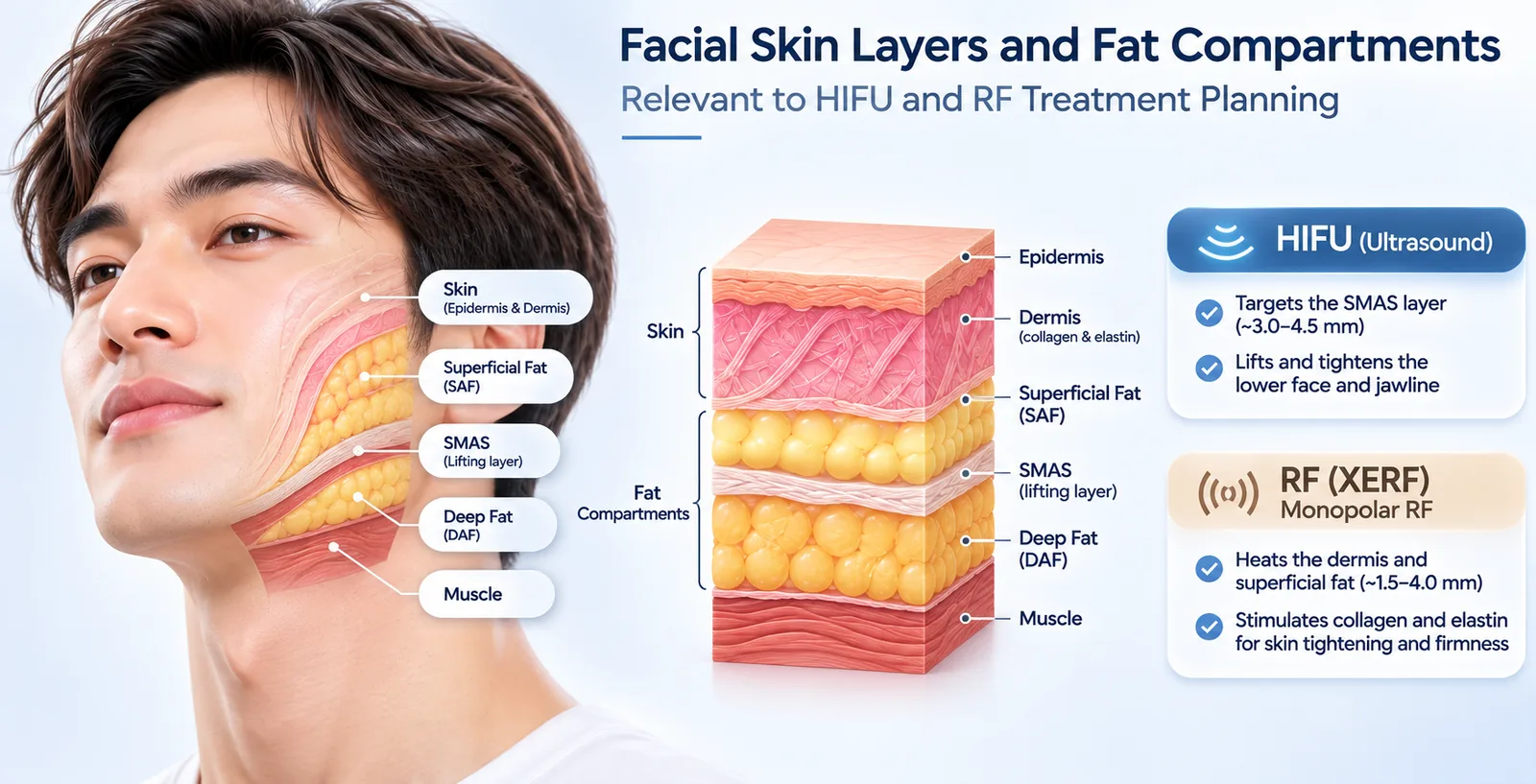
Depending on the device and settings, treatment may target different anatomical layers.
The thermal effects may stimulate collagen contraction and remodeling, potentially improving mild to moderate skin laxity.
What Can HIFU Help Improve?
In appropriately selected patients, focused ultrasound may provide modest improvement in:
- Early lower-face laxity
- Mild jowling
- Reduced jawline definition
- Loose skin beneath the chin
- Mild neck laxity
- Overall skin firmness
Results vary, and significant lifting should not be assumed.
HIFU does not reliably correct substantial tissue descent, replace lost facial volume, or remove large amounts of excess skin.
What Is Monopolar RF (XERF)?
XERF is a monopolar radiofrequency system that uses two frequencies: 6.78 MHz and 2 MHz.
Radiofrequency energy generates heat through its interaction with tissue.
Unlike focused ultrasound, which produces localized thermal zones, monopolar radiofrequency produces a distributed heating pattern.
XERF incorporates adjustable treatment settings and surface cooling.
The resulting thermal effects may stimulate collagen remodeling and improve skin firmness over time.
What Can XERF Help Improve?
Depending on patient selection and treatment settings, potential goals include:
- Improving mild skin laxity
- Increasing the appearance of skin firmness
- Addressing early lower-face looseness
- Improving mild jawline laxity
- Treating selected areas of loose skin
The amount of improvement is variable.
XERF should not be presented as a guaranteed facial lifting procedure or as an established replacement for surgery.
Long-term evidence specific to XERF remains more limited than evidence for some older radiofrequency technologies.
HIFU vs XERF: Why Might Doctors Consider Combining Them?
The rationale for combination treatment comes from the different ways the technologies generate heat.
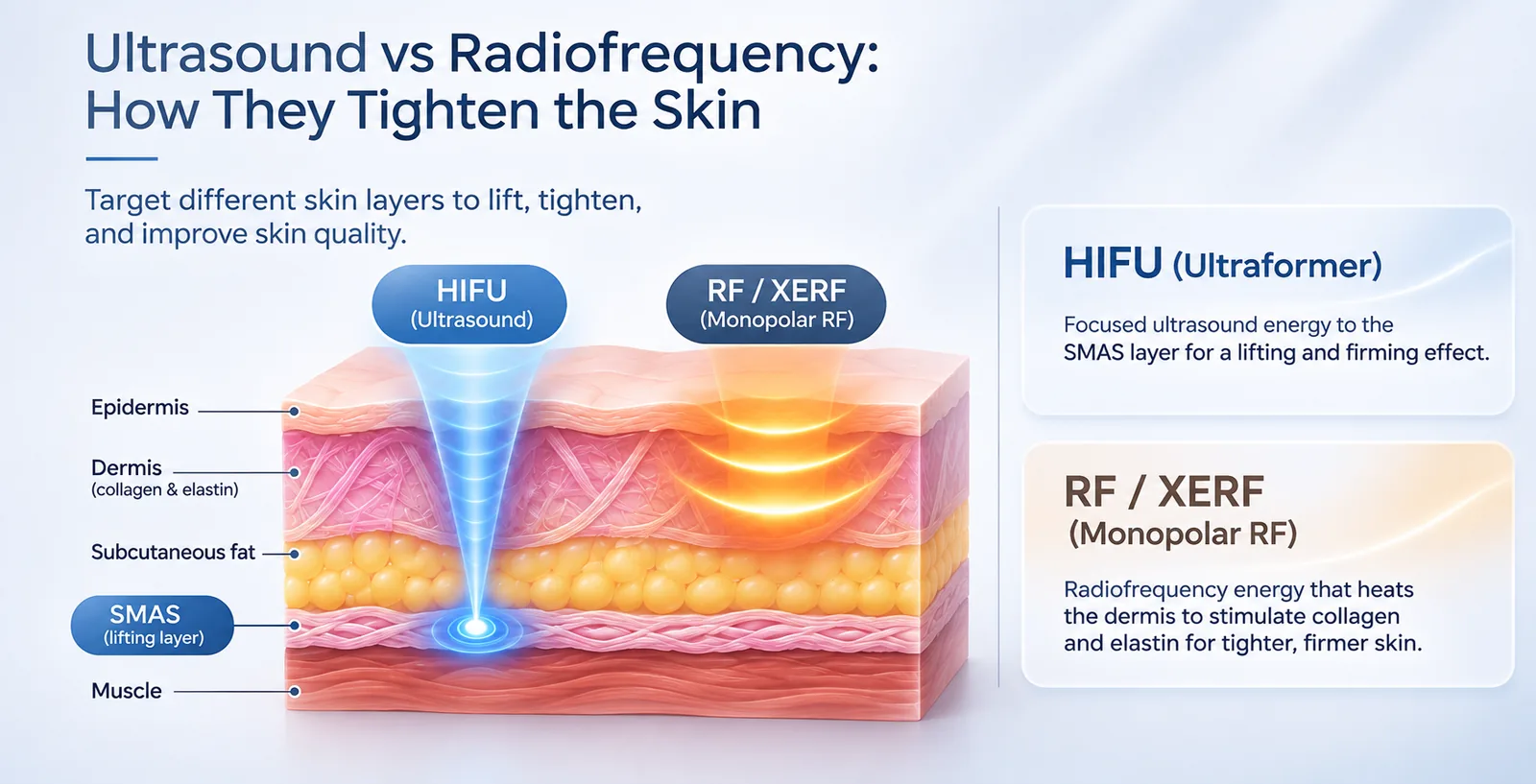
| Feature | HIFU / Ultraformer | Monopolar RF / XERF |
|---|---|---|
| Energy | Focused ultrasound | Radiofrequency |
| Heating pattern | Localized thermal zones | Distributed tissue heating |
| Treatment depth | Selected using device-specific applicators and settings | Depends on tissue properties, device design, and settings |
| Intended effect | Collagen remodeling and modest tightening | Collagen remodeling and modest tightening |
| Main limitation | Cannot reliably correct advanced sagging | Cannot reliably correct advanced sagging |
| Evidence for combining the specific devices | Limited | Limited |
A clinician may hypothesize that the technologies could address different aspects of skin laxity.
However, several important distinctions must be made.
First, a difference in heating pattern does not establish that one device treats only deep tissue while the other treats only superficial tissue. Both may affect multiple anatomical layers depending on treatment parameters.
Second, combining two energy sources does not necessarily produce additive benefits.
Third, additional thermal exposure may increase risks without providing clinically meaningful improvement.
Combination treatment should be justified by the patient’s anatomy and treatment goals—not simply by the availability of two devices.
When Might Combining HIFU and XERF Make Sense?
There are circumstances in which a dermatologist may consider using both technologies as part of a carefully planned treatment strategy.
These are clinical considerations rather than proven indications for a specific Ultraformer–XERF combination protocol.
1. When a Patient Has Mild to Moderate Skin Laxity in Different Facial Areas
Some patients have different degrees of laxity across the face.
For example, one patient may have early jowling around the jawline alongside more generalized reduction in skin firmness.
A clinician may consider whether different energy-delivery approaches could address these concerns.
However, a single treatment may also be sufficient.
The decision should depend on the likely additional benefit, not merely the presence of multiple concerns.
2. When One Treatment Has Produced a Partial but Documented Response
A patient may undergo focused ultrasound and return several months later with some improvement but persistent laxity.
After sufficient time for the result to develop, the clinician may consider whether an alternative energy-based treatment could offer additional benefit.
Before recommending another procedure, the dermatologist should assess:
- The degree of remaining laxity
- The response to the first treatment
- Any unwanted facial contour changes
- Previous treatment settings
- The patient’s expectations
- Whether further thermal treatment is justified
A partial response does not automatically mean that adding XERF is the next step.
3. When Treatment Goals Are Modest and Realistic
Combination treatment may be considered when the patient understands that nonsurgical procedures generally produce subtler changes than surgical lifting.
Appropriate goals might include improved skin firmness or a modest change in lower-face laxity.
Combination treatment is less likely to meet expectations when the patient wants dramatic repositioning of sagging tissues.
4. When the Patient Has Adequate Facial Volume
Facial fat compartments help maintain natural contours.
Patients with adequate facial volume may have different considerations from those with very thin faces or hollow cheeks.
However, adequate facial fat does not eliminate the risk of unwanted contour changes.
Treatment depth, settings, and anatomy still matter.
5. When There Is a Clear Reason to Use a Second Technology
The strongest rationale for adding another procedure is an identifiable concern that remains after the first treatment and may reasonably respond to the second.
For example, the dermatologist may determine that persistent skin laxity warrants further treatment after an adequate observation period.
Even then, the decision should include a discussion of uncertainty about the additional benefit.
When Does Combining HIFU and XERF Not Make Sense?
Not every patient benefits from more treatment.
When the Skin Is Already Firm
Patients with little or no clinically significant laxity may not need either procedure.
Routine combination treatment solely to prevent aging is not supported by strong evidence.
When Facial Volume Loss Is the Main Problem
Hollow cheeks, sunken temples, and reduced midface fullness may be caused primarily by loss of facial volume rather than loose skin.
Additional tightening may not address the underlying problem and could potentially worsen the appearance of facial hollowness if unwanted contour changes occur.
When There Is Significant Facial Sagging
Advanced jowling, pronounced tissue descent, and substantial excess skin are unlikely to be corrected adequately by combining two nonsurgical energy-based procedures.
Surgical assessment or another treatment strategy may be more appropriate.
When the Patient Has Experienced an Adverse Effect
Persistent tenderness, numbness, unexpected facial hollowing, burns, or altered facial movement should be assessed before further energy-based treatment.
When the Only Reason Is to Obtain Faster Results
Collagen remodeling takes time.
Performing another procedure before the first treatment has been adequately evaluated does not guarantee faster or better results.
When the Patient Is Being Offered an Automatic Package
A package that includes HIFU and XERF for every patient, regardless of anatomy or degree of laxity, does not reflect individualized treatment planning.
Can You Do HIFU and XERF on the Same Day?
Same-day combination treatment is an important safety question.
There is no universally validated same-day protocol for combining Ultraformer and XERF that can be recommended for all patients.
Some clinical practices may use different energy-based technologies during one visit, but the safety of a particular combination depends on the exact devices, anatomical areas, settings, and manufacturer instructions.
Both HIFU and monopolar radiofrequency create heat in tissue.
Performing them close together may increase cumulative thermal exposure, particularly when treatment areas overlap.
Potential concerns include:
- Increased discomfort
- Swelling and tenderness
- Burns or thermal injury
- Changes in sensation
- Unwanted facial contour changes
- Difficulty determining which procedure caused an adverse reaction
It would be inappropriate to recommend same-day treatment solely for convenience.
If combination treatment is considered, the clinician should confirm that the proposed approach is consistent with device instructions and available safety evidence.
How Long Should You Wait Between HIFU and XERF?
Patients frequently ask whether they should wait two weeks, one month, three months, or six months.
Unfortunately, there is no high-quality evidence establishing one ideal interval for the specific combination of Ultraformer and XERF.
The interval should depend on several factors:
- Which procedure was performed first.
- Which anatomical areas were treated.
- What energy settings were used.
- Whether the patient experienced side effects.
- Whether the result has had sufficient time to develop.
- Whether additional treatment is clinically necessary.
If You Had HIFU First
For many focused ultrasound treatments, approximately two to three months is a useful period for evaluating the developing response.
If the patient is improving and has no remaining concern requiring intervention, there may be no reason to add XERF.
If a second treatment is considered, the dermatologist should review the original HIFU treatment and determine whether additional thermal exposure is appropriate.
If You Had XERF First
The timing of further treatment depends on whether the patient has completed the planned initial XERF course and how the tissue has responded.
Some dual-frequency radiofrequency protocols involve multiple sessions, but these should not be confused with a recommendation to add HIFU automatically.
Is a Three-Month Gap Always Safe?
No fixed interval guarantees safety.
A longer interval may allow more time to assess results and adverse effects, but it does not remove all risks.
The correct timing must be individualized.
Does Combining HIFU and XERF Give Better Results Than One Treatment Alone?
This is the central question patients should ask before paying for two procedures.
The answer is that the superiority of the specific Ultraformer–XERF combination has not been conclusively established by high-quality comparative clinical studies.
There is research supporting the potential of focused ultrasound and radiofrequency as separate approaches to skin tightening.
Some studies have also explored combinations of ultrasound and radiofrequency technologies.
However, results from different devices, treatment protocols, and patient populations cannot automatically be applied to Ultraformer combined with XERF.
To demonstrate that the combination is better, a well-designed study would ideally compare:
- Ultraformer alone
- XERF alone
- Ultraformer combined with XERF
- Standardized treatment settings
- Objective measures of facial laxity
- Patient satisfaction
- Adverse effects
- Longer-term outcomes
Until sufficient evidence is available, clinicians should avoid claiming that the combination produces twice the lifting, twice the collagen, or results lasting twice as long.
Can Combination Treatment Increase Collagen Production?
Both technologies may stimulate collagen remodeling through controlled thermal effects.
However, this does not mean that using both will necessarily double collagen production.
Collagen remodeling is a complex biological process influenced by tissue characteristics, age, treatment parameters, and individual healing responses.
There is no validated clinical formula that allows clinicians to calculate a predictable increase in collagen from combining Ultraformer and XERF.
The more important question is whether the patient experiences a meaningful improvement in skin firmness and appearance without unacceptable adverse effects.
Can Combining HIFU and XERF Cause Facial Fat Loss?
Unwanted facial volume loss is an important concern when planning energy-based treatments.
Focused ultrasound can create thermal effects in fat-containing tissues, depending on the depth and settings.
Monopolar radiofrequency can also heat tissues near or within the subcutaneous fat layer.
Although both technologies may be used primarily for skin tightening, unwanted facial contour changes are possible under certain circumstances.
Who Should Be Especially Careful?
Patients who may require particular caution include those with:
- Naturally thin faces
- Pre-existing hollow cheeks
- Sunken temples
- Significant age-related facial volume loss
- Recent substantial weight loss
- Previous unexpected contour changes after energy-based treatment
- A history of repeated aggressive facial tightening procedures
There is insufficient evidence to quantify the risk of facial fat loss from the specific Ultraformer–XERF combination.
Therefore, neither the absence of published complications nor the use of two different energy types should be interpreted as proof of complete safety.
Can You Combine HIFU and XERF in Your 30s, 40s, or 50s?
Age can influence skin characteristics, but it is not a sufficient reason to combine treatments.
In Your 30s
Many patients have minimal laxity.
For these individuals, two energy-based treatments may be unnecessary.
If mild laxity is present, one appropriately selected treatment—or observation—may be reasonable.
In Your 40s
Early jowls and reduced skin firmness may become more noticeable.
Some patients may be candidates for nonsurgical tightening, but combination treatment should be considered only when there is a clear clinical rationale.
In Your 50s and Beyond
Facial aging may involve skin laxity, tissue descent, volume loss, and changes in underlying bone support.
Using two tightening technologies does not necessarily address all these changes.
Patients with advanced sagging may benefit more from discussing other treatment options.
The appropriate treatment is determined by facial anatomy and the nature of the problem, not simply by the patient’s age.
Is Combination Treatment More Painful?
Discomfort varies according to the device, treatment area, energy settings, and individual pain sensitivity.
HIFU may cause brief discomfort or tenderness during energy delivery.
Monopolar radiofrequency typically produces a warming sensation, although treatment experiences vary.
Combining procedures may increase the overall treatment burden.
Patients should not assume that combining two devices is painless simply because each is described as minimally invasive.
Pain-control options and safety precautions should be discussed before treatment.
What Are the Possible Side Effects?
Both HIFU and monopolar radiofrequency can cause temporary adverse effects, including:
- Redness
- Swelling
- Tenderness
- Sensitivity to touch
- Temporary changes in skin sensation
Less common but potentially important complications include:
- Burns or blistering
- Pigmentation changes
- Persistent sensory changes
- Nerve-related symptoms
- Unwanted changes in facial contours
The risk depends on the technology, settings, technique, anatomy, and patient characteristics.
It is not established that combining the treatments necessarily causes more complications than either treatment alone, but additional thermal exposure warrants careful consideration.
When Should You Seek Medical Attention?
Contact a qualified clinician if you develop:
- Increasing or persistent pain
- Blisters or skin burns
- New facial asymmetry
- Persistent numbness
- Unexpected facial hollowing
- Unusual skin discoloration
New facial weakness or difficulty moving part of the face requires prompt medical assessment.
Do not proceed with another energy-based treatment while an unresolved complication is present.
How Long Do Results Last After Combination Treatment?
There is no reliable evidence establishing a universal duration of results for the specific Ultraformer–XERF combination.
Both technologies may produce gradual changes over weeks to months.
Some patients may experience improvements lasting several months or longer, but durability varies.
It would be misleading to promise that combination treatment lasts one, two, or three years for everyone.
Long-term results depend on:
- Baseline skin laxity
- Facial anatomy
- Treatment settings
- Individual tissue response
- Weight changes
- Sun exposure
- Ongoing aging
The need for future treatment should be based on clinical reassessment, not a predetermined maintenance package.
How Often Should You Repeat Combination Treatment?
There is no established routine schedule for repeating both HIFU and XERF together.
Repeated combination treatment may expose the same tissues to cumulative thermal energy.
Before recommending another course, the dermatologist should evaluate the response to previous procedures and determine whether the expected benefit justifies additional treatment.
Some patients may require no further procedure for a prolonged period.
Others may benefit from a different approach rather than repeating the same combination.
Are There Alternatives to Combining HIFU and XERF?
Yes. Depending on the underlying problem, alternatives may include:
One Energy-Based Treatment
For mild skin laxity, a single appropriately selected technology may be sufficient.
Observation and Skin Care
Patients without meaningful laxity may not require an energy-based procedure.
Consistent sun protection and appropriate skin care remain important for long-term skin health.
Treatments Addressing Facial Volume
If facial hollowing is the primary concern, volume restoration may be more relevant than tightening.
Selected patients may consider injectable fillers or other approaches after discussing the benefits and risks.
Treatments for Excess Fat Beneath the Chin
If a double chin is caused primarily by fat accumulation, a treatment targeting the actual fat compartment may be more appropriate than tightening alone.
Surgical Consultation
Patients with significant jowling, tissue descent, or excess skin may achieve more substantial improvement through surgical approaches.
No nonsurgical combination should be presented as equivalent to a facelift.
What Should You Expect During a Dermatology Consultation?
A careful consultation should establish whether one treatment, combination treatment, or another approach is appropriate.

The dermatologist may assess:
- Skin thickness and elasticity
- Degree of facial laxity
- Location of jowls or loose skin
- Facial fat distribution
- Hollow cheeks or temples
- Tissue descent
- Previous cosmetic procedures
- Existing medical conditions and relevant implanted devices
- Patient goals and expectations
If the patient has undergone HIFU or radiofrequency treatment previously, the clinician should review the treatment history and any available settings.
The consultation should also address the limitations of treatment, potential side effects, recovery, and whether further procedures are necessary.
HIFU and XERF Combination Consultation at Clear Skin Dermatology Bangkok
Clear Skin Dermatology is a medical dermatology and skin cancer clinic located in Asoke, Bangkok, Thailand.
Thai patients, expatriates, tourists, and international patients considering nonsurgical facial tightening can consult a dermatologist to discuss the suitability of energy-based treatments.
Common concerns include:
- Early jowls
- Reduced jawline definition
- Mild lower-face laxity
- Loose skin beneath the chin
- Neck laxity
- Loss of facial firmness
- Facial volume loss
- Safety concerns after previous HIFU or RF treatment
The purpose of consultation is to identify the underlying cause of the patient’s concern and determine whether focused ultrasound, monopolar radiofrequency, a combination, or another treatment strategy may be appropriate.
For patients interested specifically in Ultraformer III, Ultraformer MPT, or XERF, device availability and treatment indications should be confirmed directly with the clinic before booking.
Clear Skin Dermatology
Medical Dermatology & Skin Cancer Clinic
Asoke, Bangkok, Thailand
Frequently Asked Questions
1. Can HIFU and XERF be combined?
They may be considered together in selected patients, but combination treatment is not automatically necessary or more effective than either procedure alone.
2. Can I do Ultraformer and XERF on the same day?
There is no universally validated same-day protocol for this specific combination. The decision requires consideration of device instructions, treatment settings, anatomy, and cumulative thermal exposure.
3. How long should I wait between HIFU and XERF?
No single interval has been established for everyone. The timing should be determined by the previous treatment, tissue response, and clinical need.
4. Should I do HIFU or XERF first?
There is insufficient evidence to establish one universally superior sequence. The order should depend on the treatment plan and the patient’s concerns.
5. Does combining HIFU and XERF work better than HIFU alone?
This has not been conclusively established for the specific Ultraformer–XERF combination.
6. Does combining HIFU and XERF produce more collagen?
Both technologies may stimulate collagen remodeling, but there is no evidence that combining them reliably doubles collagen production.
7. Can combination treatment make my face thinner?
Unwanted facial contour changes are possible with energy-based treatments. Patients with thin faces or hollow cheeks should receive careful assessment.
8. Is XERF safe after Ultraformer?
It may be appropriate in selected cases, but safety depends on the previous treatment, anatomical areas, settings, tissue response, and clinical assessment.
9. Can I combine HIFU and XERF for jowls?
Both may be considered for mild lower-face laxity, but combining them has not been proven to correct jowls more effectively in every patient.
10. Can I combine HIFU and XERF for a double chin?
The treatment depends on whether the double chin is caused by loose skin, excess fat, or underlying anatomy. Combination tightening is not necessarily the appropriate solution.
11. Is combination treatment suitable for someone in their 30s?
Not automatically. Many people in their 30s have little laxity and may not need either treatment.
12. Is combination treatment suitable for someone over 50?
It may be considered in selected patients with mild to moderate laxity, but advanced sagging and volume loss may require other approaches.
13. How long do combination treatment results last?
There is no established universal duration for the specific Ultraformer–XERF combination. Results depend on individual factors and treatment parameters.
14. How often should I repeat both treatments?
There is no established routine combination maintenance schedule. Repeat treatment should follow a clinical reassessment.
15. Can combination treatment replace a facelift?
No. Energy-based tightening cannot reliably reproduce the degree of tissue repositioning or excess-skin removal achieved through surgery.
Final Thoughts: When Does Combining HIFU and XERF Make Sense?
HIFU (Ultraformer) and monopolar radiofrequency (XERF) are different technologies that may improve mild to moderate skin laxity through controlled thermal effects and collagen remodeling.
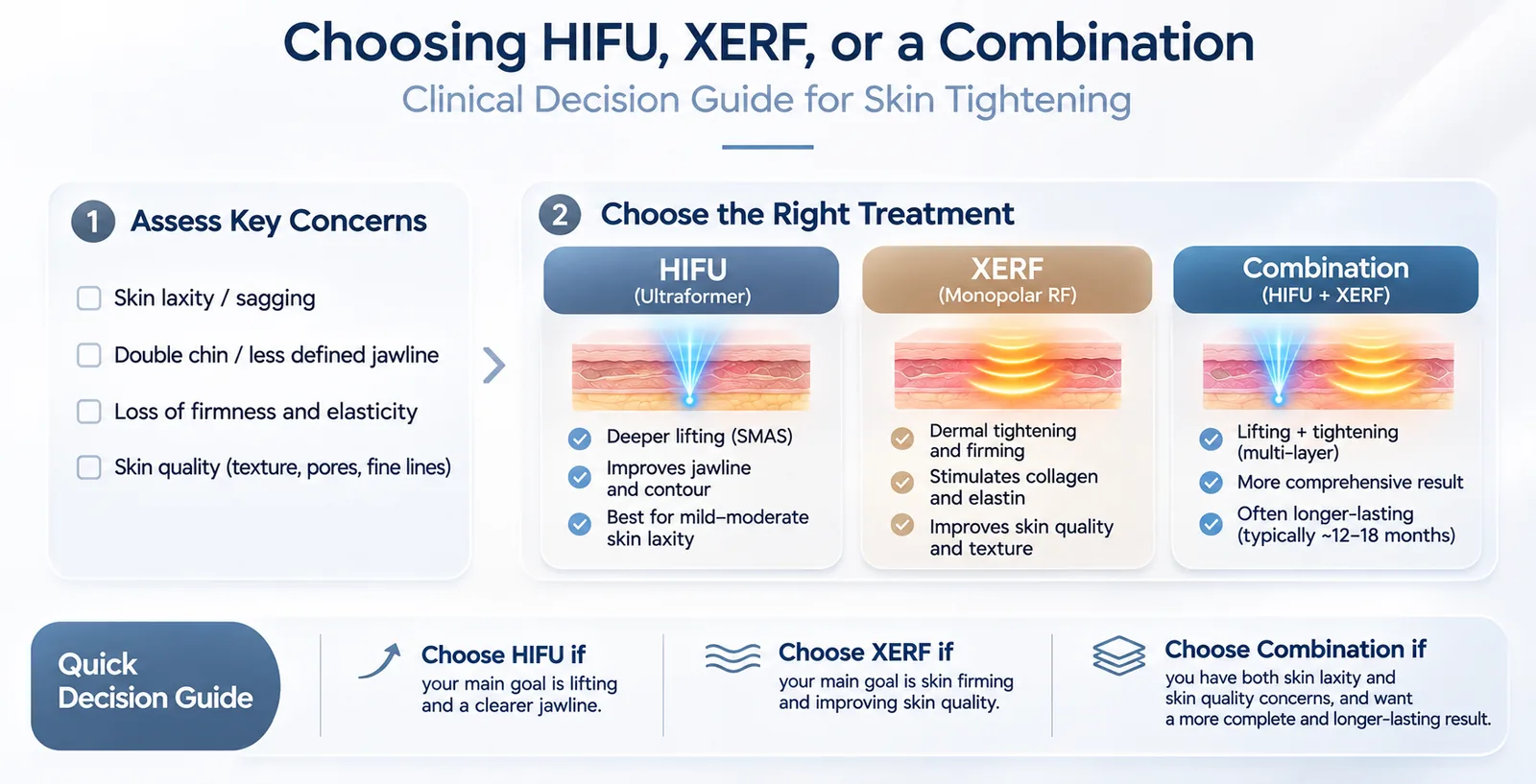
Their different energy-delivery mechanisms provide a possible rationale for combination treatment.
However, a theoretical benefit is not the same as clinically proven superiority.
There is currently insufficient high-quality evidence to recommend Ultraformer and XERF together for every patient, establish a universal treatment sequence, or guarantee that the combination produces better or longer-lasting lifting.
Combination treatment may make sense when a qualified clinician identifies a specific potential benefit that justifies the additional procedure and its risks.
It may not make sense when the patient has minimal laxity, substantial facial volume loss, advanced sagging, unresolved complications, or no clear reason to receive two energy-based treatments.
The goal should be the right treatment for the patient’s facial anatomy—not the greatest possible number of procedures.
For patients considering HIFU, Ultraformer, XERF, or combination facial tightening in Bangkok, Clear Skin Dermatology in Asoke provides an opportunity to discuss treatment suitability, realistic expectations, and safety with a dermatologist.
Medical disclaimer: This article provides general medical information and does not replace individualized medical advice. Treatment suitability, timing, results, and risks vary according to the patient, device, and treatment protocol.
Medical References
- PubMed — Systematic reviews of microfocused ultrasound for facial rejuvenation
- PubMed — Reviews of monopolar radiofrequency for skin tightening
- PubMed — Research on combining ultrasound and radiofrequency for facial rejuvenation
- CLASSYS — Ultraformer III device information
- Cynosure Lutronic — XERF device information
Medically reviewed by
Reviewed on
Related articles
-
Aesthetic & Skin Rejuvenation Rejuran vs Plinest vs Vitaran for Acne Scars, Enlarged Pores, and Skin Texture Which is better for acne scars and enlarged pores: Rejuran, Plinest, or Vitaran?

-
Aesthetic & Skin Rejuvenation Rejuran vs Plinest vs Vitaran for Anti-Aging and Skin Rejuvenation: Which Is Better? Rejuran, Plinest, and Vitaran are polynucleotide-based injectable product families increasingly discussed for skin rejuvenation. They are often promoted for improving fine lines, skin texture, and elasticity.

-
Aesthetic & Skin Rejuvenation Rejuran vs Plinest vs Vitaran: Which PN Skin Booster Is Best in Bangkok? Rejuran, Plinest, and Vitaran are injectable skin rejuvenation products associated with polynucleotides (PN), a group of DNA-derived molecules being studied for their potential to improve skin quality.