





















Nail Disorders
Changes in the fingernails or toenails are common, but they do not all mean the same thing. A nail may become yellow, thick, brittle, ridged, pitted, painful, lifted, green, white, brown, or black because of infection, repeated trauma, inflammatory skin disease, medication, an ingrown nail, or occasionally a more serious condition.
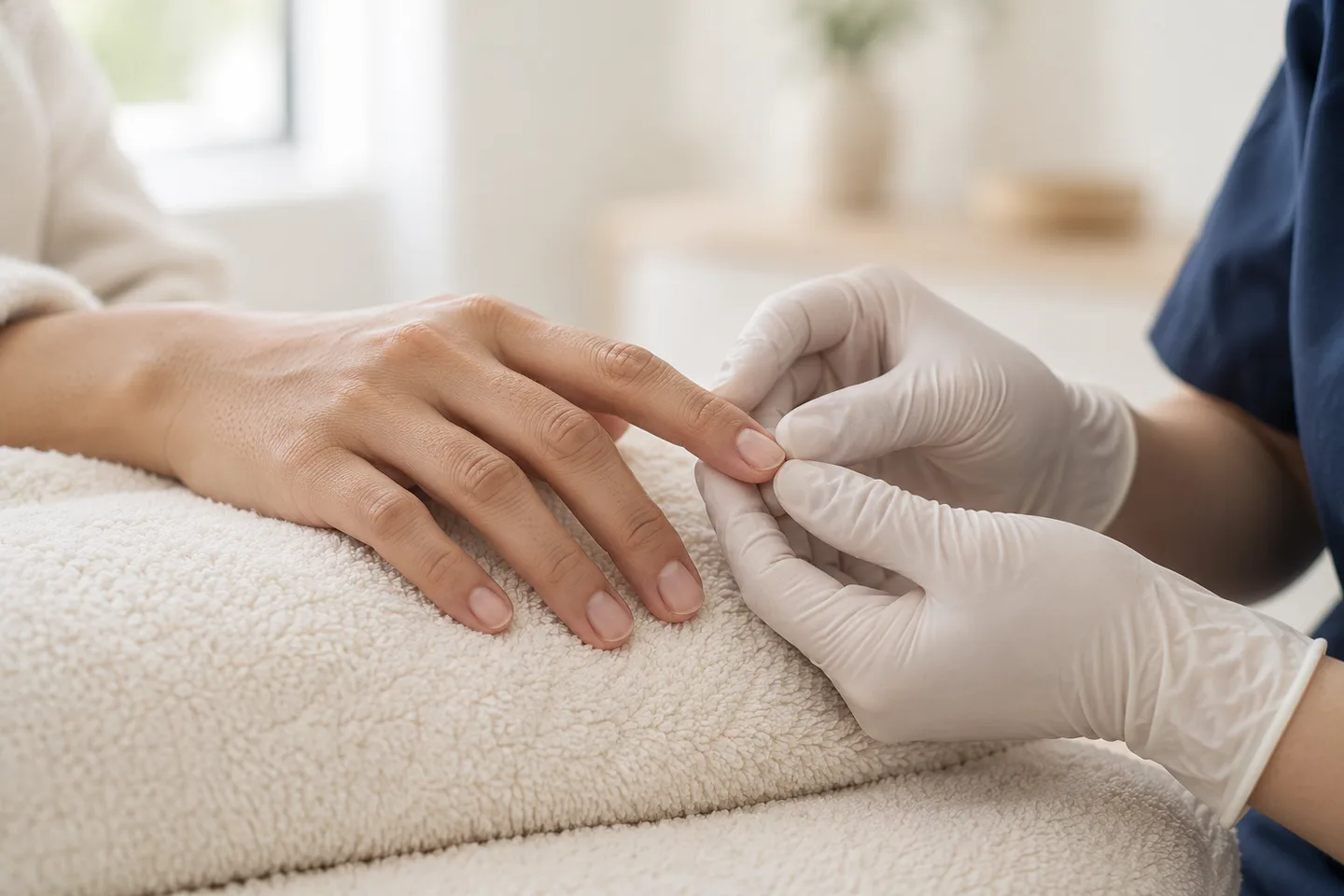
One of the most common mistakes is assuming that every abnormal-looking nail is fungal. Nail fungus can certainly cause thickening, discoloration, crumbling and separation from the nail bed, but psoriasis, eczema, trauma and other disorders can look very similar. Testing is therefore sometimes needed before treatment is started.
A new or changing dark streak in a single nail, especially when it becomes wider or irregular or extends onto the surrounding skin, deserves prompt dermatologic assessment because melanoma can occasionally develop in the nail unit.
For Thai patients, expats, tourists and international patients seeking treatment in Bangkok, the most useful first step is therefore to determine what part of the nail is abnormal and why it has changed, rather than treating the appearance alone.
What Are Nail Disorders?
“Nail disorders” is a broad term covering diseases and abnormalities affecting:
- The nail plate — the hard visible part of the nail
- The nail bed underneath it
- The nail matrix, where the nail is produced
- The cuticle
- The skin surrounding the nail
- The tip of the finger or toe beneath the nail
Problems affecting different parts of this structure produce different patterns.
For example:
- Damage to the nail matrix may cause pits, grooves, ridges or abnormal nail growth
- Disease underneath the nail may cause lifting, thickening or discoloration
- Inflammation around the nail can produce redness, swelling and pain
- Pigment arising from the nail matrix can appear as a brown or black longitudinal streak
The appearance provides useful clues, but it does not always establish the diagnosis.
What Causes Abnormal Nails?
Common causes include:
- Fungal nail infection
- Repetitive trauma
- Tight footwear
- Manicures or nail manipulation
- Nail biting or picking
- Psoriasis
- Eczema
- Lichen planus
- Acute or chronic inflammation around the nail
- Ingrown toenails
- Medication-related nail changes
- Previous illness or systemic stress
- Bacterial infection
- Benign pigmentation
- Less commonly, tumors including skin cancer
A dermatologist evaluates the number of nails involved, pattern of change, speed of progression, associated skin findings, medications and medical history before deciding which diagnosis is most likely.
Common Nail Disorders
Fungal Nail Infection
Fungal infection of the nail is medically known as onychomycosis.
It can affect fingernails or toenails, although toenails are affected more often. Typical changes include:
- Yellow, white or brown discoloration
- Nail thickening
- Brittle or crumbly nail
- Debris beneath the nail
- Nail lifting
- Distortion of the nail shape
- Occasionally pain, particularly when the nail becomes very thick
Athlete’s foot can act as a source of fungal infection and spread to the toenails. Warm, moist environments and repeated exposure to shared wet areas may also increase fungal exposure.
Bangkok’s warm climate can make sweating and moist footwear more common, but a thick yellow toenail should not automatically be attributed to fungus. Trauma and psoriasis can produce a very similar appearance.
Do all yellow or thick nails have fungus?
No.
Conditions that may resemble fungal nail infection include:
- Nail psoriasis
- Repeated shoe trauma
- Aging-related nail changes
- Nail separation
- Lichen planus
- Other nail dystrophies
This is why laboratory confirmation may be useful, particularly before prolonged systemic treatment. The dermatologist may clip, scrape or collect material from the affected nail for microscopic or other fungal testing.
How Is Nail Fungus Treated?
Treatment depends on:
- How many nails are involved
- How much of each nail is affected
- Whether the nail matrix is involved
- Fingernail versus toenail disease
- The patient’s medical history
- Other medications
- The organism involved
- Previous treatment response
Topical antifungal treatment
Medication applied directly to the nail may be suitable for selected mild or limited infections.
AdvantaUseful when oral treatment is unsuitable
Limitations
The nail plate is difficult for medication to penetrate, so treatment usually requires consistent application over a long period.
It is generally less suitable for extensive infection involving a large portion of several nails.
Oral antifungal treatment
Oral antifungal medication may be considered for more extensive or difficult fungal nail disease.
Treatment selection should take into account medical conditions, pregnancy status, medication interactions and other safety considerations.
Advantages
Oral therapy can reach the infection through the nail bed and is often considered when disease is extensive.
Limitations
It is not appropriate for every patient and may cause side effects or interact with other medications.
A proper diagnosis is particularly important before exposing a patient to prolonged systemic treatment.
Why Does a Nail Still Look Abnormal After Fungus Is Treated?
Because nails grow slowly.
Successfully treating the infection does not immediately remove the damaged nail plate. The abnormal portion must gradually grow forward and be trimmed away.
A completely replaced fingernail can take many months, while a toenail can require roughly a year or longer to fully grow out.
Therefore, persistent discoloration shortly after treatment does not necessarily mean that treatment has failed.
Can Nail Fungus Come Back?
Yes.
Recurrence is possible even after successful treatment. Fungal infection of the skin of the feet, contaminated footwear, shared nail equipment and repeated exposure to moist environments may contribute to reinfection.
Preventive measures may include:
- Keeping feet reasonably dry
- Changing damp socks
- Treating athlete’s foot
- Avoiding sharing nail clippers
- Cleaning nail instruments appropriately
- Wearing suitable footwear in communal wet areas
- Avoiding repeated nail trauma
Nail Psoriasis
Psoriasis can affect the nails even when skin psoriasis is mild.
Possible nail changes include:
- Small pits on the surface
- Nail lifting
- Thick material beneath the nail
- Yellow or salmon-colored areas
- Ridging
- Crumbling
- Splinter-like hemorrhages
- Nail distortion
Nail psoriasis may affect daily activities when nails become tender, thick or damaged.
Importantly, nail psoriasis can resemble fungal nail disease, and both conditions can occur together.
A dermatologist may therefore need to examine the skin, scalp and joints and consider fungal testing before deciding on treatment.
How Is Nail Psoriasis Treated?
Treatment depends on severity, the area of the nail involved and whether psoriasis affects the skin or joints elsewhere.
Options may include:
- Topical medications
- Treatment directed around or under the nail in selected patients
- Systemic psoriasis treatment when more extensive disease is present
Nails grow slowly, so improvement is usually gradual rather than immediate.
Patients with nail psoriasis who also experience persistent joint pain, stiffness or swelling should mention this to their physician because nail psoriasis can occur in people with psoriatic arthritis.
Nail Pitting
Pits are tiny depressions on the surface of the nail.
They are commonly associated with psoriasis but may also occur with other inflammatory conditions.
A few isolated pits do not by themselves establish a diagnosis. Dermatologists interpret the pattern together with the patient’s skin, scalp and other nails.
Nail Lifting
When the nail plate separates from the nail bed, the condition is called onycholysis.
The detached area often becomes white or opaque because air is present underneath the nail.
Possible causes include:
- Repeated trauma
- Nail psoriasis
- Fungal infection
- Other inflammatory nail disorders
- Certain medications
- Thyroid disease
- Less commonly tumors
Once the nail has separated, it generally does not simply reattach immediately. New healthy nail needs to grow forward.
The space beneath a lifted nail may also become secondarily colonized by microorganisms, sometimes producing additional discoloration.
Green Nail
Green, green-black or dark discoloration beneath a lifted nail can sometimes be caused by colonization with Pseudomonas bacteria.
It is particularly associated with moisture and nail separation.
A green nail is therefore not necessarily fungal.
Keeping the area dry and identifying the underlying reason for nail separation are important. Persistent discoloration should be assessed because several other conditions can also change nail color.
Infection and Inflammation Around the Nail
Inflammation of the skin surrounding a nail is called paronychia.
There are two main patterns.
Acute paronychia
Acute paronychia develops quickly and may cause:
- Pain
- Redness
- Swelling
- Tenderness
- Pus or an abscess
It frequently occurs after damage to the protective skin around the nail, such as:
- Nail biting
- Picking the cuticle
- Manicure trauma
- Artificial nails
- An ingrown toenail
Bacterial infection is a common cause.
When drainage may be required
If pus has collected into an abscess, medication alone may not always be sufficient, and drainage can sometimes be required.
Do not repeatedly squeeze or cut into an infected nail fold yourself.
Chronic paronychia
Chronic inflammation develops gradually and often affects people whose hands frequently contact:
- Water
- Cleaning agents
- Detergents
- Irritating chemicals
It is often primarily an inflammatory problem of the nail fold rather than simply a persistent bacterial infection.
Management may therefore include protecting the hands from moisture and irritants and treating the underlying dermatitis.
Painful Blisters Around the Nail
Not every painful nail-fold infection is bacterial.
Herpes simplex infection of the finger can produce clusters of painful blisters around the nail.
This matters because treatment differs from treatment of a bacterial abscess.
If clear blisters rather than pus develop around a painful finger, especially after contact with oral or genital herpes, medical evaluation is advisable.
Ingrown Toenail
An ingrown toenail occurs when the edge of the nail presses or grows into the surrounding skin.
The big toe is commonly affected.
Symptoms can include:
- Pain along one side of the nail
- Swelling
- Redness
- Tenderness
- Granulation tissue
- Secondary infection
Common contributing factors include nail shape, inappropriate trimming and pressure from footwear.
Early cases may respond to conservative management, while persistent, recurrent or more severe ingrown nails may need a procedure to remove part of the nail edge and, in selected cases, treat the corresponding nail matrix to reduce recurrence.
How Should Toenails Be Cut?
For most people, toenails are best trimmed straight across rather than deeply rounding the corners.
Cutting deeply down the sides can encourage an ingrown nail in susceptible people. Tight footwear can also worsen the problem.
Ridges in the Nails
Nail ridges are common and not always a sign of disease.
Longitudinal ridges
Lines running from the cuticle toward the tip may become more noticeable with age or repetitive trauma.
When mild and affecting several nails symmetrically, they are often less concerning.
Marked ridging can also occur with inflammatory nail disease, including lichen planus.
Horizontal grooves
A transverse depression across the nail is known as a Beau line.
It occurs when nail production temporarily slows or stops.
Possible triggers include:
- Significant illness
- High fever
- Major physical stress
- Trauma
- Certain medications
The position of the line gradually moves forward as the nail grows.
If similar lines suddenly appear across several nails, medical history can provide an important clue.
White Spots on the Nails
Small white spots are common and are often caused by minor trauma to the nail matrix.
They usually move toward the tip as the nail grows and do not necessarily mean calcium deficiency.
More extensive whitening involving large portions of one or several nails can have different causes and may deserve evaluation.
Brittle or Splitting Nails
Brittle nails can result from:
- Repeated wetting and drying
- Frequent exposure to detergents
- Nail polish removal
- Chemical treatments
- Trauma
- Aging
- Inflammatory skin disease
- Less commonly nutritional or systemic conditions
For people who regularly wash their hands or work in wet environments, reducing repeated water and chemical exposure may be helpful.
Nail Changes From Manicures, Gel Nails and Artificial Nails
Cosmetic nail procedures are common and are generally well tolerated, but repeated procedures can contribute to nail problems in some people.
Potential issues include:
- Mechanical thinning from filing or removal
- Irritant or allergic reactions to nail products
- Nail separation
- Infection following trauma
- Inflammation around the cuticle
Pain, persistent redness, swelling or significant nail separation after a manicure is not simply a cosmetic issue and deserves assessment.
When having nail care performed in Bangkok or elsewhere, nail instruments should be appropriately cleaned and disinfected between clients.
Nail Changes Caused by Repeated Trauma
Footwear-related trauma is one of the most common reasons toenails become abnormal.
Running, hiking, football, martial arts, dancing, long-distance walking or tight shoes may repeatedly push a nail against the front of the shoe.
This may cause:
- Thickening
- Nail lifting
- Bruising underneath the nail
- Splitting
- Nail loss
Repeatedly traumatized nails may closely resemble fungal infection.
This is particularly relevant for active travelers and people training regularly in Bangkok.
Black or Brown Nail After Trauma
Blood trapped beneath a nail following trauma is called a subungual hematoma.
It can appear dark red, purple, brown or black.
A history of clear trauma is reassuring, and as the nail grows, the discoloration should usually move forward toward the tip.
However, not every dark nail is caused by trauma.
If pigmentation does not grow outward as expected, develops without remembered injury, forms a persistent longitudinal streak or changes over time, dermatologic examination is recommended.
Brown or Black Streak in the Nail
A brown or black vertical band is called longitudinal melanonychia.
There are many benign causes, including normal pigmentation, particularly in people with more deeply pigmented skin. Trauma, inflammation and certain medications can also cause nail pigmentation.
However, melanoma of the nail unit can initially appear as a pigmented band.
Features that deserve particular attention include:
- A new band in a single nail
- Progressive widening
- Increasing irregularity
- Several shades of brown or black
- Blurred or irregular borders
- Nail splitting or destruction
- A lump beneath the nail
- Pigmentation spreading onto the surrounding skin
These features do not automatically mean cancer, but they should be assessed rather than treated cosmetically.
Nail Melanoma
Melanoma can develop in the nail matrix or nail bed.
Unlike many skin melanomas, nail-unit melanoma is not thought to be primarily related to sun exposure.
Because benign nail pigmentation is also common—particularly among people with darker skin tones—diagnosis requires experience and should not be made from photographs alone when concerning features are present.
A dermatologist may use magnification to examine the pattern of pigmentation. If the lesion remains suspicious, a nail-unit biopsy may be required for definitive diagnosis.
Does Every Dark Nail Need a Biopsy?
No.
Many causes of nail pigmentation are benign.
The decision to biopsy depends on factors such as:
- Age
- Whether one or several nails are involved
- Duration
- Recent change
- Width of the band
- Pattern and color
- Pigment on the surrounding skin
- Nail damage
- Clinical and magnified examination
Because biopsy of the nail matrix can potentially alter future nail growth, it should be carefully planned when indicated.
Nail Lichen Planus
Lichen planus is an inflammatory disease that can affect the skin, mouth, scalp and nails.
Nail changes may include:
- Longitudinal ridging
- Thinning
- Splitting
- Roughness
- Nail lifting
- Progressive nail destruction
Unlike many cosmetic nail abnormalities, severe nail lichen planus can damage the nail-producing structures and may lead to permanent nail deformity.
A nail that is progressively thinning, splitting or developing scarring without an obvious cause therefore warrants dermatologic assessment.
Nail Changes Associated With Eczema
Eczema around the fingers can affect the nail-producing structures.
Possible findings include:
- Irregular ridging
- Surface roughness
- Pitting
- Chronic inflammation around the nail folds
Treatment focuses not only on the nail but also on controlling the surrounding dermatitis and reducing exposure to irritants.
Can Nail Changes Be a Sign of Internal Disease?
Sometimes, but patients should avoid diagnosing systemic disease based on a nail photograph alone.
Certain patterns can be associated with underlying medical conditions, including abnormalities related to:
- Iron status
- Thyroid disease
- Cardiopulmonary conditions
- Previous severe illness
- Medication effects
However, many of these nail changes have several possible causes.
A dermatologist will determine whether additional medical evaluation or blood testing is appropriate based on the nail findings and other symptoms.
When Does Nail Clubbing Need Evaluation?
Clubbing refers to progressive enlargement of the fingertips with increased curvature of the nails.
It is different from simply having naturally curved nails.
New or unexplained clubbing should receive medical assessment because it can sometimes be associated with underlying heart, lung, gastrointestinal or other systemic disease.
The priority is identifying the underlying cause rather than treating the nail itself.
How Do Dermatologists Diagnose Nail Disorders?
Diagnosis starts with examining all fingernails and toenails, not just the nail that bothers the patient.
The dermatologist may evaluate:
- Nail color
- Thickness
- Surface
- Shape
- Pattern of pigmentation
- Whether the nail is attached to the nail bed
- Skin surrounding the nail
- Cuticle
- Other skin lesions
- Scalp
- Feet
- Joints when appropriate
The pattern across different nails can be diagnostically important.
Nail Testing
Depending on the suspected diagnosis, testing may include:
Nail clipping or scraping
Useful when fungal infection is suspected.
A sample can be collected from abnormal nail material to help distinguish fungal disease from disorders such as psoriasis or trauma.
Bacterial or fungal culture
This may be considered for certain infections or persistent nail-fold disease.
Magnified nail examination
Magnification can help evaluate pigmented streaks, vascular changes and other nail structures.
Blood tests
Blood tests are not necessary for every nail disorder.
They may be selected when the history suggests an underlying condition such as thyroid disease or another systemic cause.
Nail biopsy
Biopsy is generally reserved for situations where examination and less-invasive testing cannot adequately establish the diagnosis, particularly when a tumor, melanoma or certain inflammatory nail diseases are suspected.
Treatment of Nail Disorders
Treatment depends entirely on the cause.
There is no useful single “nail treatment” for all abnormal nails.
For example:
Nail problem Possible approach
Fungal infection Topical or oral antifungal therapy when appropriate Nail psoriasis Anti-inflammatory or psoriasis-directed treatment Acute nail-fold infection Local care, antimicrobial treatment or drainage when necessary
Chronic nail-fold inflammation Irritant avoidance and treatment of dermatitis
Ingrown toenail Conservative care or nail procedure Traumatic nail damage Remove the source of repeated trauma and allow nail regrowth
Nail separation Identify and treat the underlying cause Suspicious pigmentation Nail examination and possible biopsy Inflammatory nail disease Treatment directed at the underlying disease
Accurate diagnosis matters because treating nail psoriasis with antifungal medication, for example, will not correct the underlying inflammatory disease.
Why Nail Treatment Takes Time
One of the most important things to understand about nail disease is that treatment response and visible nail improvement are not the same thing.
Even when the underlying disease has been controlled, damaged nail must grow out.
Fingernails generally replace themselves faster than toenails. After complete nail removal, fingernails may require six months or longer to regrow, while toenails may require approximately 12–18 months.
Patients should therefore judge treatment over an appropriate time period rather than expecting the existing damaged nail to immediately become normal.
Nail Care During Recovery
General nail care varies with the diagnosis, but useful principles often include:
- Keep nails reasonably short
- Avoid aggressive cleaning underneath detached nails
- Avoid cutting the cuticle
- Reduce repeated trauma
- Wear shoes with adequate toe space
- Keep wet or infected feet dry when appropriate
- Avoid sharing nail tools
- Stop picking or biting damaged nails
- Avoid covering a worsening nail with repeated cosmetic procedures before establishing the diagnosis
Specific aftercare should follow the treatment performed.
When Should You See a Dermatologist for a Nail Problem?
Dermatology assessment is particularly useful if you notice:
- A nail changing without an obvious reason
- Persistent yellow or thickened nails
- Nail lifting
- Recurrent fungal infection
- Multiple abnormal nails
- Pain or difficulty walking
- Persistent inflammation around a nail
- Pus or an abscess
- Nail pitting
- Progressive nail destruction
- Recurrent ingrown toenails
- Nail abnormalities associated with psoriasis
- A new unexplained pigmented streak
- Progressive darkening or widening of a nail streak
- A lump beneath the nail
- Pigment extending onto the surrounding skin
- Nail changes that have not responded to previous treatment
The American Academy of Dermatology specifically recommends evaluation of several nail changes because some seemingly minor abnormalities can indicate an underlying dermatologic or systemic condition.
Nail Warning Signs That Should Not Be Ignored
Seek timely medical assessment for:
- Rapidly spreading redness and swelling around a nail
- Severe throbbing pain with pus
- Fever with an infected finger or toe
- Rapidly worsening infection in someone with diabetes, poor circulation or reduced immunity
- A painful dark nail without a clear explanation
- New or changing brown or black pigmentation in one nail
- Nail pigment spreading onto surrounding skin
- Bleeding or an unexplained lump underneath a nail
- Progressive destruction or scarring of the nail
- A painful toe with increasing redness or drainage from an ingrown nail
A new or changing dark streak should not simply be covered with nail polish until the cause is known.
What to Expect During a Nail Consultation in Bangkok
A nail consultation should begin with diagnosis rather than immediately selecting a cosmetic or antifungal treatment.
The dermatologist may ask:
- When did the nail first change?
- Did it begin suddenly or gradually?
- Is one nail or several nails affected?
- Is there pain or itching?
- Has the nail been injured?
- Do you run, hike or wear tight shoes?
- Do you have athlete’s foot?
- Have you recently had a manicure or artificial nails?
- Do you have psoriasis or eczema?
- Are you taking any regular medications?
- Have previous treatments helped?
- Has a dark streak changed in width or color?
For international patients or tourists visiting Bangkok, it is helpful to bring:
Previous nail test results
A list of current medications
Photographs showing how the nail has changed
Details of previous antifungal treatment
Previous pathology reports if a nail biopsy has already been performed
Because nail conditions often require months of follow-up, patients staying in Thailand temporarily should discuss how results and ongoing treatment will be managed after they leave Bangkok.
Frequently asked questions
Why are my toenails yellow and thick?
Fungal infection is a common possibility, but trauma, psoriasis and other nail disorders can produce the same appearance.
Testing may be useful before prolonged antifungal treatment.
How do I know if my nail problem is fungal?
Appearance alone is not always reliable.
A dermatologist may collect a scraping or clipping from the abnormal nail for fungal examination.
Can nail fungus go away by itself?
Established fungal nail infection commonly persists without treatment and can spread or gradually damage the nail.
Why is my nail lifting?
Nail separation can result from trauma, psoriasis, fungal infection, inflammatory disease, medications or systemic causes.
The underlying cause should be identified when the separation is persistent or unexplained.
Why is my nail green?
A lifted nail can become colonized by bacteria such as Pseudomonas, producing green discoloration.
Other causes are possible, so persistent nail discoloration should be evaluated.
Why do I have small holes in my nails?
Small pits can be associated with psoriasis and some other inflammatory disorders.
The significance depends on how many nails are affected and whether other skin or joint symptoms are present.
Can psoriasis affect only the nails?
Nail psoriasis can sometimes be prominent even when skin disease is limited.
A dermatologist may examine the scalp, skin and joints for other features.
Why are the sides of my nail red and painful?
Possible causes include acute paronychia, an ingrown nail, irritant dermatitis or, less commonly, viral infection.
Pus, severe swelling or spreading redness deserves assessment.
Should pus around a nail be drained?
An established abscess may require drainage. It should not be repeatedly punctured or cut at home.
Can manicures damage nails?
Repeated filing, cuticle trauma, artificial nail application or reactions to nail products can contribute to nail thinning, separation or inflammation in some people.
How long does a damaged nail take to grow back?
Nail growth is slow. Fingernails may require several months for replacement, while complete toenail regrowth can take approximately a year or longer.
Why does my toenail keep becoming ingrown?
Nail shape, incorrect cutting, footwear pressure and recurrent local inflammation can contribute.
Persistent cases may require a procedure rather than repeated short-term treatment.
Are vertical nail ridges dangerous?
Mild longitudinal ridges are common, especially with increasing age.
Marked ridging, splitting or progressive nail damage may indicate inflammatory nail disease and should be assessed when unexplained.
Do white spots mean calcium deficiency?
Usually not. Small isolated white marks commonly follow minor trauma to the nail matrix.
Should I worry about a black line in my nail?
Many pigmented nail streaks are benign, particularly in people with naturally darker skin.
However, a new, changing, widening or irregular dark streak in a single nail should be evaluated by a dermatologist, especially if pigment spreads to the surrounding skin.
Can melanoma occur under a nail?
Yes. Melanoma can arise from the nail matrix or nail bed, although it is far less common than benign causes of nail discoloration.
Does nail melanoma come from sun exposure?
Nail-unit melanoma does not appear to have the same strong relationship with ultraviolet exposure as typical sun-related cutaneous melanoma.
Can a dermatologist biopsy a nail?
Yes. Nail-unit biopsy may be performed when necessary to diagnose suspicious tumors, pigmentation or certain inflammatory disorders.
Because the nail matrix produces the nail plate, biopsy technique is important to reduce the risk of permanent nail deformity.
When should I see a dermatologist for a nail disorder?
Consider evaluation when a nail has changed without explanation, remains painful or inflamed, becomes progressively abnormal, fails previous treatment or develops a new or changing dark streak.
Related conditions
-
Fungal Skin Infections Fungal Skin Infections Fungal skin infections are common causes of itchy, scaly, discolored or persistent rashes. They can affect almost any part of the body, including the feet, groin, trunk, scalp and nails.

-
Psoriasis Psoriasis Psoriasis is a chronic immune-mediated inflammatory disease that most commonly affects the skin, but it can also involve the nails and joints.
-
Bacterial Skin Infections Bacterial Skin Infections Bacterial skin infections can range from a small infected hair follicle to cellulitis, a skin abscess, or a rapidly spreading infection requiring urgent hospital treatment.
-
Atopic Dermatitis / Eczema Atopic Dermatitis / Eczema Atopic dermatitis, commonly called eczema or atopic eczema, is a chronic inflammatory skin condition that causes dry, itchy and easily irritated skin. It can affect children and adults and often goes through cycles of improvement and flare-ups.